
Diesel vs Electric Air Compressor: How to Choose the Right Power Source
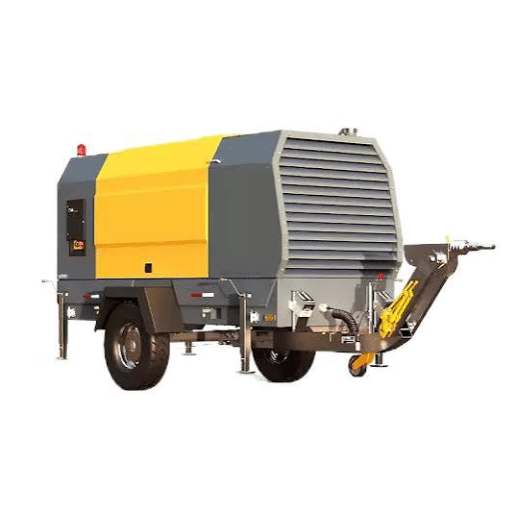
The diesel vs electric air compressor decision starts with the power available where the machine will work. Consider electric when a suitable supply reaches the operating position. Consider diesel when electrical supply is impractical and fuel, servicing and a suitable operating location are available. Then compare actual airflow at working pressure, mobility and the operating schedule.
Power source alone does not tell you whether a compressor is portable, suitable for continuous duty or economical for your project. This guide separates those decisions so you can request a configuration that fits your site. For background on engine-driven equipment, see our Diesel Screw Compressor Guide.
Already have a site specification? Send your requirements to our team, including airflow, pressure and available power.
Diesel vs electric air compressor at a glance
An engine-driven compressor uses a diesel engine to turn the compression element, often called the airend. An electric compressor uses a motor. Both drive types are used in industrial equipment; their usable output depends on the particular package and operating conditions.
| Selection factor | Diesel compressor | Electric compressor |
|---|---|---|
| Supply | Requires fuel and engine servicing; independent of a grid connection | Requires an electrical supply compatible with the selected model |
| Practical mobility | Check transport arrangements, refuelling and access to the work area | Portable models exist; check connections and cable arrangements at each position |
| Airflow and pressure | Compare documented delivery at the required pressure | Compare documented delivery at the same required pressure |
| Runtime | Check package rating, fuel logistics, cooling and service plan | Check package rating, supply availability, cooling and service plan |
| Maintenance | Includes engine and compressor-package requirements | Avoids diesel-engine service, but compressor-package service remains |
| Cost inputs | Fuel, service, acquisition and site logistics | Electricity, service, acquisition and supply infrastructure |
| Local engine exhaust | Engine exhaust must be considered in siting | No diesel-engine exhaust at the compressor; generation may produce emissions elsewhere |
Use the table to identify feasible packages before comparing prices. A machine that cannot receive suitable power or deliver the required air is not a useful cost benchmark.
Start with the available site power
Confirm the supply at the compressor connection
A powered site does not automatically have a suitable connection for every electric compressor. Request the selected model’s voltage, phase, frequency, current requirements and starting method. Have a qualified installer check available capacity, protection, connection and cable arrangements at the proposed location.
Check the operating position as well as the main distribution point. If a compressor must move between work areas, establish how it will connect at each one. For a more detailed preparation checklist, see fixed-speed compressor electrical requirements; the actual model documentation must govern installation.
Account for off-grid and generator operation

No grid connection does not exclude every electric option. A generator can supply an electric compressor if the complete arrangement is properly specified. Generator sizing must account for the compressor’s electrical requirements and starting behaviour, rather than just comparing two nameplate power figures.
Include generator fuel, service, transport and connection costs in the assessment. A generator does not automatically erase an electric package’s advantage or make it cheaper than a diesel package. It creates a system with additional inputs that need to be compared.
For diesel, confirm fuel availability and the refuelling and service arrangements for the actual work schedule. Independence from the grid still requires a practical operating plan.
Mobility depends on more than the prime mover
Separate transportability from the ability to operate after a move. Check how often the compressor changes position, how it is transported, whether the ground and access suit the package, and what supply is available at the destination. Outdoor suitability also needs model-specific confirmation.
Electric equipment is not restricted to fixed indoor installations. In a customer story dated September 28, 2026, Atlas Copco describes a WesTrac E-Air H250 VSD operating outdoors while supplying pneumatic tools for assembly work. This manufacturer-reported example illustrates an outdoor electric installation; it does not establish expected service life for other machines.
Atlas Copco also lists an electric portable E-Air H185 VSD. Its existence is a useful reminder to assess the package and supply together. For the separate question of factory layout and relocation, see portable vs stationary air compressors for factory use.
Match airflow, working pressure and duty cycle

Compare rated delivery at the pressure your tools need
Ask for the airflow a package delivers at your required working pressure. Horsepower alone does not specify usable air delivery. Likewise, a maximum-flow value and a maximum-pressure value may describe different operating points; do not assume the machine delivers both simultaneously.
Confirm that the units and rating conditions are comparable. The Compressed Air & Gas Institute resource library provides technical definitions and guidance on compressor performance and air treatment. Use the applicable data sheet to compare complete packages, rather than treating motor efficiency as the efficiency of producing compressed air.
Tell the supplier your altitude, ambient temperature and installation conditions, and request any applicable derating. There is no single oversizing rule for every diesel or electric package. Our diesel portable air compressor sizing guide covers the next sizing step. For mining-specific application considerations, see diesel screw compressors for mining.
Check the package rating and actual load schedule
Describe how long tools run, which tools run together, and when the compressor will be loaded, unloaded or stopped. Ask whether the selected package supports that schedule under your site conditions, including its cooling limits and required maintenance.
An electric drive does not by itself certify continuous operation. A diesel engine does not by itself rule it out. For either option, confirm the documented package rating and arrange the energy supply, refuelling where relevant, and service access needed for the planned hours.
Compare costs on the same operating basis
Compare packages that meet the same airflow, pressure and load schedule. For electricity, use measured or documented package consumption for that schedule and the applicable tariff. For diesel, use fuel consumption at the relevant load and the local fuel price. Atlas Copco’s operational-cost calculator illustrates why usage profile and local energy costs are necessary inputs; its assumptions are not measurements of your site.
- Electricity energy charge: consumed kWh × applicable price per kWh. Add other tariff charges where relevant.
- Diesel fuel charge: consumed litres × price per litre. Keep the fuel-volume units consistent.
These formulas cover energy or fuel only. Add purchase or rental, electrical works, generator costs if applicable, transport and servicing over the same project period. Keep projected consumption separate from measured consumption. For the broader economics discussion, see our electric vs diesel compressor cost comparison.
Check noise, exhaust and required air quality separately
Compare sound measurements on a consistent basis
Ask for documented sound values with their measurement distance, test conditions and operating load. Sound pressure at a stated distance and sound power are different quantities. A quieter-looking number is not a reliable comparison when the measurement basis differs.
Equipment sound data also differs from a worker’s exposure over a shift. The UK Health and Safety Executive’s noise guidance addresses workplace exposure requirements in Great Britain. It should not be read as a universal equipment-noise limit or a substitute for the assessment applicable to your location.
Separate engine exhaust from compressed-air quality
An electric drive produces no diesel-engine exhaust at the compressor. Electricity generation, including an on-site generator, can still produce emissions. Verify the model documentation and site requirements for the proposed installation, especially where exhaust or ventilation affects equipment placement.
Drive source also does not establish the quality of the compressed air. Oil-injected or oil-free compression, drying and filtration are separate specification decisions. State the air-quality requirements of the process and select the appropriate package and treatment; an electric motor alone does not guarantee oil-free air or prevent downstream corrosion.
Use a site-selection checklist before requesting a quote
These starting points help narrow the options. Each still requires confirmation against the actual package specification.
| Site situation | Starting point | What to confirm |
|---|---|---|
| Fixed plant with suitable electrical capacity | Evaluate an electric package | Connection capacity, rated delivery, load schedule and installed cost |
| Outdoor work with power at each operating position | Consider portable electric as well as diesel | Outdoor rating, transport, cable arrangements and connection access |
| Remote work without a practical electrical supply | Evaluate diesel; assess any proposed generator-electric system as a whole | Fuel logistics, access, required output and service arrangements |
| Enclosed or noise-sensitive work area | Assess exhaust, ventilation and sound constraints before selection | Equipment placement, exposure assessment and applicable site requirements |
Illustrative scenario: A compressor moves between assembly areas within one powered facility. The procurement question is whether each position has a compatible connection and suitable access. Movement alone does not settle the choice in favour of diesel.
Illustrative scenario: A remote crew has no practical electrical connection. An engine-driven package is a candidate if its rated delivery and fuel arrangements suit the work. If a generator-electric alternative is proposed, compare the entire system before choosing it.
Before requesting a quote, answer five questions:
- What power is available at the operating position? Record voltage, phase, frequency and available capacity, or explain the off-grid arrangement.
- How often must the machine move? Describe transport, access and supply at each destination.
- What air must it deliver? State required airflow and working pressure, plus relevant site conditions.
- What is the operating schedule? Describe simultaneous demand, loaded and unloaded periods, shift hours and service opportunities.
- What constraints and costs apply? Include exhaust, noise, air quality, project duration, energy prices and installation needs.
When a third option makes sense

If a battery-powered package or another electrical supply arrangement is proposed, request documented usable energy, operating limits and runtime for the intended load. Include charging or replenishment arrangements in the schedule. Judge it against the same output and site requirements as the diesel and grid-powered options.
Choose the power source after confirming supply feasibility, then compare packages by delivery, mobility, runtime and total project cost. To discuss your application, contact Shandong Loyal Machinery with your required airflow and pressure, site power details, working conditions, moving frequency and operating schedule.