
Screw Compressor vs Piston Compressor for Small Shops: Which Wins in 2026?
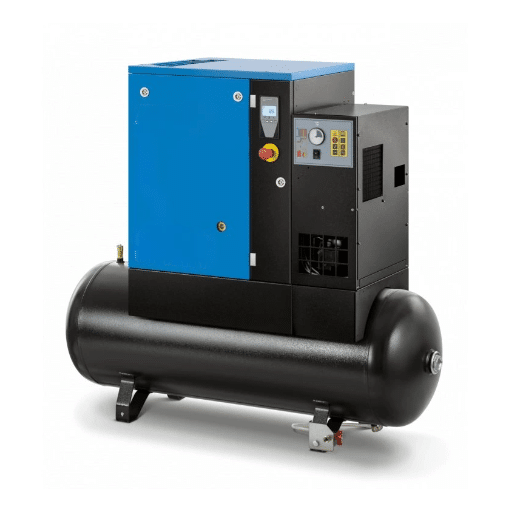
In March last year, a Houston based metal fabrication workshop was faced with a decision: should they replace their existing 10 HP piston compressor worth USD 3,200 with a 10 HP screw compressor priced at USD 6,500? The owner chose to go for the screw compressor option. After 18 months, his power bill had fallen by 26%, the plasma table did not trip any more due to thermal overload and he had recovered the initial price difference from savings in electricity alone.
That is the decision that faces all small shop owners, yet most advice available online does not address it properly. That stops today. Not only do you get the precise dollar-based calculations comparing piston vs screw compressors for 5, 10 and 15 HP systems over five years, but also an easy-to-use break-even hour calculator and professional recommendations for auto repair, woodworking, metal fabrication and other industries. You now know precisely when a screw compressor beats a piston and vice versa.
How Each Compressor Type Works

Before comparing dollars, you need to understand why these two machines behave so differently.
How Piston (Reciprocating) Compressors Work
The piston air compressor utilizes the rotation of a crankshaft to move the piston upwards and downwards inside the cylinder. In the process of downward movement, air enters from the atmosphere using the inlet valve while air is compressed and released into the receiving tank when the piston moves up using the discharge valve. It is critical for the operation of the piston air compressor to be intermittent so as to keep the pressure high in the tank.
How Rotary Screw Compressors Work
With a rotary screw compressor, the compression process requires two spiral rotors that rotate within the confined housing. Air gets caught between rotors while they continue rotating to be continuously compressed. There is no cycling here, only rotation; therefore, the machine produces compressed air with a constant flow.
Why the Mechanical Difference Matters for Small Shops
Continuous rotation and steady flow of air make screw compressors able to operate throughout the day without overheating. In contrast, the cycling nature of the piston compressor results in increased temperatures, wearing of valves and deterioration of ring tension. It is clear to see how this would not make much of a difference to the hobbyist who fires his nail gun 10 times an hour. In the case of a body shop running an HVLP spray gun for forty minutes non-stop, things start getting interesting.
The Five Factors That Decide Your Choice
Five factors separate a smart compressor purchase from an expensive mistake. Each one matters more or less depending on how you run your shop.
| Factor | Why It Matters | Wins For |
|---|---|---|
| Initial cost | Cash flow, financing | Piston |
| Energy efficiency | 70-80% of lifetime cost | Screw |
| Duty cycle | Continuous vs intermittent | Screw |
| Noise level | OSHA compliance, comfort | Screw |
| Lifespan and service | Replacement frequency | Screw |
The rest of this guide walks through each factor in detail, then translates them into real dollars and a clear decision for your trade.
Factor 1: Initial Cost Comparison
Only the initial cost of purchase represents an advantage that piston air compressors have over their counterparts in rotary screw designs. The price of a 5 HP single stage piston air compressor varies depending on brand but generally goes for between $1,200 and $2,500. At the same power rating, a rotary screw air compressor would go for anything between $3,500 and $5,000 regardless of the size of the capacity in small shops.
2026 Price Ranges by HP
| HP | Piston (Cast Iron, Industrial) | Rotary Screw (Tank-Mounted) | Rotary Screw VSD |
|---|---|---|---|
| 5 HP | USD 1,200 to USD 2,500 | USD 3,500 to USD 5,500 | USD 4,500 to USD 6,500 |
| 7.5 HP | USD 1,800 to USD 3,200 | USD 4,500 to USD 6,500 | USD 5,500 to USD 7,500 |
| 10 HP | USD 2,500 to USD 4,500 | USD 5,500 to USD 7,500 | USD 6,500 to USD 9,500 |
| 15 HP | USD 3,500 to USD 5,500 | USD 7,500 to USD 9,500 | USD 8,500 to USD 11,500 |
Why Screw Compressors Cost More Upfront
Three reasons. First, the helical rotors are precision-machined to tolerances measured in microns. Second, screw units include integrated coolers, oil separators, and electronic controllers that piston compressors do not need. Third, the airend itself is designed for 80,000-plus operating hours, while a piston pump is built for replacement at 20,000.
But for what you get, you pay four times less for durability. Whether that is worthwhile depends only on how long you actually use your compressor.
Factor 2: Energy Efficiency and Operating Cost

With piston compressors, electricity costs may become an elephant in the room after a certain number of working hours. Once an industrial shop starts using its compressor for more than 1,000 hours a year, electricity becomes the largest expenditure of the entire process.
CFM Per HP: The Efficiency Metric
A 10 HP single-stage piston typically delivers 30 to 35 CFM at 175 PSI. A 10 HP rotary screw delivers 38 to 45 CFM at 125 PSI. Per horsepower of input, the screw produces 15 to 25% more usable air. Multiply that across thousands of operating hours and the difference becomes thousands of dollars.
Why Energy Equals 70 to 80% of Lifetime Cost
Estimates made by the US Department of Energy state that the energy costs of an industrial compressor operating for 4,000 hours a year will be seven times the original cost after ten years of service. The corresponding estimate for a small shop using the same equipment in its operations for 1,500 hours is approximately 3:1 in favor of power.
How VSD Changes the Screw Advantage
Variable Speed Drive screw compressors vary engine speed to match the air demand. Operating at a fifty percent air requirement, a conventional compressor uses 75% of its full power, whereas a VSD compressor would use around 55%. In situations characterized by fluctuating demand, such as an auto shop firing its equipment in bursts, energy use would fall by 20 to 35%.
For a deeper look at how VSD economics work, see our complete buyer’s guide to 5-10 HP screw compressors.
Factor 3: Duty Cycle and Continuous Operation
Duty cycle is the proportion of the hour that compressor spends on producing compressed air without overheating. This parameter is typically overlooked, yet it determines the life span of compressors more than any other.
Piston Duty Cycle: 50 to 70%
A one-stage piston compressor normally operates at the rate of 50% duty cycle, while an industrial two-stage piston achieves 70%. In other words, in the course of an hour of operation, piston compressor needs to stay idle for 18 to 30 minutes. Overwork would result in head temperatures over 350°F, carburation of valves, and quick wear out of rings.
Screw Duty Cycle: 100% Continuous
A rotary screw is rated for continuous operation. The integrated cooler holds discharge temperature near 200°F whether the machine runs for ten minutes or ten hours. You can leave it loaded all shift without consequence.
What This Means for Your Daily Operations
Run a body shop’s HVLP spray gun continuously for forty minutes. A 5 HP piston will struggle, heat up, and likely trip thermal protection. A 5 HP screw will not break a sweat. The same applies to plasma cutting, sandblasting, large nailers, and any tool with sustained CFM draw.
If your shop does any continuous-air work, the screw is not a luxury. It is the right tool.
Factor 4: Noise Levels and OSHA Compliance
Sound levels are about more than comfort. They are a regulatory issue, an employee retention issue, and increasingly, a customer-perception issue.
Piston Compressors at 80 to 95 dBA
The typical noise levels of a cast-iron piston air compressor are from 85 to 95 dB(A) measured from one meter distance. They are quieter than a gas-powered lawn mower but louder than a vacuum cleaner. Although enclosed in a sound insulation enclosure, piston air compressors will never produce less than 80 dB(A) noise.
Rotary Screw Compressors at 60 to 75 dBA
A modern rotary screw with an acoustic enclosure emits 60 to 75 dBA noise at a one-meter distance. This corresponds to a conversation or busy office. It is possible to conduct a phone call even while standing near the machine.
OSHA’s 85 dBA Limit and Shop Layout Implications
OSHA permissible exposure limit is 90 dBA averaged during eight-hour workdays, which requires hearing conservation measures starting from 85 dBA. If operated continuously, a piston compressor may cause average workplace noise above the action level in a small workshop. A rotary screw compressor hardly ever does. For shops that are planning operations in close proximity to residential properties or with limited floor space, the noise issue alone may settle the decision.
Need a deep dive on a specific size? See our dedicated guides for 5 HP screw compressors.
Factor 5: Lifespan and Maintenance Cost

Lifespan is where the upfront price gap closes fast.
Piston Service Life: 20,000 to 30,000 Hours
On average, the air pump of a cast-iron piston air compressor may run for 20,000 to 30,000 hours without requiring a rebuilding. Given 1,500 work hours per year, its operational life would last 13 to 20 years, whereas for 3,000 hours per annum it will operate 7 to 10 years. Although the pump itself may be rebuildable, its motor and tanks will not.
Screw Service Life: 80,000 to 100,000 Hours
An air end of a contemporary rotary screw compressor is expected to deliver 80,000 to 100,000 hours before it needs an overhaul. It corresponds to 27 to 33 years of work with 3,000 hours annual capacity. Upon replacement of the air end, the machine may still operate for another 80,000 hours.
Annual Maintenance Cost Comparison
| Service Item | 5-10 HP Piston | 5-10 HP Screw |
|---|---|---|
| Oil change | USD 25 to USD 50 per change, 3 to 4 times per year | USD 40 to USD 80 per change, every 4,000 hours |
| Air filter | USD 20 to USD 40 per change, 2 times per year | USD 30 to USD 60 per change, every 4,000 hours |
| Oil separator | Not applicable | USD 80 to USD 150, every 4,000 to 8,000 hours |
| Valve and ring service | USD 200 to USD 400 every 2,000-4,000 hours | None until airend replacement |
| Annual labor and parts | USD 250 to USD 450 | USD 150 to USD 300 |
The screw costs roughly half as much per year to maintain once you account for valve and ring work on the piston side.
The 5-Year TCO Showdown: Real Dollar Numbers
Price is one variable in a lengthy equation. TCO calculated for 5 years gives the actual numbers. These calculations assume USD 0.12/kWh electricity costs, medium maintenance costs, and average utilization.
5 HP TCO: Light Use, 1,000 hours per year
| Cost Item | 5 HP Piston | 5 HP Screw |
|---|---|---|
| Purchase price | USD 1,500 | USD 3,800 |
| Energy (5 years) | USD 2,239 | USD 1,651 |
| Maintenance (5 years) | USD 1,500 | USD 1,250 |
| 5-year TCO | USD 5,239 | USD 6,701 |
At 1,000 hours annually, the piston compressor is cheaper by roughly USD 1,500. Intermittent home and hobby applications should stick to piston models.
10 HP TCO: Moderate Use, 1,500 hours per year
| Cost Item | 10 HP Piston | 10 HP Screw |
|---|---|---|
| Purchase price | USD 3,500 | USD 6,500 |
| Energy (5 years) | USD 6,800 | USD 4,200 |
| Maintenance (5 years) | USD 2,000 | USD 1,500 |
| 5-year TCO | USD 12,300 | USD 12,200 |
With 1,500 hours, the screw is already more economical by USD 100 in five years. An extra five years adds more than USD 4,000 to the savings.
10 HP TCO: Heavy Use, 2,500 hours per year
| Cost Item | 10 HP Piston | 10 HP Screw |
|---|---|---|
| Purchase price | USD 3,500 | USD 6,500 |
| Energy (5 years) | USD 11,000 | USD 7,000 |
| Maintenance (5 years) | USD 3,500 (includes mid-life rebuild) | USD 1,500 |
| 5-year TCO | USD 18,000 | USD 15,000 |
With intensive operation, the rotary screw compressor reduces operating costs by USD 3,000 within five years. The piston compressor requires significant repair before reaching the five-year mark.
Ready to map these numbers to your actual operating hours? Request a customized quote and we will model your shop’s exact 5-year cost in either technology.
Break-Even Hours: When Screw Beats Piston
The break-even point is the annual operating hours at which the total cost of ownership crosses over.
The Break-Even Formula
(Price Premium of Screw) divided by (Annual Energy Savings + Annual Maintenance Savings) equals Break-Even Years. Then multiply the result by your annual hours for break-even hours.
Typical Break-Even Points
| HP | Break-Even Hours per Year |
|---|---|
| 5 HP | 1,200 to 1,400 hours |
| 7.5 HP | 1,000 to 1,200 hours |
| 10 HP | 800 to 1,000 hours |
| 15 HP | 600 to 800 hours |
Run your compressor more than these hours and the screw saves money. Run it less, and the piston stays ahead. Most full-time small shops easily exceed 1,500 operating hours per year, which puts every machine 7.5 HP and up firmly on the screw side of the line.
Need a deep dive on a specific size? See our dedicated guides for 10 HP screw compressors.
Decision Matrix by Trade
Real shops live in trades, not spreadsheets. Here is what works for each.
Automotive Repair Shops
The typical independent auto shop with 2-4 bays operates 1,500 to 2,500 compressor hours annually. The air ratchet, impact wrench, and tire equipment use the air in bursts. Recommendation: 7.5 to 10 HP rotary screw; VSD if the budget will allow it; avoid the piston unless it is a part-time shop.
Woodworking and Cabinet Shops
Pneumatic nailers and staplers require intermittent operation, while spray finishing requires steady supply of air. Sanding tools also require a steady CFM. Recommendation: 5 to 10 HP rotary screw compressor. Piston compressor may work for hobby shops with fewer than 800 annual hours.
Metal Fabrication and Welding Shops
Plasma cutters, large pneumatic nailers, continuous machines dominate in their application fields. Frequent thermal shutdowns reduce productivity due to the lack of compressed air. Recommendation: 10 to 15 HP rotary screw compressor, no exceptions in the full-fledged fab shop.
Auto Body and Paint Shops
DA Sanders, HVLP guns, and downdraft booths require constant, clean, dry, and steady air flow. Noise is also a problem because painters operate near the compressor. Recommendation: 7.5 to 15 HP rotary screw with a refrigerated dryer, ideally VSD.
Food and Beverage Light Manufacturing
The packaging, dispensing, and conveyor air require 24/5 continuous operation and an oil-free or oil-filtration air supply. Recommendation: 10 to 20 HP rotary screw, oil injected with air filtration downstream or oil-free screw where air contacts food product.
Hobbyist and Home Shops
Weekend projects, 200 to 600 hours per year. Occasional air use. Recommendation: Two-stage cast-iron piston air compressor 5 to 7.5 HP. Save screw air compressor money for tools.
When a Piston Compressor Still Wins

Piston compressors are not obsolete. They are the right answer for specific situations.
Low duty cycle. Home hobbyists, part-time businesses, weekend builders that use less than 800 hours of operation per year would hardly break even with a screw compressor. They can enjoy the service of a two-stage cast-iron piston compressor for decades at a much lower price point.
Budget-constrained startups. New shops with tight capital sometimes need a lower entry price to get operating. A solid piston bought today can be replaced with a screw when revenue justifies the upgrade.
Backup or emergency air. A small piston unit makes an excellent backup to a primary screw compressor. Cheap to buy, simple to maintain, ready when the main unit needs service.
Portable or mobile work. Construction sites, mobile mechanics, and remote work benefit from a portable piston compressor that fits in a truck bed. For factory floors and stationary shops, see our portable vs stationary compressor guide.
Honest answer: about 25% of small shops are better off with a piston compressor. The other 75% will save real money switching.
Frequently Asked Questions
Is a rotary screw compressor worth it for a small shop?
Yes. For shops that use their compressor over 1,200 to 1,500 hours per year. In most cases, energy saving, reduced maintenance costs, and increased equipment lifespan give an ROI in 3 to 5 years. Under that threshold, a piston compressor may fit your needs better.
How long does a piston compressor last vs a screw compressor?
A piston compressor will operate for 20,000-30,000 hours until overhaul. Rotary screws take 80,000 to 100,000 hours. Considering an operating time of 1,500 hours a year, this amounts to 13-20 years in the case of pistons and 53-67 years
Can a piston compressor run continuously?
Not necessarily. Typical piston compressor duty cycle rating is 50% to 70%. Full-time operation makes them overheat, wear valves, and shorten their lifespan. Work that needs a continuous air supply for more than 40 minutes? You need a rotary screw air compressor.
What is the break-even point between piston and screw compressors?
A break-even period of 800 to 1,000 hours of utilization per year is achieved by the 10HP equipment as long as the price of electricity is 0.12 per kilowatt-hour. As the price of electricity rises, the break-even period decreases. Frequent utilization of the equipment results in lower break-even periods.
Conclusion: The Right Compressor for Your Shop
The decision on whether to use a rotary screw compressor or a piston compressor is based on four factors including number of operational hours, cost of electricity, duty cycle specifications and budget consideration. If calculated properly, no further debate should be necessary.
For 75% of full-time small shops, a rotary screw compressor delivers a lower 5-year cost of ownership, quieter operation, longer service life, and zero thermal shutdowns. For hobbyists, part-time operations, and backup applications, a piston compressor remains a sound investment.
Shandong Loyal Machinery manufactures rotary screw compressors between 5 to 500 HP for industrial and commercial air applications worldwide. Our air compressors in 5-10 HP class are precisely tailored to the scenarios outlined above. We can offer tank-mounted, base-mounted, VSD, and fixed speed screw air compressors, with drying systems and filters tuned to your air needs.
Ready to make the right decision? Request a customized quote with your operating hours and tool list, and our team will model your 5-year cost in either technology. The math will tell you exactly which compressor wins for your shop.