
How Rotary Screw Air Compressors Work: Internal Mechanics Explained

Rotary screw compressors are the engine behind endless industrial and commercial activities, ensuring users meet every performance requirement day in and day out without fail to worry about it. Now you start to wonder how the secret behind the world of the omnipotent machines unfolds. If you understand the internal mechanics of rotary screw compressors, you are going to start making an informed decision regarding their usage, maintenance, and advantages. This article will delve into mechanical and architectural details about the operations of these compressors, pointing out the particular features that allow continuous airflow and why rotary compressors are preferred in various industries. Thus, get set to delve into rotary screw technology and learn why these compressors are a critical piece of modern machinery.
Understanding the Rotary Screw Principle
Definition of Rotary Screw Technology
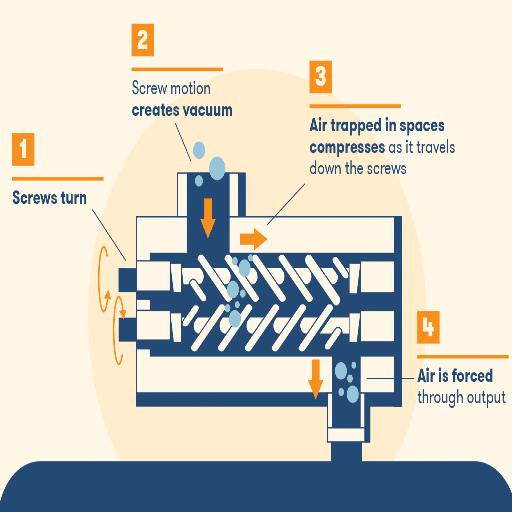
The rotary-screw technology states the two intertwining helical rotors or screws to compel air to compress continuously in a very efficient manner. The rotors within a casing rotate in opposite directions from each other, therefore trapping the air between them and reducing its volume. This method avoids the use of valves and as a result, one could expect a steady pressure of compressed air. Rotary-screw compressors are highly valued for their unchanging, energy-efficient productivity and application; they are especially poetic in continuous-flow applications in the manufacturing, motor, and construction industries.
How Screw Compressors Work
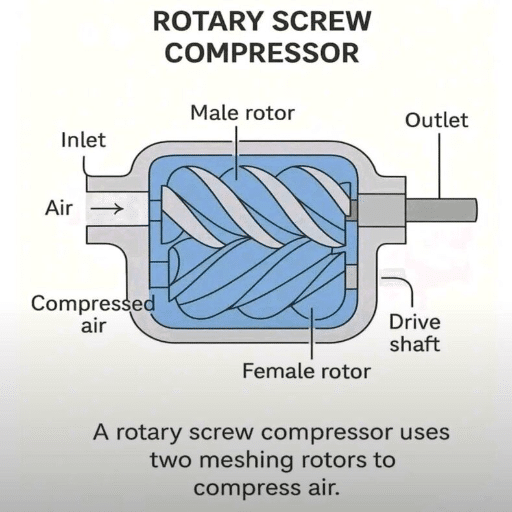
Screw compressors employ two helical rotors, a male and a female rotor, which rotate in reverse directions candidly within a carefully manufactured case. Air enters the chamber of compression and becomes entrapped between the rotors. The rotors’ turning reduces the volume of air, allowing compression to take place in a steady, pulsation-free fashion. This design obviates the need for valves and guarantees a continuous supply of compressed air. The operation described herein is extremely efficient, as you must know. Furthermore, because screw compressors are able to provide a highly predictable flow rate with utmost reliability, they present a somewhat excellent choice for industrial applications needing anticipated airflow and in such scenarios where one must witness a continuous controlled flow of air.
Components of a Rotary Screw Compressor
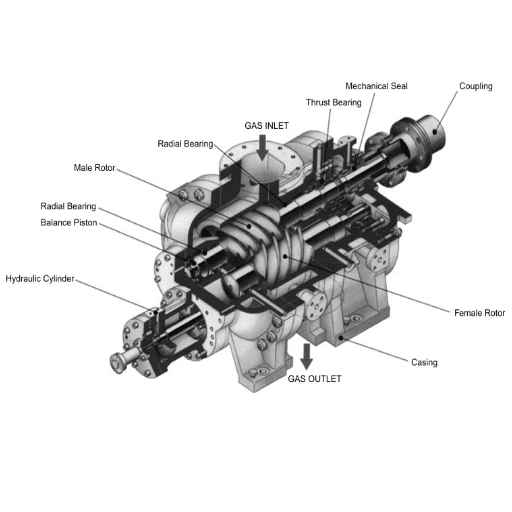
A rotary screw compressor is a mechanical appliance having a unique design that helps it efficiently compress air by first having an intake valve to facilitate air intake. What could be considered as any compressed object in this machinery is the linked rotors, which practically do the compressing in the cylinder. A casing is provided to enclose the rotors, offering support to their connection to the valve. It supports the surrounding air at the pressure being pumped by minimizing escape of air. The oiling system includes the compressor motor to drive the rotors, a cooling system works around the clock, with panels that monitor its performance. These specified functions are closely related to ensuring the equipment achieves high reliability, energy efficiency, and constant airflow.
Working Principle of Rotary Screw Air Compressors
Mechanics of Air Compression
The basic principle of rotary screw air compressor design involves two helical rotors, commonly known as screws, aligned in a chamber. As one rotor turns, it inhales the air with jackhammers from space between the lobes. The lobe exterior serves as a perfect envelope in its own right, which wards off the airship’s entrance. An infinite volume of volumetric flow, directed from high pressure to low pressure, seems to move, therefore, toward one end of these rotors which acts as a precompressed charge. Capable of changing screw design from milder precise rotors to a somewhat wiser precision efficiency, considerable focus is put on creating rotor compressions in as little power as possible. In effect, extraordinary relief systems identify key in-house motor designs; while powerful interacting control systems, through deeply covering the optimisation of motor-speed requirements during varied load conditions.
Rotors are Important for Compression
The heart of the rotary screw air compressor system are the rotors that play a crucial role in the compression process. Rotation brings them together, creating air chambers during transition, which trap and compress air therein. Close tolerances between the rotors maximize efficiency and seal off any air leakage during compression. The shape and alignment of rotors also determine the compressor capacity and pressure, making the rotors one of the most important components for smooth, high-performance.
Types of Rotary Screw Compressors
The oil-injected type utilizes oil for cooling compressed air, sealing, and lubricating the rotors, allowing them to be used for applications with permissible slight oil contamination. In contrast, oil-free compressor do not lubricate their compression chambers with oil; this ensures that the air is absolutely clean and free from contamination, as, for example, is required in pharmaceuticals, food processing, and electronics industries. This deduced flexibility based on unique industries offers two types with a range of operational functionalities.
Benefits of Rotary Screw Air Compressors
Advantages Over Piston Compressors
The rotary screw air compressor is chosen for industrial services due to several reasons that make it superior to piston compressors. Rotary screw air compressors provide high durability due to a continuous flow of compressed air along the line of consistent product performance foregoing the intensity instigated by the fluctuating production variables involved in piston air compressors. Also, the rotary screw air compressors function very quietly, allowing their use in noisy environments. Rotary screw compressors come with energy-efficient designs that save major expenses in the long term. Additionally, rotary screw air compressors have high duty cycles and require very low maintenance costs, adding the advantages of less downtime and ability to maximize productivity. Therefore, rotary screw air compressors are the most proficient in compressors.
Efficiency in Air Systems
Screw-type air compressors have a lot to do with efficiency in air systems. A continuous supply of compressed air in low-energy mode, indeed, furnished them with a job to be done. With their no-flight design, these compressors ensure significantly reduced leakage mechanisms and hence save a lot of energy. And lest we forget excess noise in some environments and the noise these machines send out wherever they are; the screw-type machines work way quieter than their back-flow cousins. This importance is priceless in knowing about the maintenance of the screw-type machine, as less corrosion favors longer lasting and less interruptions due to maintenance. This leads to slight downtimes giving a happier instance for making the operation cost-effective. Thus, such composites will be the item of choice for any industry to be guarded while elsewhere abiding with the wrenches on the best cost and reliability of the air system operation.
Affecting the Quality of the Compressed Air
Rotary screw compressors are known for delivering high air qualities due to their capability of maintaining a consistent and clean flow of air with fewer contaminants. With this in mind, the advanced filter systems within the machines efficiently rid the gas of impurities such as oil, moisture, or dirt, allowing an outlet of clean compressed air for sensitive applications. This is important for industrial sectors including food processing, pharmaceuticals, and electronics, where air contamination could cause tremendous quality problems or even damage to equipment. Also, their effectiveness ensures that the air output is stable and the compressor will continue to perform effectively across diverse applications in many industries.
Maintenance and Installation of Rotary Screw Compressors
Best Practices for Compressor Maintenance
The long life and hot efficiency of open-type rotary compressors depend on regular maintenance. These include periodically checking and replacing air filters to avoid contamination and ensure that the airflow distribution is in perfect condition; monitoring the correct oil lubrication and checking the right oil levels for temperature control; and regularly changing the oil and also oil filters to prevent wear and tear to internal components. Looking for weakened or loose connections of belts can prevent potential breakdown. Furthermore, thorough and frequent cleaning of coolers can keep everything running fine and stop the problem of overheating. The manufacturer’s maintenance schedule and use of recommended parts provide optimal performance.
Installation of Compressors
In order to ensure that the compressor would remain unharmed and give maximum performance, the compressor should be properly fabricated. When selecting the site, care must be taken to have sufficient ventilation, less exposure to dust, moisture, and sources of extremely high temperatures. Mount the compressor on a level base to minimize vibrations and the accompanying share on internal components. Check that electrical connections are made according to the specifications. Furthermore, ensure that the secure arrangement is such that neither vibrations onward can ever prevent the desired effect (voltage) from ever being able to enter the motor from the source. Unsuitably sized air receiver tanks will provide less free air storage, resulting in an unacceptably high demand for onsite drying and post-cooling of the compressed air.
A proper layout of piping and bends will do much good in limiting air resistance. Flexible hose connectors should also be used in places to absorb vibrations and take off stress from the system. Regular inspections for leaks in the air system should be maintained to ensure optimum efficiency. To maintain safety and performance, always follow the manufacturer’s guidelines and take advice from professionals if any complicated situation arises. Such precautions for a system will definitely result in a reliable system and lower interference from operational uncovering.
Additional Insights
For an air system to operate at its optimum state, installing it right and then upscaling that process through continual servicing and monitoring need to be brought into play. The question most frequently asked, is “How frequently should an air system be serviced?” The secret is all about the intensity of usage; however, a structure featuring once-quarterly checks is deemed a good starting point. All the same, a plan can be drawn up for what needs to be done to address other forms of wear and tear, like replacing filters, identifying the blocking problem etc. On the other hand, all those new technologies, such as sensors enabled by IoT help to bring in large-scale real-time operations and data for the whole-system performance, thereby yielding quicker responses to any challenges emerging as well as adding system reliability.
Reference Sources
-
Atlas Copco: Working Principle of a Screw Compressor – This article explains the mechanics of screw compressors, including the role of male and female rotors in compressing air.
-
Nigen: How Do Rotary Screw Air Compressors Work? – This source discusses the operating principles of screw compressors, focusing on how air pressure increases as volume decreases.
-
CompAir: Rotary Screw Compressor Technology Explained – This page provides an overview of the technology behind screw compressors, including the process of air compression within the rotor cavities.
Frequently Asked Questions (FAQs)
Can you please explain the working concepts of air compressors in a rotary screw air compressors work setup?
The rotary screw air compressors achieve the compression of air by utilizing a pair of meshing helical rotors (the air end), which is the fundamental principle of screw compression, as the air passes through the decreasing volume. In oil-injected rotary screw models, compressor oil is supplied to seal and cool the compression chambers, whereas oil-free screw compressors maintain dry air with the help of special coatings or different designs. The rotary compressor part’s air compression results in a constant supply of compressed air that is suitable for many applications in industrial air compressors. Rotary screw compressors ensure a continuous flow and they are known to have less pulsation as compared to a reciprocating compressor. Proper air treatment that includes compressed air dryers and filters is mostly necessary because the compressed air needs to be clean for many processes.
How does a compressed air system influence the way in which compressors are utilized?
The compressor is a design in itself, but it is not sufficient for a complete compressed air system. A complete compressed air system includes air compressors, air receivers, piping, and air treatment components. The compressor type coming in a variety of types, including rotary and reciprocating, and the size and cycle of each compressor are determined by the system design. In the process, the system is all about the matching of the delivered air to the demand without any pressure discrepancy. The compressed air is dried and cooled by the system as it is submitted to the different equipment or tools that require the air to be in a dry state. Because it is possible that air from the compressor could mix with the sensitive tools or processes, the system also ensures that the compressed air is cooled and dried accordingly. One of the important parts that cannot be missed is compressor oil management. When the compressor is oil-flooded, compressors are fitted with separators, and filters are a necessity, but oil-free screw compressors lower the risk of contamination. Moreover, the optimization of energy use by good system control is one of the factors that make a system highly efficient and cost-effective, as the cost of operation and efficiency is significantly influenced by air flow and pressure values.
Can you give me some tips on the maintenance of a rotary screw air compressor?
The rotary screw compressor is popular because of its minimal maintenance requirements, but that doesn’t mean it can be neglected completely. Regular checking of the compressor oil, filters, belts, and the air end are the fundamentals in taking care of the unit and extending the life of the compressor as well. In the case of oil-flooded compressor units, oil changes and monitoring need to be done regularly as the compressor oil does the job of sealing, cooling and lubricating; oil-free screw compressors are free from oil contamination but still need filter and element inspections. Check compressed air dryers and condensate management to ensure that the compressed air system is providing dry and clean air for the end uses. Monitor air pressure, temperature, and vibration to predict the coming issues and thus to have a continuous supply of compressed air. It is a good habit of running the compressors according to the manufacturer
What are the concepts behind the compression of air in the screw and the rotary screw types of compressors?
The main idea behind screw compression is that two rotors that are meshed together trap air and move it axially while the space between lobes gets smaller, which ultimately compresses the air. The rotary screw principle, specifically, refers to the turning motion that carries the air from the air-end to be compressed with a minimum of pulsations and an uninterrupted flow of the air. Depending on the designing the rotary screw air compressors can be oil-injected or oil-free; the oil-injected rotary screw compressors make use of compressor oil through the process to improve sealing and enhance heat transfer. This rotary way of doing the job is entirely different from running a piston-based reciprocating compressor but on the other hand, it is well-appreciated for bringing in a lot of air very smoothly. As a rule, systems that compress air normally do so with the heat, which is why most of them also cool the air to make it ready for downstream air treatment and use.
How do I choose the right compressor among different compressor types for your needs and rotary screw compressors are among the varieties?
In order to make the best choice for the kind of compressor that matches your requirements, you should pay attention to the calculated air flow, air pressure, duty cycle, and whether the process calls for clean air since the air compressor kinds are very diverse when it comes to these capabilities. Even though there are two categories of rotary screw compressors, oil-flooded and oil-free, they are usually very suitable for continuous-duty industrial air compressors which demand an uninterrupted supply of compressed air. The reciprocating compressor alternatives might be a good choice for occasional operation or for high-pressure types of applications, but they usually need more maintenance. Complete the perspective by considering the whole compressed air system, which includes treatment of air like compressed air dryers, to make sure the output is up to the quality needs such as dry air or oil-free requirements. Moreover, when we talk about the lifecycle costs, maintenance needs, and available space, by going for screw compressors as used versus other compressor technologies, consider all these things together.