
Skid Mounted Diesel Screw Compressor: A Complete Buyer’s Guide
A drilling contractor in Western Australia once lost three days on a water well project because his towable diesel compressor kept sinking into soft ground every time the crew moved it. The compressor worked fine. The problem was the wrong configuration for a site that needed a stable, semi-permanent installation.
If your project is remote and off-grid, and it needs high-volume compressed air for weeks or months, a skid-mounted diesel screw compressor is often the most practical choice. These units give you the mobility of a portable package without the daily relocation hassle of a trailer. They also avoid the long installation timeline of a permanent stationary system.
In this guide, you will learn what a skid-mounted diesel screw compressor is and how it works. You will also learn when it outperforms towable and stationary alternatives, how to size one for your application, and what common mistakes buyers make. We cover installation, operating costs, and safety compliance too.
For a comprehensive and in-depth understanding of diesel screw compressors, please check out our diesel screw compressor guide.
What Is a Skid-Mounted Diesel Screw Compressor?
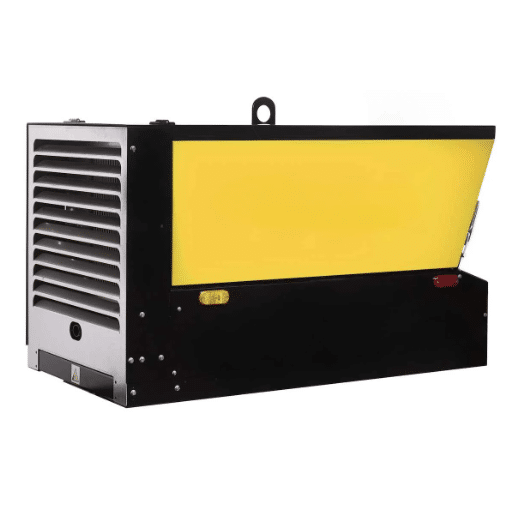
A skid-mounted diesel screw compressor is a rotary screw air compressor powered by a diesel engine, mounted on a rigid steel frame called a skid. The skid provides a stable base that can be lifted by crane or forklift, placed on a level pad, and connected to fuel and air systems with minimal site work.
These compressors are factory-assembled packages. A typical unit includes:
- A diesel engine (Cummins, Kubota, Yanmar, Yuchai, or equivalent)
- A rotary screw airend for continuous compression
- An air/oil cooler and cooling fan
- Air intake filters and an oil separator
- A control panel with engine and compressor monitoring
- A fuel tank sized for extended unattended operation
- Safety shutdowns for high temperature, low oil pressure, and overspeed
Because the entire system arrives pre-plumbed and pre-wired, a skid-mounted diesel air compressor can be operational within hours of delivery. That makes it ideal for remote mining camps, drilling sites, construction projects, and emergency backup applications where permanent infrastructure is not practical.
Mini-story: Chen, a project manager at a geotechnical drilling firm in Southeast Asia, originally rented towable compressors for each job. Moving them every few days burned fuel and crew time. After switching to a 350 CFM skid mounted diesel screw compressor that stayed on site for the full six-week project, his team cut mobilization time by 40% and kept the drill running continuously.
How a Skid-Mounted Diesel Screw Compressor Works
A skid-mounted diesel screw compressor works by using a diesel engine to drive two interlocking helical rotors. These rotors sit inside the compressor airend. As they turn, air is drawn in and trapped between the lobes. The trapped air is then compressed into a smaller volume before being discharged into the air receiver or distribution line.
The process is continuous, not pulsating like a piston compressor. That matters for three reasons:
- Steady airflow: Tools and drilling equipment receive consistent pressure without pressure spikes.
- Continuous duty: Rotary screw compressors can run at 100% duty cycle. Piston compressors are typically limited to 60–70%.
- Better fuel efficiency at scale: Above roughly 100 CFM and 7 bar, screw compression is generally more fuel-efficient than piston compression.
After compression, the air passes through an oil separator, an aftercooler, and filtration. The control system monitors engine speed, discharge pressure, oil temperature, and fuel level. If a fault occurs, the unit shuts down automatically to protect the engine and airend.
Skid Mounted vs Towable vs Stationary: Which Configuration Is Right for You?
Not every off-grid project needs the same type of compressor. The table below compares the three main configurations.
| Feature | Skid Mounted | Towable/Trailer | Stationary |
|---|---|---|---|
| Mobility | Crane or forklift | Highway towable | Fixed install |
| Typical setup time | 2–6 hours | 30–60 minutes | Days to weeks |
| Best use case | Semi-permanent remote sites | Frequent relocation between job sites | Permanent factories and plants |
| Power options | Diesel or electric | Diesel or gasoline | Usually electric |
| Common CFM range | 100–1,600+ | 185–1,600+ | 100+ |
| Foundation needs | Level pad or compacted ground | Minimal | Concrete pad, piping, electrical |
| Relocation cost | Medium (requires lifting equipment) | Low | High |
Choose a skid-mounted diesel screw compressor when:
- The unit will stay in one location for several weeks or months.
- The site has no reliable electrical supply.
- You need a stable platform that resists vibration and ground movement.
- Relocation is occasional rather than daily.
Choose a towable compressor when:
- You move between job sites every few days.
- Highway towing is practical and permitted.
- Setup speed matters more than long-term stability.
For more information, please read our article on towable diesel air compressors.
Choose a stationary compressor when:
- You have a permanent facility with three-phase power.
- Operating cost and noise control are priorities.
- The compressor will run continuously for years in the same location.
Mini-story: A mining contractor in Chile started with a fleet of towable compressors for bench drilling. After six months, the maintenance team noticed that constant towing was damaging radiators and electrical connections. They switched to skid mounted units for long-term benches and kept only two towable units for exploration work. Downtime dropped by 25%.
Key Industrial Applications for Skid-Mounted Diesel Screw Compressors

Skid-mounted diesel screw compressors are used wherever high-volume compressed air is needed off the grid. Common applications include:
Mining and Quarrying
In open-pit and underground mines, these compressors power DTH hammers, pneumatic breakers, roof bolters, and ventilation systems. Their ability to run continuously in dusty, high-temperature environments makes them a standard choice for production drilling. For detailed sizing guidance, see our diesel screw compressor for mining guide.
Water Well and Geothermal Drilling
Water well rigs need steady airflow to clear cuttings and drive down-hole hammers. Skid-mounted units in the 350–750 CFM range at 17–25 bar are common for medium-depth wells. Learn more in our water well drilling compressor guide.
Construction and Civil Engineering
Road building, tunneling, bridge work, and foundation projects use skid-mounted compressors to run jackhammers, compactors, shotcrete machines, and pneumatic tools. The stable skid frame is especially useful on uneven job sites.
Oil, Gas, and Pipeline Projects
Pipeline pressure testing, pigging, well servicing, and exploration drilling all require reliable compressed air in locations far from grid power. Skid-mounted diesel units provide the pressure and flow needed for these operations.
Sandblasting and Surface Preparation
Shipyards, steel fabrication shops, and coating contractors use skid-mounted compressors to supply blast pots and spray equipment. Consistent pressure improves surface quality and reduces media consumption.
Emergency Backup and Temporary Air Supply
When a factory’s stationary compressor fails, a skid-mounted diesel air compressor can be delivered quickly to maintain production while repairs are completed.
Ready to match a compressor to your application? Contact our team for a customized recommendation.
Sizing a Skid-Mounted Diesel Screw Compressor
Sizing starts with two numbers: the airflow you need (CFM or m³/min) and the pressure you need (PSI or bar). Every tool, hammer, or process downstream has a minimum requirement. Adding all tool demands together gives your base airflow. Add a 25–30% safety margin to cover leaks, future expansion, and altitude losses.
Skid Mounted Diesel Compressor Size Classes
| Size Class | CFM Range | Pressure Range | Typical Engine Power | Common Applications |
|---|---|---|---|---|
| Small | 185–250 CFM | 7–10 bar | 45–60 HP | 1–2 jackhammers, light sandblasting, utility work |
| Medium | 350–600 CFM | 7–14 bar | 75–150 HP | Multi-tool crews, shallow drilling, quarry work |
| Large | 600–950 CFM | 10–25 bar | 150–250 HP | Mining production drilling, deep water wells |
| Heavy | 950–1,600+ CFM | 18–35 bar | 250–500+ HP | DTH blast-hole drilling, tunneling, reverse circulation |
Pressure Class Guide
| Pressure Class | Range | Best For |
|---|---|---|
| Standard | 7–10 bar | General construction tools, sandblasting, spraying |
| Medium | 10–14 bar | Shallow drilling, quarry work, some pipeline jobs |
| High | 18–25 bar | DTH drilling, deep water wells, blast-hole drilling |
| Ultra-high | 30–35 bar | Deep geothermal, hard rock exploration |
Altitude and Temperature Derating
Diesel engines and compressor airends both lose performance at high altitude and high temperature.
- Naturally aspirated diesel engines lose roughly 3% power per 300 m of altitude.
- Turbocharged diesel engines lose roughly 1–1.5% per 300 m.
- Compressor airflow drops approximately 3–5% at 35°C, 5–10% at 45°C, and 10–15% at 50°C.
Example: A site at 3,000 m and 40°C needs 750 CFM. It may require a compressor rated for roughly 1,300 CFM at standard sea-level conditions. Always ask the supplier to confirm derated output for your actual site conditions.
Engine Power Reserve and Fuel Tank Sizing
A well-sized diesel engine should run at 75–85% of its rated load at full compressor output. That reserve protects the engine from overload and extends service life. Fuel tank sizing depends on how long the unit must run between refueling. Larger tanks reduce downtime on remote sites but add weight and cost.
Essential Design Features to Look For

Not all skid-mounted diesel screw compressors are built for the same conditions. Before buying, evaluate these design features:
Frame and Mobility Features
- Reinforced steel skid with lifting points and forklift pockets
- Corrosion-resistant coating for outdoor storage
- Vibration isolation mounts to protect components during transport and operation
- Drainage provisions to prevent water and debris accumulation
Filtration and Cooling for Harsh Environments
- Cyclone pre-cleaner or centrifugal dust separator for dusty sites
- Dual-stage air filter with a safety element
- Oversized oil cooler and air/oil radiator
- Removable radiator guards for cleaning
Engine and Airend Quality
- Diesel engines from reputable manufacturers such as Cummins, Kubota, Yanmar, or Yuchai
- Rotary screw airends from proven suppliers
- Direct drive or reliable belt-drive arrangement
- Easy access to oil and air filters for maintenance
Controls and Monitoring
- Digital control panel showing pressure, temperature, engine speed, and fuel level
- Automatic start/stop based on air demand
- Fault alarms and shutdown protection
- Optional remote monitoring or telematics
Safety Features
- Spark arrestor on the exhaust for mining and flammable environments
- Automatic shutdown for high coolant temperature, low oil pressure, and overspeed
- Emergency stop button accessible from the ground
- Fire suppression system or mounting provisions
At Shandong Loyal Machinery, we design our skid-mounted diesel screw compressors with these features as standard. We also customize configurations for high-altitude, high-temperature, and high-dust environments.
Installation, Siting, and Commissioning
A skid-mounted diesel screw compressor is faster to install than a stationary system, but proper siting still matters. Follow these steps:
Site Preparation and Leveling
Place the skid on compacted, level ground or a gravel pad. Avoid soft ground, drainage channels, and low spots where water can collect. Use shims if needed to level the unit within manufacturer specifications.
Fuel, Air, and Exhaust Connections
Connect the fuel supply to the tank using clean diesel that meets the engine manufacturer’s specifications. Route the discharge air line away from the exhaust outlet to avoid hot air recirculation. Ensure the exhaust points away from work areas and air intakes.
Ventilation and Clearance Requirements
Maintain clearance around the radiator, exhaust, and air intake as specified by the manufacturer. Poor airflow causes overheating and reduces performance. In hot climates, orient the unit so the radiator faces the prevailing wind if possible.
Initial Startup and Testing Checklist
Before putting the compressor into service:
- Check engine oil, coolant, and fuel levels.
- Inspect air and oil filters.
- Verify all safety shutdowns are functional.
- Run the unit unloaded and check for leaks or abnormal noise.
- Confirm discharge pressure and temperature are within range.
- Log baseline readings for future maintenance.
Operating Costs: Fuel, Maintenance, and Total Cost of Ownership
Fuel and maintenance are the two largest operating expenses for a skid-mounted diesel screw compressor. Understanding both helps you compare options accurately.
Fuel Consumption Ranges by Size Class
Diesel engine fuel consumption is typically expressed in grams per kilowatt-hour (g/kWh). A practical range is 196–230 g/kWh depending on engine technology and load.
| Compressor Size | Approximate Fuel Consumption |
|---|---|
| 185–250 CFM | 8–15 L/hr |
| 350–600 CFM | 18–35 L/hr |
| 750 CFM | 42–58 L/hr |
| 1,500 CFM | 90–120 L/hr |
Actual consumption depends on load factor, altitude, ambient temperature, and engine condition.
Maintenance Intervals
Routine maintenance keeps the unit reliable and protects resale value. Typical intervals include:
- Daily: Check oil, coolant, fuel, and air filter restriction indicator.
- Every 250 hours: Change engine oil and oil filter; inspect air filter.
- Every 500 hours: Replace air filter and fuel filter; inspect belts and hoses.
- Every 1,000 hours: Service compressor oil and oil separator; inspect valves and coolers.
- Every 8,000–15,000 hours: Major airend overhaul.
In dusty environments, cut these intervals in half. For more details, read our diesel screw compressor maintenance schedule.
Rental vs Purchase Considerations
Renting makes sense for short projects or when you need a specific size temporarily. Buying is usually more cost-effective when the unit will run more than 500–800 hours per year for multiple years. Ownership also gives you control over maintenance quality and resale value.
To estimate fuel costs accurately, use our diesel air compressor fuel consumption guide.
Compliance, Noise, and Emissions

Before deploying a skid-mounted diesel screw compressor, confirm it meets local regulations.
MSHA and Mine Safety Considerations
In U.S. underground mines, diesel power packages must comply with 30 CFR Part 7, Subpart E or Subpart F. The required subpart depends on the mine area.
Requirements cover exhaust emissions, surface temperature limits, flame arresters, coolant safety shutdowns, and electrical component approval.
Even where MSHA does not apply, mining operators should specify spark arresters, fire suppression provisions, and automatic shutdown systems.
Tier 4 Final / Stage V / CARB Awareness
Diesel engine emissions standards vary by region:
- Tier 4 Final: U.S. EPA standard for off-road diesel engines.
- Stage V: European Union standard with strict particulate and NOx limits.
- CARB: California Air Resources Board rules, often stricter than federal U.S. standards.
If you operate in a regulated region, confirm the engine certification before purchase. Some export markets accept Tier 2 or Euro II engines, but the trend is toward cleaner emissions everywhere.
Noise Levels and Hearing Protection
Skid-mounted diesel compressors typically produce 75–90 dB(A) at operator distance. Permanent installations may require acoustic enclosures or placement away from work areas. Provide hearing protection where exposure exceeds local occupational limits.
Common Mistakes to Avoid
Even experienced buyers can make costly errors when selecting a skid-mounted diesel screw compressor. Watch for these:
- Under-sizing for altitude and temperature: Catalog ratings are based on sea-level, standard-temperature conditions. Always request derated output for your site.
- Insufficient filtration: Standard filters fail quickly in dusty mines or deserts. Specify cyclone pre-cleaners and heavy-duty filters.
- Wrong mounting type: If you relocate daily, a towable trailer unit is usually better than a skid.
- Ignoring local regulations: Emissions, noise, and safety rules vary by country and site. Verify compliance before delivery.
- Poor site preparation: An unlevel or soft pad causes vibration, cooling problems, and premature component wear.
- Skipping commissioning: A quick startup checklist prevents early failures and establishes baseline performance data.
Mini-story: A construction supervisor in the Middle East bought a 250 CFM skid mounted diesel air compressor based on catalog specs alone. On site, the ambient temperature regularly exceeded 45°C and fine sand clogged the standard air filter within days. Output dropped 20% and the engine overheated twice. After upgrading to a high-temperature, high-dust package with a cyclone pre-cleaner, the unit ran reliably for the rest of the project.
Conclusion
A skid-mounted diesel screw compressor is a practical solution for remote, off-grid projects that need reliable compressed air over weeks or months. It combines the mobility of a portable package with the stability of a semi-permanent installation.
To choose the right unit, focus on four things:
- Match CFM and pressure to your actual tools or process, including altitude and temperature derating.
- Select a robust frame, heavy-duty filtration, and proven engine and airend components.
- Plan the site, fuel, exhaust, and ventilation before delivery.
- Confirm local emissions and safety requirements early.
When specified correctly, a skid-mounted diesel screw compressor reduces mobilization time, supports continuous operation, and lowers total cost of ownership compared to constantly moving towable units.
Need help selecting the right skid-mounted diesel screw compressor for your project? Contact Shandong Loyal Machinery for expert guidance and a customized solution tailored to your site conditions.