
Towable Diesel Air Compressor: A Complete Guide for Industrial Job Sites
Marcus Chen watched his crew idle for three hours on a remote pipeline job. The electric compressor they had shipped to the site could not handle the voltage drop from the portable generator, and the nearest grid connection was seventeen kilometers away. That single equipment mistake cost the project a full day and pushed the schedule into penalty territory.
If your work takes you off the grid, you have probably faced a version of this problem. A towable diesel air compressor solves it by bringing its own power plant, its own air supply, and its own mobility in one trailer-mounted package. It does not ask for a building connection. It does not wait for an electrician. It arrives, hooks up, and produces compressed air where nothing else can.
In this guide, you will learn how a towable diesel compressor works, where it delivers the most value, and how to size and select one for construction, mining, drilling, or rental fleet use. We will cover CFM and pressure requirements, emissions compliance, operating costs, and maintenance. By the end, you will know whether a towable diesel unit is the right choice for your next job.
Want help matching a compressor to your exact tools and site conditions? Our team builds towable diesel compressor configurations for contractors and rental fleets worldwide. Get a tailored sizing recommendation before you buy.
What Is a Towable Diesel Air Compressor?

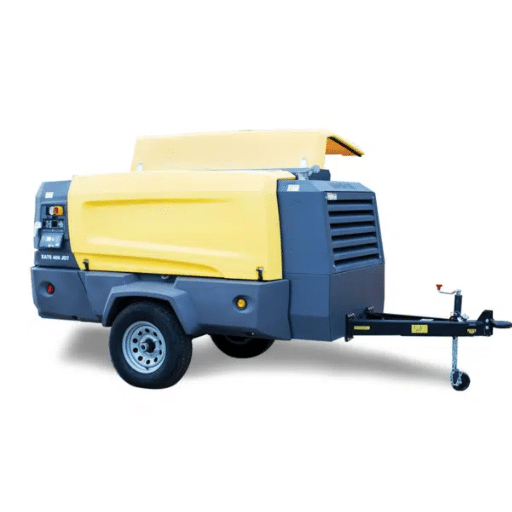
A towable diesel air compressor is a diesel-powered rotary screw compressor mounted on a road-legal trailer with wheels, axle, hitch, and braking system. A diesel engine drives the compressor element. That element draws in ambient air and compresses it into a receiver tank. From there, regulated air flows through hoses to pneumatic tools or process equipment.
Most units range from roughly 90 CFM for light work up to 800 CFM or more for heavy infrastructure. Pressure ratings typically fall between 100 PSI and 200 PSI, with specialized models reaching 300 PSI or higher for drilling applications. Because the package is self-contained, it can operate anywhere a truck can tow it.
The key difference between a towable diesel compressor and a portable electric unit is independence. Electric compressors need a reliable power source. Towable diesel compressors bring their own. That makes them the default choice for remote construction, mining, pipeline work, water well drilling, and emergency backup air.
For a comprehensive and in-depth understanding of Diesel Screw Compressors, please check out our diesel screw compressor guide.
Key Applications Where Towable Diesel Compressors Excel
Towable diesel compressors are not the right fit for every shop floor. They are purpose-built for mobile, outdoor, and high-demand work where grid power is unavailable or impractical.
Construction and Roadwork
Construction crews use towable diesel compressors to run jackhammers, pavement breakers, chipping hammers, impact wrenches, and concrete vibrators. An 185 CFM unit is the most common size on road repair and utility crews because it supports one heavy tool or two lighter tools at once.
Mining and Quarrying
Open-pit mines and quarries rely on towable diesel units for blast-hole drilling, down-the-hole (DTH) hammers, and material handling. These applications demand higher airflow and pressure, often 400 CFM to 950 CFM or more, in locations far from permanent electrical infrastructure.
Pipeline and Infrastructure Projects
Pipeline construction requires mobile air for sandblasting, coating removal, pressure testing, and pneumatic pipe bending. A towable diesel compressor moves along the right-of-way as the work progresses.
Water Well and Geothermal Drilling
Drilling rigs need continuous high-pressure air to clear cuttings and maintain borehole stability. Towable diesel compressors rated for 350 CFM to 1,600 CFM at 200 PSI to 500 PSI are common in this field.
Rental Fleets and Emergency Backup
Equipment rental companies value towable diesel compressors for their utilization rate. A single unit can serve construction, municipal maintenance, and industrial outage response. When a plant’s fixed compressor fails, a towable diesel unit can keep critical processes running until repairs are complete.
How to Size a Towable Diesel Air Compressor
Sizing is the single most important decision when selecting a towable diesel compressor. The wrong size starves tools, wastes fuel, or forces you to buy more capacity than you need.
Start With CFM and PSI
CFM measures air volume. PSI measures pressure. Every pneumatic tool has a minimum requirement for both. Start by listing every tool that will run simultaneously, then add their CFM requirements. Multiply the total by 1.2 to 1.3 to create a safety margin for leaks, hose length, and future expansion.
For pressure, match the highest PSI requirement among your tools. Most construction tools operate at 90 to 100 PSI. Rock drills and some sandblasting setups need 125 to 150 PSI. Specialized drilling applications may require 200 PSI or more.
Match CFM Class to Application
| CFM Range | Typical Tools and Applications |
|---|---|
| 90–110 CFM | Single jackhammer, breaker, medium-demand tool |
| 185 CFM | One jackhammer or rock drill, two light tools |
| 250–400 CFM | Multiple tools, larger sandblasting, drilling |
| 400–800 CFM | Pipeline work, multi-nozzle blasting, large drills |
| 800+ CFM | Heavy mining, quarrying, deep drilling rigs |
For example, a 185 CFM towable diesel compressor can run a 90 CFM jackhammer with room to spare. If the same crew also wants to run a 70 CFM impact wrench at the same time, the combined demand is 160 CFM. Adding a 20% buffer pushes the requirement to 192 CFM, so an 185 CFM unit would be slightly undersized. A 250 CFM unit would be the safer choice.
Account for Real-World Conditions
Published CFM ratings are based on standard conditions: sea level, 68°F inlet temperature, and clean filters. Real job sites rarely match those conditions. Apply these adjustments:
- Altitude: Expect roughly 3% CFM loss per 1,000 feet above sea level.
- Temperature: Hot inlet air reduces density, lowering effective output.
- Hose length and fittings: Long hoses and multiple couplings create pressure drop.
- Dust and filter loading: Clogged intake filters reduce airflow.
- Duty cycle: Continuous operation demands more reserve capacity than intermittent use.
If you operate at 7,000 feet elevation, a compressor rated for 400 CFM at sea level may deliver closer to 320 CFM. Size accordingly, or choose a turbocharged engine designed for high-altitude work. For a deeper methodology, see our diesel portable air compressor sizing guide.
Towable Diesel vs Portable Electric: Which Should You Choose?
Not every job needs a diesel engine. The right choice depends on where you work, how much air you need, and what regulations apply.
Choose Towable Diesel When:
- No reliable grid power is available.
- You need 90 CFM or more at the job site.
- The compressor must move frequently between locations.
- Continuous runtime matters more than minimizing noise.
- Emissions restrictions are manageable or do not apply.
Choose Portable Electric When:
- Reliable grid power or a clean generator is available.
- You work indoors, underground, or in noise-sensitive areas.
- Air demand is low to moderate.
- Zero on-site emissions are required.
- Operating cost per CFM is the top priority.
Electric compressors convert electrical energy to compressed air more efficiently than diesel engines convert fuel. However, that advantage disappears if you need a large diesel generator to power the electric compressor. In remote locations, the diesel towable often wins on simplicity and total cost.
For a side-by-side comparison of these two technologies, read our guide on diesel vs electric air compressors.
Key Selection Criteria for Towable Diesel Compressors

Once you know the required CFM and PSI, evaluate these factors before making a purchase decision.
Engine Brand and Power Reserve
Common engine choices include Cummins, Kubota, Deutz, Kohler, and Yuchai. Established brands generally offer better parts availability and service networks. Make sure the engine has enough reserve power to handle load swings and altitude derating. Ask the supplier for the engine power curve and altitude correction data.
Emissions Compliance
In the United States, diesel air compressors fall under EPA Tier 4 Final standards for nonroad compression-ignition engines. Tier 4 Final reduced particulate matter and NOx emissions by approximately 95% to 99% compared to 1996 Tier 1 levels. Depending on your region, you may also need EU Stage V compliance or California Air Resources Board (CARB) certification.
Tier 4 Final and Stage V systems typically use one or more of these technologies:
- Diesel particulate filter (DPF) to trap soot.
- Selective catalytic reduction (SCR) using diesel exhaust fluid (DEF).
- Exhaust gas recirculation (EGR) to lower combustion temperatures.
- Diesel oxidation catalyst (DOC) to reduce carbon monoxide and hydrocarbons.
Before you buy, confirm that the engine has the correct emissions label for your market. Non-compliant equipment may be barred from public works sites. For more detail, see our explanation of diesel air compressor emissions standards.
Fuel Consumption and Runtime
Fuel use varies by engine size, load, and efficiency. Typical ranges by CFM class are:
- 185–250 CFM: 3 to 6 liters per hour
- 350–600 CFM: 8 to 18 liters per hour
- 600–950 CFM: 18 to 35 liters per hour
- 950–1,600 CFM: 35 to 70 liters per hour
Choose a fuel tank size that covers your expected shift length. A larger tank reduces refueling stops but adds weight. Some models include variable speed or variable capacity control to reduce fuel consumption during partial-load operation.
Cooling and Filtration
Air-cooled compressors are simpler and lighter, but liquid-cooled systems handle high ambient temperatures and continuous duty better. In dusty environments such as mining or desert construction, high-efficiency intake filters and pre-cleaners extend service life.
Trailer and Towing Requirements
Single-axle trailers are lighter and more maneuverable, typically used for units up to about 250 CFM. Dual-axle trailers provide better stability for larger, heavier compressors. Check your vehicle’s towing capacity, hitch class, and local trailer braking laws before selecting a unit.
Noise Level
Modern enclosed towable diesel compressors typically operate in the 70 to 80 dB(A) range. For comparison, a typical conversation is about 60 dB(A), and a gasoline lawn mower is roughly 90 dB(A). If you work near residential areas, hospitals, or noise-restricted zones, verify the published sound level and any local ordinances.
Safety and Certifications
Look for pressure relief valves, emergency shutdown switches, fire suppression options, and rollover protection on the trailer. Verify that the compressor carries CE, ISO, or other certifications required in your market. Request factory test reports and inspection certificates before shipment.
If you want a deeper comparison of skid-mounted systems, read our skid-mounted diesel screw compressor guide.
Maintenance Best Practices for Long-Term Reliability
A towable diesel compressor will last for many years if it receives regular care. Neglect turns small problems into expensive failures.
Daily Checks
- Inspect oil and coolant levels.
- Check for air, oil, and fuel leaks.
- Clean or inspect intake filters.
- Drain moisture from air receiver tanks and filters.
- Verify tire pressure and trailer lights if the unit will be towed.
Weekly and Monthly Tasks
- Inspect belts, hoses, and electrical connections.
- Clean the cooler and radiator fins.
- Check battery charge and terminal condition.
- Inspect the trailer hitch, safety chains, and brakes.
Scheduled Service
- Change engine oil and filters according to the manufacturer’s hour interval, often every 250 to 500 hours.
- Replace air compressor oil and separator elements on schedule.
- Service the DPF, SCR, or EGR system as required for emissions compliance.
- Conduct annual professional inspections of safety valves and pressure vessels.
If you run into operational problems, our portable diesel air compressor troubleshooting guide covers the most common causes and fixes.
Cost Considerations and Total Cost of Ownership

The purchase price is only the starting point. Over a typical ten-year life, fuel, maintenance, and downtime often exceed the initial investment.
Purchase Price Ranges
Exact pricing depends on brand, engine, options, and region, but rough ranges are:
- 90–110 CFM: $15,000 to $25,000
- 185 CFM: $25,000 to $40,000
- 250–400 CFM: $40,000 to $75,000
- 400–800 CFM: $75,000 to $150,000+
Options such as aftercoolers, high-pressure packages, cold-start kits, and advanced control systems add to the base price.
Operating Costs
Diesel fuel is the largest ongoing expense. At 8 hours per day and 250 working days per year, a 400 CFM unit consuming 15 liters per hour will use approximately 30,000 liters annually. Multiply that by your local diesel price to estimate annual fuel cost.
Maintenance adds another layer. Engine oil, filters, compressor oil, separator elements, belts, hoses, and emissions components all need scheduled replacement. Parts availability and local labor rates have a major impact on total maintenance cost.
Residual Value
Well-maintained towable diesel compressors from recognized engine brands tend to hold resale value. Rental fleets often recover a significant portion of the original investment when they rotate older units. Poorly maintained equipment, or units with obsolete emissions certification, depreciate faster.
Real-World Selection Example
Sarah runs a municipal road maintenance crew in a mountainous region. Her crew uses two 70 CFM jackhammers and one 90 CFM pavement breaker, but only two tools run at the same time. Peak demand is 160 CFM. At 6,000 feet elevation, she applies a 25% derating buffer, bringing the effective requirement to 200 CFM.
She initially considered a 185 CFM unit to save money. After reviewing altitude losses and the need for future expansion, she chose a 250 CFM towable diesel compressor with a Kubota engine and Tier 4 Final emissions certification. The larger unit eliminated tool starvation on hot summer days and gave her crew headroom to add a third tool later. Over two years, the reduced downtime and better fuel efficiency under partial load offset the higher purchase price.
This example illustrates why sizing by worst-case conditions, not catalog ratings, leads to better long-term value.
Conclusion
A towable diesel air compressor is one of the most flexible compressed air solutions for remote and mobile work. It combines self-contained power, high airflow, and road-ready mobility in a single package that electric compressors cannot match off the grid.
To choose the right unit, start with your tools. Add up simultaneous CFM demand, apply a safety margin, and adjust for altitude and temperature. Match the engine and emissions certification to your market. Evaluate trailer requirements, fuel consumption, noise limits, and maintenance access. Finally, calculate total cost of ownership rather than focusing only on the purchase price.
Ready to specify a towable diesel compressor for your next project? Contact our team with your CFM, pressure, and site conditions. We will help you select a configuration that delivers reliable performance and lower operating costs from day one.
Key Takeaways
- A towable diesel air compressor is a self-contained, trailer-mounted rotary screw compressor that operates without grid power.
- It is ideal for construction, mining, pipeline work, drilling, rental fleets, and emergency backup air.
- Size by simultaneous tool CFM plus a 20% to 30% safety margin, then adjust for altitude and temperature.
- Verify emissions compliance for your market before purchase.
- Compare total cost of ownership, including fuel, maintenance, and resale value, not just the initial price.