
5-10 HP Screw Compressor: A Complete Buyer’s Guide for Small Shops and Manufacturing
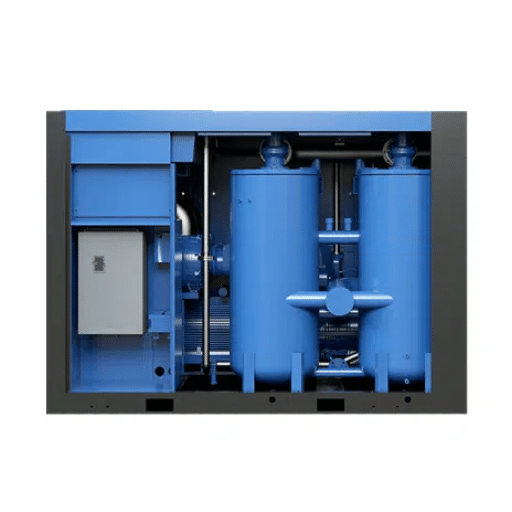
An Ohio-based three-person metal fabrication shop made some enhancements to their facility when they moved from a 5 HP piston compressor to a 10 HP VSD screw compressor. It’s during such periods of work that up to four people used to work with handheld grinders to do a job, which was a major challenge in this particular building since the pressure in the system kept going below 80 PSI and out of service. Even after the company rejected a production deal for ninety kilograms, amounting to $18,000 production came to a standstill. The bottleneck no longer exists.
Dear those operating small workshops, car service centers and emerging light manufacturing firms, positioning between a 5-10 HP screw air compressor is the most critical investment one has to make in equipment. One that is too small would require you to wait longer thus wasting time. On the contrary, one that is too large will require you to pay extra for what you do not require.
In this guide, we’ll show you how to find the right air compressor by measuring the tank size with airflow, determining the motor horsepower and knowing the units’ configuration to match the real-world needs, etc. You will learn about the main differences between 5 HP, 7.5 HP, and 10 HP air compressors. You will find out why a variable speed drive is the best return in investment. And, you will get a hands-on guide on how to avoid the errors that make small shop owners lose time and money.
What Is a 5-10 HP Screw Compressor?

A screw compressor ranging from 5-10 HP is a ventilation and air conditioning equipment used for the purposes of industrial applications with a moderate size. It is a gap-bridging alternative to light-duty compressors (either with or without help from belts) and the operator of the huge machines.
These compressors feature an interlock design that incorporates two screws that convey air as it moves within a single compression cycle intentionally eliminating the constant need to stop compressing gas and starting again as in the case of piston compressors hence preventing overheating associated with heavy duty equipments. A small and compact rotary compressor can operate round the clock under the maximum load condition without developing any structural damage. Such quality justifies its application in settings with hand tools are used for extended periods or even groups of workers are employed at the same time.
Purchasing his equipment from an already existent woodworking mint in Portland, Marcus also purchased by right an old 5 h power piston air compressor, which proved to be on all the time even with no need for that kind of running. For every survives quarter his light bills kept shooting upwards. After the adoption of a 10 hp VSD screw compressor, the first year energy cost reduction was remarkable as they reduced almost 28%. In fact, the compressor in-quarter returned more than three quarters of its investment on energy savings.
Compressors in this category can produce between 3.7 kW and 7.5 kW of power. This corresponds to delivery rates of 16 CFM and 50 CFM for a 5 HP and a 10 HP machine, respectively. It should be pointed out that working pressures range between 100 PSI and 175 PSI depending on the airend and drive motor characteristics.
Who Needs This Size Range?
A range of 5-10 hp is what is normally required by small auto body shops, personal carpentry shops for cabinet making, light, often fabrication work and food and beverage processing in the start-up stages, for factories with small or no line production even packing and simple assembly.
5 HP vs. 7.5 HP vs. 10 HP: Specifications Compared

With these three possible types, the most conspicuous disparity pertains to the capacity of airflow. Cfms that can be dispensed by a 10 HP system are within 2 to 2.5 times the generation from 5 HP systems. Here is a simple comparison of the parameters:
| Specification | 5 HP Screw Compressor | 7.5 HP Screw Compressor | 10 HP Screw Compressor |
|---|---|---|---|
| Typical CFM @ 125 PSI | 16 – 22 CFM | 25 – 32 CFM | 35 – 50 CFM |
| Pressure Range | 100 – 150 PSI | 100 – 175 PSI | 100 – 175 PSI |
| Power | ~3.7 – 5.5 kW | ~5.5 kW | ~7.5 kW |
| Typical Voltage | 208-230V 1-phase or 3-phase | 208-230V 1-phase or 3-phase | 208-230V/460V 3-phase |
| Noise Level | 65 – 74 dBA | 62 – 70 dBA | 60 – 68 dBA |
| Tank Size (Common) | 60 – 80 gallons | 60 – 80 gallons | 80 – 120 gallons |
| Price Range (USD) | 2,500−2,500−5,000 | 4,000−4,000−7,000 | 5,000−5,000−12,000+ |
Note: Exact specifications vary by manufacturer and configuration. Always verify Free Air Delivery (FAD) at your operating pressure.
How to Calculate Your Real CFM Need
Between a 5 HP screw compressor and 10 HP screw compressor, first calculate the total CFM of all tools being operated at the same time. Also, bearing in mind an additional 25% – 30% safety factors
Common workshop tool CFM demands at 90 PSI are:
| Tool | CFM Required |
|---|---|
| 1/2″ impact wrench | 4 – 5 CFM |
| Air ratchet | 3 – 4 CFM |
| Die grinder | 4 – 6 CFM |
| Dual-action sander | 6 – 9 CFM |
| HVLP spray gun | 8 – 15 CFM |
| Plasma cutter | 4 – 8 CFM |
| Sandblaster | 15+ CFM |
Illustratively, if an impact wrench (5 CFM) is applied, use a spray gun (12 CFM) and polished up with a grinder (6 CFM) at the same time you would need 23 CFM as the operating air consumption. After applying a 25% margin, it would be sufficient to provide the systems with approximately 29 CFM.
Electrical Requirements: Single-Phase vs. Three-Phase
This often cuts the smallest size for small-scale industries. 5 HP and 7.5 HP compressors usually come in 208-230V single-phase versions and so their access is to non-three-phase industrial consumers. However, single phase machines consume large power and it is necessary to ensure that the watts of the machine and the wiring do not exceed those of the panel.
As a rule of thumb, devices of more than 10 horsepower shall function with the help of a three-phase power connection. When this facility rarely encountered, its absence not only disturb the system engineers but also costs thousands of dollars to make three-phase available. On occasion, the smaller 7.5 HP single-phase units make more financial sense than the 10 HP models if we were only to consider the airflow needed.
Elena placed an order for a 10 HP three-phase screw compressor for her wood workshop based in Austin. That’s when she found out that the industrial estate had single-phase power supply. The charge to introduce three-phase voltage outstripped the estimate for the compressor. She opted for a 7.5 HP model with a single-phase connection that produced 28 CFM sufficient for a maximum of three machines and she steered clear of a $4500 electrical erection.
Key Applications for 5-10 HP Screw Compressors
Understanding where these compressors excel helps you justify the investment and choose the right features.
Auto Repair and Body Shops
In the automotive industry, a rotary screw compressor usually serves to run wrenches, polishers, paint guns, tire changers and other workshop items. The average garage serving one vehicle per day might consider a 5 HP model, while a body shop spraying and sanding on the regular usually falls back on about 10 HP compressor fitted with a rotary air compressor system to provide a continuous supply of air.
Woodworking and Cabinetry
Due to the fact that even these tools also require substantial amounts of compressed air, some further facilities are also required. Rooms that use machines such as CNC routers will need compressed air for certain purposes. The companies that were utilizing the 7.5HP units then moved to the 10 HP screw compressors, often enclosed units because most workshop tools which are expensive and require a lot of people’s effort to execute were installed in these places. Either fully exhausted or integrated, you can select which one suits your needs if spraying will be done only sometimes.
Metal Fabrication and Light Manufacturing
Grinders, cutoff saws, plasma cutters, and pneumatic presses are air-hungry tools. In most such cases, a 10 HP VSD screw compressor will be the most suitable. This is because the demand of the facility can change by a very high percentage of what it was about fifteen minutes before. Other than this, in the case of the so-called fixed speed units, these units are only to be switched on or running at maximum output when some operations are being carried out on the site.
Food and Beverage Processing
Oil-free compressed air is utilized at lower performance in some oil stores, dough and bread factories, as well as food packaging facilities. However, 5-10 HP screw compressors, the oil-free type, are costly. And oil-injected screw compressors are more favorable than this other type. For non-contact applications like packaging, an oil-injected unit with proper filtration may still suffice.
Fixed Speed vs. Variable Speed Drive (VSD)
One of the most important decisions when buying a 5-10 HP screw compressor is whether to choose fixed speed or variable speed drive technology.
When Fixed Speed Makes Sense
A fixed-speed compressor operates at a regular speed. It performs best when air generation is known and constant but it is also least effective since it does not convert work when air is not needed. If this compressor operates in a sequence such that the compressor is at rated capacity most of the time during the shift, then a fixed speed and IE3 motor combination is effective.
VSD Energy Savings in the 5-10 HP Range
A type of 10hp air compressor is a VSD Screw Compressor. This particular model automatically adjusts its motor speed to fit the gas demand at that exact point in time. According to recent research, this is better than even the most efficient comparable fixed speed units, which have a consumption rate of 25%-35%. Advanced models with constantly improved designs of Lagis compressors are able to raise these savings even more.
No wonder the savings are pretty huge: there’s no waste in pointless unloading. This is because, simply considered, fixed-speed units still consume 20% to 30% of full-load power when unloaded as inbound waste, while a VSD in fact has a certain speed and power reducing countervailing system but not a blow-off mechanism. Starters mounted in the enclosure eliminate the problem of high rack with only device fixed-speed units in any caseographical classification draw when energised. Narrower pressure seal is plus or minus 1.5 to 3 PSI, rather than that of fixed speed in which case it was up to plus or minus 7 to 10 PSI. In the case that there is pressure replacement, or in other words, the booster load is adjusted, an increase of 0.1 MPa (approximately 15 PSI) results in an energy expenditure by 7% more.
ROI and Payback Period for Small Shops
In a small firm whose demand changes frequently and where operations are often shut for substantial parts of the day, the time required for return on investment on a 10 HP VSD is usually around 18-36 months. At such point, the capital that up to then would have been spent to plough back the energy saving costs directly comes as profit. The agreement becomes even more favorable if the person in question is already in possession of a rotary compressor or the fast speed type that has been in existence for some time as the cost is recovered in a shorter duration of time.
Configuration Options: Base Mount, Tank Mount, and All-in-One

Small rotary screw compressors are available in three primary forms. One will have to take into consideration the size of the space in question, what equipment is already available, and the conditions through which the air is to flow.
Base Mount
The compressor kit only. Client provides their own air tank, air dryer, and filter. This option is the least expensive, used in cases wherein you already have a tank and dryer that you still use from a different compressor.
Tank Mount
The compressor is fitted at the top of a vertical air receiver which is usually 60 to 120 gallons. It saves the ground space as well as simplifies the installation. This Model type is one of the best in small workshops.
All-in-One (Integrated System)
These packages consist of compressor, air tank, refrigeration air dryer and other filter houses all sealed in one box. They are more expensive but on the other hand reduce the erection time as there is no need to search for accessories that will match. In case you need clean air that is completely devoid of moisture to use in automobiles for refinishing, for CNC machining operations or for precision devices like flow meters, buying an all-in-one system can be a good choice.
Choosing the Right Air Receiver Tank Size
The tank reduces sporadic surges in demand for air, resulting in less on-off cycling of the compressor. As a rule of thumb for this kind of equipment, it is suggested that approximately 1 gallon of a supportive or production level air volume per 1 CFM of full air delivery should be prepared so that the use of the compressor is still possible. For long continuous operation, provide 3 – 4 gallons for each cfm. For example, a 10 HP screw compressor producing 40 CFM should have a minimum tank size of 120 gallons for the operation of the workshop.
Space and Noise Considerations
Today’s modern 5-10 HP screw compressors are less noisy. Unit models containing the noise within the enclosed cabinet would have the sound ranged between 62 to 68 dBA, which is so low that it can be installed close to the workstations even without the use of ear protection. It is worthwhile to note that some clearance should be left for the equipment for purposes of Ventilation and service.
Common Buying Mistakes

Inappropriately sized compressors are inarguably the biggest error which can be made. These 5 HP compressors running at full power cannot withstand too much abuse and might not be able to supply the required pressure during peak load. If you have nearly covered your calculations with a 5 HP, then go with 7.5 HP or 10 HP.
Forgetting about power supply has to be another very costly error. A purchase of a 3-phase 10hp air compressor by one phase shop may involve thousands of dollars on unexpected electrical alterations. You have to make sure you are getting the correct voltage and the number of phases before making a purchase.
Another disadvantage common to fixed speed air compressors is the cost requirement on light demand. Customers who fluctuate in their air use and require a fixed-speed compressor are being subjected to energy wastage during the time it takes for the compressor to start. Although variable speed drive costs more on the front end, investment in them generally pays back in not so long a period.
There are downsides to skipping the dryer, as it results in long term degradation. Tools are rendered ineffective, paint coatings are spoiled and pneumatic lines are covered with rust as the compressed air becomes damp. In case you happen to use a spray gun and do any CNC work or operation that requires modest accuracy, then factoring the cost of a refrigerated dryer is a must.
However, it is wrong to say price is the only characteristic and ignore the other costs that the compressor will actually consume. It is estimated that energy meeting 70% of the compressor’s operational expenses over the 20 year lifespan of the equipment. A cost-efficient pump often saves numerous times its extra cost over a ten-year period.
Frequently Asked Questions
How many CFM does a 10 HP screw compressor produce?
The screw compressor is normally built with 10 HP engine capacity which produces air in the size of 35 to 50 CFM at full pressure or at 100 to 125 PSI in other embayments within the height of 150 PSI. These compressors can flow between 30 to 38 CFM at 150 PSI. Also, be sure to look up the Free Air Delivery based on the rated air pressure given by the compressor manufacturer.
Is a 5 HP screw compressor enough for an auto shop?
This will rely upon how many floors are required in addition to how much equipment will be needed. For example, for a smaller 5 HP compressor unit, a small general automobile repair shop with just one work bay and daylight intermittent usage might suffice. But, with grinding tools, spray guns, and air guns all working together in a body shop and even more than one bay, then a 7.5 or even a 10 HP screw compressor will be needed the most.
What is the difference between 5 HP and 10 HP screw compressors?
The most notable difference is the maximum airflow rate intensity, this is the only reason why a 10 HP machine produces about 2-2.5 times more CFM compared to the 5 HP compressor. For 10 HP compressors they typically have a 3 phase connection at either 208-230V or 460V. However, regarding 5 HP machines, in most cases, they can work on single-phase electrical systems. For a more comprehensive comparison between both technologies, screw and reciprocating air compressors, see our screw vs piston air compressor guide.
Can a 10 HP screw compressor run on single-phase power?
The vast majority of 10 HP rotary screw compressors need 3 phase electricity supplies of 208-230V or 460V to operate. Some single-phase 10 HP compressors only exist as special versions, but they are rare compared to three-phase types as they may be less efficient and lack VSD features. Also, it is important to check the power rating you require because some single phase 10 HP compressors do not have the capability of using VSD and are few in the market when electrical requirements come in.
Should I choose fixed speed or VSD for a small screw compressor?
Should your air consumption be constant and uniform, it is normal to have the fixed rotational speed air compressors. If there are changes in your air demand – rises and falls during shifts, VSD kind of compressor is preferable. This is also useful to cut down a cost of electricity. An example is there are cases 1-2 years when a variable speed drive compressor is already capable of paying for itself in any small workshop.
What size air tank do I need for a 10 HP screw compressor?
For the continuous use there must be a tank with 3-4 gallons of capacity on each CFM of the air outlet. If it is a 10 HP air compressor that produces 40 CFM of output, a minimum tank of 120-gallons is to be installed. But for a pulsating operation, 1 gallon/min per CFM is enough.
Conclusion
Choosing between a 5-10 screw compressor mainly depend on the real volume demand, power limitations and operating expenses. The point is that one should choose the compressor on the basis of busy time and not average, and above that, plan some future expansion.
You should be able to fix the following issues, no matter what direction you are taking: consider calculating the required air volume flow rate, and add 25% to 30% efficiency just in case. Determine the maximum operating load of the compressors: light single bay use 5 HP, multiple tools or prolonged use of 7.5 HP to 10 HP. Before deciding on voltage also see if the power is really available for a certain type of wiring. You can go for VSD if there are changes in consumption and fixed speed if the load is constant and balanced. Do not forget to include the appropriate size of the tank and dryer for the application.
For the beginner who is engaging in a one-bay auto workshop or one who is working in a small scale production, a 5-10 HP screw compressor is essential to achieve pressure stability, reduce the cost of energy, and minimized all the delays that may occur during production.
If you are looking for a good 5-10 HP screw-type air compressor for your business, contact our team and within the shortest time possible of receiving the email, you shall have a customized proposal. We will also be happy to help you in choosing a unit that serves the purpose while keeping the cost within the set expenditure.