
Fixed Speed Compressor Sizing Guide: Matching HP, CFM, and PSI to Your Demand
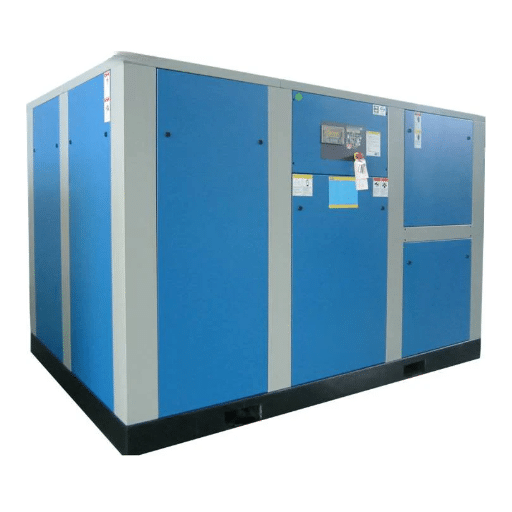
You bought a 50 HP compressor and your pressure still collapses during peak production. The maintenance team says the compressor is too small. Your supplier says it should be enough. The real problem is that neither of them sized the unit for how your factory actually uses air.
This is the most expensive mistake in compressed air procurement. Sizing by horsepower alone ignores the single metric that determines whether your system succeeds or fails: CFM. For fixed speed compressors, the error is even more damaging because the motor runs at constant RPM. It cannot throttle output to match a demand spike, and it cannot dial back when demand drops. Understanding fixed speed compressor sizing is not about buying the biggest unit you can afford. It is about matching a constant-speed machine to your real-world demand pattern.
Need the big picture first? Our complete fixed speed air compressor guide covers working principles, control systems, and the total cost of ownership.
Why Sizing Matters More for Fixed Speed Compressors
A fixed speed compressor runs its motor at full RPM whenever it is on. On a 60 Hz supply, that is 1,800 or 3,600 RPM. On 50 Hz, it is 1,500 or 3,000 RPM. The motor never slows down. It either runs at full speed or it stops.
This is the defining difference between fixed speed and variable speed drive (VSD) technology. A VSD compressor changes motor speed to match real-time demand. A fixed speed compressor keeps the motor at constant RPM and controls output by opening and closing the inlet valve. That means the compressor can only deliver full output, partial output through modulation, or no output at all through load/unload cycling.
When you oversize a fixed speed unit, it spends excessive time running unloaded. An unloaded rotary screw compressor still consumes 20% to 40% of its full-load power. When you undersize, the compressor cannot keep up during peak demand. Pressure collapses, tools lose torque, and production slows.
Real scenario: A machine shop in Dongguan bought a 50 HP fixed speed screw compressor because the old 30 HP piston unit “felt underpowered.” The new machine had plenty of horsepower, but its FAD at 115 PSI was only 160 CFM. The shop’s actual peak demand was 180 CFM. During morning startup, when three CNC machines, two sanders, and the paint booth all ran at once, system pressure dropped from 110 PSI to 82 PSI. Tools stalled. Operators complained. The maintenance manager eventually realized the problem was not horsepower. It was airflow.
Understanding how fixed speed output is controlled helps you size correctly. See our article on how fixed speed compressor load/unload control works before you buy.
The Four Numbers That Determine Compressor Size
Before you open a catalog, understand what each number means and which one matters most.
| Number | What It Means | Why It Matters |
|---|---|---|
| CFM | Cubic feet of air delivered per minute | The primary sizing metric. Your tools consume CFM. The compressor must deliver enough. |
| PSI | Pounds per square inch of pressure | Must meet the highest tool requirement plus system pressure drop. |
| HP | Motor horsepower | A byproduct of compressor design, not a sizing input. Two 50 HP compressors can deliver very different CFM. |
| FAD | Free Air Delivery | The actual volume of air the compressor delivers, measured at inlet conditions. This is the only rating you should trust. |
Manufacturers love to sell by horsepower because it is simple. Buyers love to buy by horsepower because it is familiar. Both parties are wrong. HP is an output of compressor design. CFM is the input your factory demands. Start with CFM and work backward to HP.
New to compressor sizing terminology? Our guide to general air compressor sizing principles explains the fundamentals before you dive into fixed-speed-specific rules.
Step 1: Inventory Your Air Consumers
Start with a list. Every tool, machine, actuator, blow gun, and process that uses compressed air belongs on it.
For each item, record:
- Tool name or description
- Rated CFM at operating pressure
- Typical duty cycle (percentage of time it runs during a shift)
CFM ratings are usually stamped on the tool or listed in the manufacturer’s manual. If you cannot find them, use standard values for common industrial equipment.
| Tool or Process | Typical CFM @ 90 PSI |
|---|---|
| Impact wrench (1/2 inch) | 4-5 |
| Angle grinder | 5-6 |
| Orbital sander | 8-12 |
| Spray gun (HVLP) | 10-15 |
| Air blow gun | 2-4 |
| Pneumatic cylinder (small) | 1-2 |
| Pneumatic cylinder (large) | 3-5 |
| CNC machine tool changer | 3-6 |
| Sandblasting nozzle | 15-25 |
| Air-jet loom | 0.8-1.2 per nozzle |
| Packaging line actuator | 2-4 |
Do not forget the hidden consumers. A typical industrial plant loses 20% to 30% of its compressed air to leaks before that air ever reaches a tool. Add a line item for leakage. If your plant has never done a leak survey, assume 25%.
Step 2: Apply the Simultaneous Use Factor

Here is where most buyers fail. They add every CFM value on the list and buy a compressor of that size. That approach assumes every tool in your plant runs at the same time, which rarely happens.
Instead, calculate what realistically runs during your peak production period. This is your simultaneous use factor, sometimes called a diversity factor.
| Number of Air Consumers Running Concurrently | Simultaneous Use Factor |
|---|---|
| 1-2 | 1.00 |
| 3-5 | 0.85 |
| 6-10 | 0.75 |
| 11+ | 0.65 |
Multiply the sum of your tool CFM ratings by the factor that matches your typical peak concurrency. Then multiply each tool by its duty cycle if the tool does not run continuously. A blow gun used for 10 minutes per hour has a 17% duty cycle.
Batch operations need special attention. If your packaging line runs all actuators simultaneously for 30 seconds every 5 minutes, that burst is your peak. Size for it, not the average.
Step 3: Add Safety Margin and Growth Reserve
Your simultaneous demand is the floor, not the ceiling. Add a safety margin of 25% to 50% to account for realities that never show up on a tool list.
| Buffer Component | Typical Allowance |
|---|---|
| Leakage (unrepaired plant) | 20-25% |
| Pressure drop across dryers, filters, piping | 5-10% |
| Future expansion or new equipment | 10-25% |
| Peak surge above normal concurrent use | 10-15% |
A 30% total safety margin is a reasonable starting point for most factories. That means: Adjusted Demand = Simultaneous Demand × 1.30.
For fixed speed compressors, this margin is especially important. A VSD unit can speed up to cover a brief surge. A fixed speed unit cannot. If your peak demand exceeds compressor capacity even briefly, pressure collapses. If your margin is too large, the unit runs unloaded too often. The sweet spot for fixed speed is typically a 25% to 35% margin.
Real scenario: A packaging plant in Zhejiang sized its fixed speed compressor by adding every tool in the facility. Total: 320 CFM. They bought a 75 HP unit rated for 330 CFM. The problem? Only three lines ran at once during peak, and the actual simultaneous need was 180 CFM. The compressor spent 60% of its runtime unloaded, consuming 30% of full-load power while producing no air. Annual wasted electricity: approximately $2,400 at local industrial rates. After a proper sizing study, they downsized to a 40 HP unit and added a 500-gallon receiver tank. Cycling frequency dropped. Energy bills fell 35%.
Step 4: Convert SCFM to Required FAD
Manufacturers publish CFM ratings in two forms, and the difference can cost you a compressor.
- SCFM (Standard CFM) is corrected to ideal lab conditions: sea level, 68°F, 0% humidity. It is useful for comparing compressors. It is not what you get on a hot summer day at 1,000 meters elevation.
- FAD (Free Air Delivery) is the actual volume the compressor delivers, measured at inlet conditions. This is what your pipes and tools see.
If you buy a compressor rated in SCFM and your site is hot or at altitude, you will be undersized. You must convert your demand into the required FAD using a derating factor.
| Site Condition | Approximate Derating Factor |
|---|---|
| Sea level, 20°C (68°F) | 1.00 |
| Sea level, 30°C (86°F) | 0.95 |
| 300m altitude, 35°C (95°F) | 0.91 |
| 400m altitude, 40°C (104°F) | 0.87 |
Formula: Required Nameplate FAD = Adjusted Demand (CFM) / Derating Factor
Example: Your adjusted demand is 200 CFM. Your plant is at 300m altitude with summer ambient temperatures of 35°C. The derating factor is 0.91.
Required FAD = 200 / 0.91 = 220 CFM
You need a compressor with a nameplate FAD of at least 220 CFM at your required discharge pressure. Not 200. Not the SCFM rating. The FAD at your pressure, at your site.
HP to CFM Reference Table for Fixed Speed Rotary Screw
Use this table as a starting point. Always verify the exact FAD at your required pressure with the manufacturer.
| Motor HP | Approx. FAD @ 7 bar (100 PSI) | Approx. FAD @ 8 bar (115 PSI) | Approx. FAD @ 10 bar (145 PSI) |
|---|---|---|---|
| 5 | 18-20 | 16-18 | 14-16 |
| 7.5 | 28-30 | 25-28 | 22-25 |
| 10 | 38-42 | 35-38 | 30-34 |
| 15 | 55-60 | 50-55 | 45-50 |
| 20 | 75-82 | 70-76 | 62-68 |
| 25 | 95-105 | 88-96 | 78-86 |
| 30 | 115-125 | 105-115 | 95-105 |
| 40 | 155-170 | 145-158 | 130-142 |
| 50 | 195-210 | 180-195 | 162-178 |
| 60 | 235-255 | 218-238 | 195-215 |
| 75 | 295-320 | 275-300 | 245-270 |
| 100 | 395-430 | 370-405 | 330-365 |
These values are typical for two-stage oil-injected rotary screw compressors with IE3 efficiency motors. Actual performance varies by airend design, motor class, and cooling configuration. Always request the CAGI performance data sheet.
Understanding inrush current is critical for electrical planning. See our fixed speed compressor electrical requirements for breaker sizing and starter selection.
Sizing the Receiver Tank With the Compressor

For fixed speed compressors, receiver tank size is not an afterthought. It is part of the sizing calculation.
A fixed speed unit switches between loaded and unloaded states. When demand is low, it unloads and the motor keeps spinning. When demand rises, it reloads. The receiver tank stores compressed air during the loaded phase and feeds the system during the unloaded phase. Without enough storage, the compressor cycles every few minutes. Short cycling destroys motor contactors, stresses bearings, and wastes energy.
Rule of thumb for fixed speed: 3 to 5 gallons of receiver tank capacity per CFM of compressor output.
| Compressor FAD | Minimum Tank Size | Recommended Tank Size |
|---|---|---|
| 50 CFM | 150 gallons | 250 gallons |
| 100 CFM | 300 gallons | 400-500 gallons |
| 200 CFM | 600 gallons | 800-1,000 gallons |
| 300 CFM | 900 gallons | 1,200-1,500 gallons |
VSD compressors can get away with 1 to 2 gallons per CFM because they modulate speed instead of cycling. Fixed speed units need more buffer.
For precise tank sizing with load/unload control, use the formula:
V = t × Qs × P1 / (P0 × delta P)
Where:
- V = tank volume in cubic feet
- t = desired cycle time in minutes (minimum 2 minutes for motors above 15 HP)
- Qs = compressor output in CFM
- P1 = cut-in pressure (absolute)
- P0 = atmospheric pressure (14.7 PSI)
- delta P = pressure band (cut-out minus cut-in)
The receiver tank size directly affects which control method works best. Learn how to calculate proper storage in our air receiver tank sizing guide.
Worked Examples: Three Factory Scenarios
Example 1: Small Machine Shop (15-20 HP Range)
A shop in Foshan runs two CNC machines, one sander, one spray booth, and general blow guns. Peak occurs when the CNC machines and the sander run together.
| Tool | CFM | Duty Cycle |
|---|---|---|
| CNC machine 1 | 5 | 100% |
| CNC machine 2 | 5 | 100% |
| Orbital sander | 10 | 80% |
| Spray gun | 12 | 50% |
| Blow guns (2) | 6 | 30% |
| Leak allowance | 8 | 100% |
Simultaneous peak: CNC 1 + CNC 2 + sander + one blow gun = 5 + 5 + 10 + 2 = 22 CFM base. With duty cycles applied: (5×1.0) + (5×1.0) + (10×0.8) + (6×0.3) + 8 = 5 + 5 + 8 + 1.8 + 8 = 27.8 CFM. Add 30% safety margin: 27.8 × 1.30 = 36.1 CFM. The site is at sea level, with a summer temperature of 30 °C. Derating factor 0.95. Required FAD = 36.1 / 0.95 = 38 CFM.
Recommended: 10 HP fixed speed rotary screw, ~40 CFM at 8 bar, with 120-gallon receiver tank.
Example 2: Medium Packaging Plant (30-50 HP Range)
A plant in Hangzhou runs four packaging lines with pneumatic actuators, conveyors, and label applicators. Peak hits when three lines run simultaneously during the morning shift.
| Equipment | CFM | Duty Cycle |
|---|---|---|
| Line 1 actuators | 8 | 60% |
| Line 2 actuators | 8 | 60% |
| Line 3 actuators | 8 | 60% |
| Line 4 actuators | 8 | 60% |
| Conveyors (4) | 12 | 100% |
| Label applicators (4) | 8 | 70% |
| Leak allowance | 15 | 100% |
Simultaneous peak (3 lines + all conveyors + 3 labelers): 24 + 12 + 6 + 15 = 57 CFM. With duty cycles: (24×0.6) + 12 + (6×0.7) + 15 = 14.4 + 12 + 4.2 + 15 = 45.6 CFM. Add 30% margin: 45.6 × 1.30 = 59.3 CFM. Site at 200m altitude, 32°C. Derating factor ~0.93. Required FAD = 59.3 / 0.93 = 63.8 CFM.
Recommended: 20 HP fixed speed rotary screw, ~75 CFM at 7 bar, with 300-gallon receiver tank.
Example 3: Large Textile Weaving Plant (75-100 HP Range)
A 24-hour weaving operation in Jiangsu runs 120 air-jet looms. Demand is continuous and predictable.
| Equipment | CFM | Duty Cycle |
|---|---|---|
| Air-jet looms (120) | 120 | 100% |
| Pneumatic doffers | 15 | 80% |
| Cleaning blow guns | 10 | 40% |
| Leak allowance | 35 | 100% |
Simultaneous peak (all looms + doffers + occasional blow gun): 120 + 15 + 10 + 35 = 180 CFM. With duty cycles: 120 + (15×0.8) + (10×0.4) + 35 = 120 + 12 + 4 + 35 = 171 CFM. Add 25% margin (demand is very stable): 171 × 1.25 = 213.8 CFM. Site at sea level, 28°C. Derating factor ~0.97. Required FAD = 213.8 / 0.97 = 220 CFM.
Recommended: 75 HP fixed speed rotary screw, ~295 CFM at 7 bar, with 1,000-gallon receiver tank. The unit runs loaded 95% of the time. Minimal cycling. Predictable maintenance.
Real scenario: This Jiangsu textile plant originally considered an 100 HP unit “to be safe.” After proper sizing, they chose 75 HP. The compressor runs at 75% load factor during normal operation and reaches 90% during peak. Because it rarely unloads, the motor contactor lasts years instead of months. Five-year maintenance costs run 30% below the industry average for comparable plants.
Fixed speed compressors have extensive applications in multiple industries. Please read our article on fixed speed compressor applications to learn more.
Common Sizing Mistakes (Fixed Speed Specific)

| Mistake | Why It Happens | The Cost |
|---|---|---|
| Sizing by HP instead of CFM | HP is familiar; CFM requires analysis | Undersizing or oversizing by 20-40% |
| Summing all tools without the simultaneous use factor | Fear of missing peak demand | Buying a compressor twice the necessary size |
| Ignoring leaks and pressure drop | Invisible losses are easy to forget | Pressure collapse during peaks; operators raise setpoints |
| Buying “one size up to be safe” | Conservative procurement mindset | Constant unloading, 20-40% wasted power, short cycling |
| Using SCFM without site derating | Manufacturer ratings look better in SCFM | Effective undersizing at altitude or high temperature |
| Undersizing the receiver tank | Tank treated as separate from compressor | Compressor cycles every 2-3 minutes; premature contactor failure |
| Sizing for average demand instead of peak | Budget pressure or poor data | Pressure drops during shift startup or batch cycles |
Oversizing is not safer. It is more expensive. A fixed speed compressor running unloaded 50% of the time is burning electricity for air it is not making. A properly sized unit running loaded 80% of the time is the goal.
Want to optimize your pressure settings? Our pressure band optimization guide walks through the exact adjustment procedure.
When to Size for Base Load in a Hybrid System
If your demand varies significantly, a pure fixed speed installation may not be optimal. The most energy-efficient architecture for many plants is a hybrid: fixed speed compressors handle the constant base load, and a VSD trim compressor handles variable demand above that floor.
In this architecture, sizing the fixed speed unit changes. You are no longer sizing for peak demand. You are sizing for the minimum sustained demand that occurs during normal production.
Rule of thumb: Size the fixed speed base unit for 60% to 70% of your peak demand. Size the VSD trim unit for the remaining 30% to 40% plus a 10% margin. The fixed speed unit should run at 90% to 100% load whenever it is on. The VSD handles all the variability.
This approach gives fixed speed compressors the one operating condition where they excel: constant, high load. It gives VSD the conditions where it excels: variable, partial load. Together, they typically outperform either technology alone.
Need a more detailed comparison? Please read our article on Fixed Speed Screw vs Piston.
Conclusion
Fixed speed compressor sizing follows a simple sequence: CFM first, simultaneous use second, safety margin third, FAD verification fourth. Get those four steps right and your compressor will run loaded most of the time, cycle at reasonable intervals, and never leave your line operators staring at a pressure gauge in the red.
Get them wrong and you will either waste thousands of dollars per year on unloaded power or watch your production grind to a halt during peak demand. The difference is not the compressor. It is the math you do before you buy.
If you are evaluating a new fixed speed compressor or suspect your current unit is the wrong size, Shandong Loyal Machinery can help. We build fixed-speed screw compressors from 5 HP to 100 HP with FAD ratings verified to CAGI standards. We will size the unit for your actual demand profile, not your horsepower guess.