
Fixed Speed Air Compressor: The Complete Industrial Buyer’s and Operator’s Guide
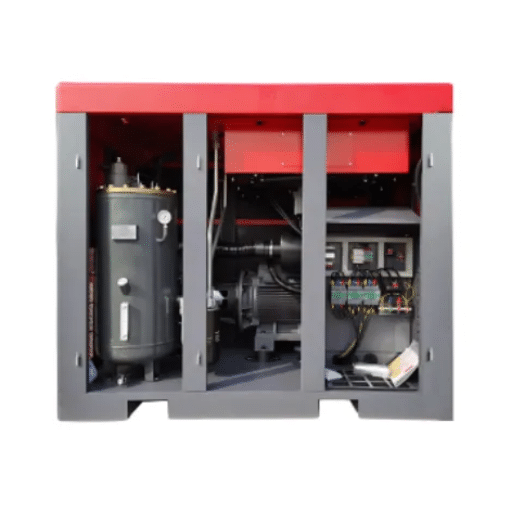
Most buyer’s guides treat fixed speed air compressors as the budget alternative to variable speed drive (VSD) — something you settle for when you cannot afford the premium option. That’s a mistake. For factories with steady, predictable air demand, a fixed speed compressor often delivers lower total cost of ownership, simpler maintenance, and more reliable operation over a 10-year lifecycle.
If you are evaluating a new compressed air system or trying to get more out of an existing fixed speed unit, this guide will give you exactly what you need. By the end, you will know how fixed speed compressors control air output, how to size the compressor and receiver tank for your demand, how to optimize pressure settings for energy savings, which industries benefit most from constant-speed operation, and how to maintain your system for maximum reliability. You will also see why fixed speed remains the dominant technology in industrial plants worldwide — and when it is genuinely the smarter engineering choice.
Want to see how fixed speed compares to VSD before you decide? Our VSD vs fixed speed comparison breaks down the real numbers side by side.
What Is a Fixed Speed Air Compressor?

A fixed speed air compressor is a compressor that runs at a constant motor speed — typically 1,800 or 3,600 RPM on a 60 Hz supply, or 1,500 / 3,000 RPM on a 50 Hz supply — regardless of how much compressed air the factory actually uses at any moment. When demand drops below the compressor’s full output, the machine does not slow down. Instead, it switches between a loaded state (producing air) and an unloaded state (running but not producing air) using an automatic control system.
This is the fundamental difference between a fixed speed air compressor and a variable speed unit. A VSD compressor slows the motor to match real-time demand. A fixed speed compressor keeps the motor at full RPM and manages output through inlet valve modulation or load/unload cycling. Both approaches can be efficient in the right environment. The question is which one fits your operating pattern.
Fixed speed technology is not a leftover from the past. It is the standard choice for continuous production lines, steady-shift factories, and any facility where air demand stays relatively flat during operating hours. The design is simpler, which means fewer electronic components to fail and easier field maintenance. For many industrial buyers, that simplicity translates directly into uptime.
If you want to learn more about content on Fixed Speed Compressors, please check out our article on How Fixed Speed Compressors Work.
How Fixed Speed Compressors Work: Load, Unload, and Modulation
Understanding the control cycle is essential for anyone who operates or specifies a fixed speed compressor. The machine’s efficiency and longevity depend heavily on how well the control system is configured.
The Load/Unload Control Cycle
Load/unload control is the most common method for rotary screw fixed speed compressors. Here is how the cycle works step by step:
- Production (loaded): The inlet valve is fully open. The compressor draws in air, compresses it through the screw element, and delivers it to the system at the target pressure.
- Target pressure reached: When system pressure rises to the cut-out setpoint — for example, 125 PSI — the pressure switch signals the inlet valve to close.
- Unloaded running: The motor keeps turning at full speed, but the compressor is no longer drawing in new air. The unit vents the internal pressure through a blowdown valve and enters an unloaded state.
- Pressure drops: As the factory consumes air, system pressure falls. When it reaches the cut-in setpoint — for example, 110 PSI — the inlet valve reopens and the compressor reloads.
The gap between cut-in and cut-out is called the pressure band. We will cover how to optimize this band for energy savings in a later section.
During unloaded operation, the motor still consumes power — typically 20% to 40% of full-load power, according to CAGI and DOE data. This is the main energy penalty of fixed speed operation. The shorter the unloaded periods, the better the efficiency.
Modulation Control: Inlet Valve Throttling
Some fixed speed units use modulation control instead of load/unload cycling. In this mode, the inlet valve partially closes to throttle intake air as demand drops. The compressor stays loaded continuously but produces less air. Modulation avoids the mechanical stress of frequent cycling, but it is less energy efficient than well-tuned load/unload control at low demand. Most industrial screw compressors default to load/unload and offer modulation as a secondary option.
Start/Stop and Dual Control
Smaller piston compressors and some screw units use start/stop control. The motor shuts off entirely when pressure reaches the cut-out point and restarts when pressure falls to the cut-in point. This eliminates unloaded power draw but causes high inrush current on each restart. For this reason, start/stop is limited to applications with long idle periods and relatively few cycles per hour.
Dual control, also called auto dual, lets the compressor switch between load/unload and start/stop automatically based on demand patterns. After a set time in unload, the machine stops the motor rather than continuing to run unloaded. This is useful for factories with intermittent demand.
Key Components in the Control System
| Component | Function |
|---|---|
| Pressure switch | Monitors system pressure and triggers load/unload transitions |
| Inlet valve | Opens for loading, closes (fully or partially) for unloading or modulation |
| Blowdown valve | Vents trapped pressure from the compressor element during unload |
| Minimum pressure valve | Maintains minimum internal pressure for lubrication and seal function |
| Controller/timer | Manages dual control timing and optional sequencing in multi-compressor setups |
Fixed Speed vs Variable Speed: When Fixed Speed Is the Right Choice
The honest answer is that both technologies have a place. The wrong choice is assuming VSD is always better.
When Fixed Speed Wins
Fixed speed compressors are the better engineering choice when:
- Air demand is steady and predictable. If your factory consumes roughly the same CFM across every shift, a fixed speed unit running at full load most of the time will match or beat a VSD on efficiency.
- Upfront capital cost matters. Fixed speed units cost less to purchase and install. For small and medium factories, that capital difference can be significant.
- Maintenance simplicity is a priority. Fixed speed machines have no variable frequency drive (VFD) electronics, no complex motor insulation requirements, and fewer failure points. Your maintenance team can service most issues with standard tools.
- You run a base-load hybrid system. In multi-compressor installations, fixed speed units often serve as the base-load workhorses while a single VSD handles trim demand. We will explain this strategy later.
Real scenario: Chen runs a 24-hour textile weaving plant in Jiangsu Province. Air demand stays within 10% of his 75 HP compressor’s rated output around the clock. He originally considered a VSD but ran the numbers and found that his fixed speed unit would operate at 95% load factor — meaning almost no unloaded running. The VSD’s part-load efficiency advantage would never materialize, and the higher purchase price would extend his payback period beyond eight years.
When VSD Wins
Variable speed is the right choice when demand fluctuates significantly — for example, a workshop with multiple shifts of varying intensity, or a facility where air use drops by 50% or more during breaks and changeovers. VSD also wins when you need tight pressure control (within 1-2 PSI) or when you are expanding and cannot accurately predict future demand.
The Hybrid Solution: Fixed Speed Base + VSD Trim
Many modern plants run a hybrid system. Two or three fixed speed compressors cover the constant baseline demand, and one VSD unit trims the peaks and valleys. This gives you the capital efficiency and simplicity of fixed speed for the bulk of your operation, plus the flexibility of VSD for variation. The fixed speed units handle the hours; the VSD handles the variability.
If you are still weighing this decision, our factory air compressor selection guide walks through the full decision framework from demand analysis to final specification.
Specifications and Sizing Guide for Fixed Speed Compressors
Sizing a fixed speed compressor starts with two numbers: required airflow (CFM) and required pressure (PSI). Everything else flows from there.
CFM, PSI, and HP: What Matters Most
- CFM (cubic feet per minute): The volume of air your equipment needs. Add up the CFM requirements of all tools and processes that run simultaneously, then apply a safety margin.
- PSI (pounds per square inch): The pressure required by your highest-demand application. Most industrial systems operate at 90 to 125 PSI.
- HP (horsepower): The motor size needed to deliver your CFM at your PSI. This is an output of the calculation, not an input.
If you are new to these terms, our article on understanding CFM, PSI, and horsepower explains the relationship in detail.
Fixed-Speed-Sizing Reference Table
This table shows typical rotary screw fixed speed compressor outputs. Always confirm exact ratings with the manufacturer’s datasheet.
| Motor HP | Approx. CFM at 90 PSI | Approx. CFM at 125 PSI | Typical Application |
|---|---|---|---|
| 10 HP | 35-40 CFM | 30-35 CFM | Small workshops, auto repair |
| 20 HP | 80-90 CFM | 70-80 CFM | Mid-size machine shops |
| 30 HP | 120-135 CFM | 105-120 CFM | Small factories, packaging |
| 50 HP | 200-220 CFM | 180-200 CFM | Medium manufacturing |
| 75 HP | 300-330 CFM | 270-300 CFM | Large production lines |
| 100 HP | 400-450 CFM | 360-400 CFM | Heavy industry, continuous duty |
The 30% Safety Margin Rule
Calculate your peak simultaneous demand, then multiply by 1.3. This safety margin accounts for leaks, future expansion, and the fact that compressors lose output slightly as filters load and ambient temperatures rise. A fixed speed unit sized exactly at peak demand with no margin will run constantly loaded and leave no room for growth.
Sizing Examples
Small shop: Four technicians with air tools running simultaneously = ~28 CFM peak demand. 28 x 1.3 = 36.4 CFM. A 10 HP fixed speed unit at 90 PSI fits comfortably.
Medium factory: Automated packaging line + pneumatic conveyors = ~150 CFM peak. 150 x 1.3 = 195 CFM. A 50 HP unit at 125 PSI provides adequate capacity with room for a second shift.
Need help sizing your system correctly? Our fixed speed compressor sizing methodology walks through demand calculations and safety margins.
Air Receiver Tank Sizing: Why Storage Is Critical for Fixed Speed Units
The receiver tank is not just a storage vessel. For a fixed speed compressor, it is a buffer that reduces cycling frequency, stabilizes pressure, and protects the motor from excessive start/stop wear.
The Cycling Problem
Without enough storage, a fixed speed compressor will cycle rapidly — loading and unloading every few minutes. Frequent cycling causes thermal stress on the motor, wears the inlet valve and pressure switch, and wastes energy during transitions. A properly sized tank stretches out the cycle intervals, letting the compressor run longer loaded periods and longer rest periods.
The Sizing Formula
For load/unload control, the minimum recommended receiver tank volume is:
V = t x Q x Pa / (P1 - P2)Where:
- V = tank volume in gallons (or liters)
- t = desired loaded time in minutes (typically 1-2 minutes minimum)
- Q = compressor output in CFM
- Pa = atmospheric pressure (14.5 PSI at sea level)
- P1 = cut-out pressure (PSI)
- P2 = cut-in pressure (PSI)
Rule of Thumb
If you prefer a quick reference, industry guidance from VMAC and FS-Curtis suggests:
| Compressor Output | Minimum Receiver Tank |
|---|---|
| Up to 25 CFM | 80-120 gallons |
| 25-50 CFM | 120-240 gallons |
| 50-100 CFM | 240-400 gallons |
| 100-200 CFM | 400-800 gallons |
| 200+ CFM | 800+ gallons or multiple tanks |
Worked Example
A 50 HP fixed speed compressor delivers 200 CFM at 125 PSI. The system is set to cut out at 125 PSI and cut in at 110 PSI. The factory wants at least 90 seconds of loaded time per cycle.
V = 1.5 min x 200 CFM x 14.5 PSI / (125 - 110)
V = 4,350 / 15
V = 290 gallons minimum
In practice, this factory would install a 300-400 gallon tank for margin. Undersizing to 120 gallons would cause the compressor to cycle every 30-40 seconds — hard on the equipment and inefficient.
The receiver tank size directly affects which control method works best. Learn how to calculate proper storage in our air receiver tank sizing guide.
Pressure Band Optimization: Setting Cut-In and Cut-Out Pressures
The pressure band on a fixed speed compressor is one of the most overlooked optimization levers in a compressed air system. A narrow, poorly positioned band wastes energy and accelerates wear. A properly tuned band saves money and extends equipment life.
The 7% Rule
Industry data from Atlas Copco and the Compressed Air Challenge show that every 1 bar (14.5 PSI) reduction in system pressure saves approximately 7% in energy consumption. For a 100 HP compressor running 6,000 hours per year, dropping average system pressure by 10 PSI can save over $800 annually at typical industrial electricity rates.
Similarly, every 2 PSI reduction saves approximately 1% in energy. Small adjustments add up.
Step-by-Step Adjustment Procedure
- Identify your minimum required pressure. Check the nameplate or manual of every tool and process on the line. The highest minimum pressure is your floor.
- Set cut-in 10-15 PSI above that minimum. This gives you a safety margin against pressure drops in dryers, filters, and piping.
- Set the pressure band width. For load/unload control, a band of 10-15 PSI is typical. Narrower bands (8-10 PSI) give tighter pressure control but cause more frequent cycling. Wider bands (15-20 PSI) reduce cycling but create larger pressure swings.
- Record cycle timing. After adjustment, time how long the compressor runs loaded and how long it runs unloaded. Loaded time should be at least 60-90 seconds; unloaded time should be at least 30-60 seconds. If not, increase receiver tank volume or widen the band.
- Check downstream equipment. Verify that no process suffers from the new minimum pressure.
Trade-Offs: Narrow vs Wide Bands
| Band Width | Pros | Cons |
|---|---|---|
| Narrow (8-10 PSI) | Tighter pressure control; better for sensitive equipment | More frequent cycling; higher wear |
| Standard (12-15 PSI) | Good balance for most factories | Moderate cycling |
| Wide (18-25 PSI) | Fewest cycles; lowest wear | Larger pressure swings; some processes may need regulation |
Want to optimize your pressure settings? Our pressure band optimization guide walks through the exact adjustment procedure.
Key Applications and Industries for Fixed Speed Compressors
Fixed speed compressors excel wherever air demand is continuous and relatively constant. Here is how that maps to real industries.
Automotive Manufacturing
Assembly lines, pneumatic robots, and paint booths often run on fixed schedules with steady air consumption. A fixed speed base-load compressor keeps the line pressurized predictably without the control complexity of VSD.
Food and Beverage Packaging
Bottle filling, capping, labeling, and conveying typically operate at constant speed during production hours. Fixed speed units deliver the stable, clean air these processes need — especially when paired with proper filtration and drying.
Textile Production
Weaving, spinning, and finishing operations use compressed air continuously for jet looms and material handling. The 24/7 nature of textile manufacturing makes fixed speed an economical choice.
Mining and Construction
Drilling, breaking, and material processing in mining often run in long, uninterrupted shifts. Fixed speed screw compressors handle the heavy-duty, high-CFM demands reliably in dusty, rugged environments.
General Manufacturing
Machine shops with steady CNC operations, injection molding plants with consistent cycle times, and metal fabrication facilities with continuous welding and cutting all fit the fixed speed profile.
When NOT to Use Fixed Speed
Avoid fixed speed as your only compressor if your demand fluctuates by more than 30% during normal operations, if you run frequent batch processes with long idle periods between cycles, or if your application requires pressure stability within 2 PSI. In these cases, VSD or a hybrid system is the better investment.
Fixed speed compressors have extensive applications in multiple industries. Please read our article on fixed speed compressor applications to learn more.
Fixed Speed Compressor Maintenance and Reliability
Fixed speed compressors are simpler than VSD units, but they are not maintenance-free. A disciplined schedule prevents the downtime that destroys production schedules.
Daily Checks
- Check oil level and top up if needed
- Inspect for audible leaks around fittings and hoses
- Monitor discharge temperature and pressure gauges
- Drain moisture from the receiver tank and air dryer
Weekly Checks
- Inspect air filter condition; clean or replace if dirty
- Check belt tension and alignment on belt-driven units
- Verify cooler cleanliness; blow out dust and debris
- Log running hours and note any unusual cycling patterns
Monthly and Quarterly Tasks
- Replace air and oil filters per manufacturer intervals
- Take oil samples and check for contamination
- Inspect the inlet valve and blowdown valve for carbon buildup
- Tighten electrical connections and inspect contactors
Oil Change Intervals
| Oil Type | Typical Change Interval |
|---|---|
| Mineral oil | 2,000-4,000 hours |
| Synthetic oil | 6,000-8,000 hours |
| Food-grade oil | Follow manufacturer specification strictly |
Cycling Wear: What to Monitor
Because fixed speed units cycle between load and unload, certain components wear faster than on continuous-load or VSD systems. Pay special attention to:
- Inlet valve: Carbon and oil varnish can cause sticking
- Pressure switch: Mechanical contacts degrade over thousands of cycles
- Motor contactors: Inrush current at each start stresses contacts
- Blowdown valve: Must seal completely; a leaking valve causes constant reloading
Expected 5-Year Maintenance Costs
For a 50 HP fixed speed rotary screw compressor running 4,000 hours per year, budget approximately 2,500 to 4,000 annually for consumables, filters, oil, and minor repairs. Major overhauls (air end rebuild, motor bearing replacement) typically occur after 30,000 to 50,000 hours with proper care. Quality rotary screw units last 10+ years in normal industrial environments.
Maintenance is essential for compressors, and if you want to learn more, please check out our article on Fixed Speed Compressor Maintenance.
Energy Efficiency for Fixed Speed Compressors

A fixed speed compressor can be efficient — but only if the system around it is optimized. Here is a four-step audit you can run today.
Audit Step 1: Leak Detection and Repair
Leaks are the silent killer of compressed air efficiency. The Compressed Air Challenge estimates that undetected leaks waste 20% to 30% of total compressed air output in a typical plant. A 1/8-inch leak at 100 PSI costs approximately $1,200 per year in wasted energy. Walk the line with an ultrasonic leak detector during a quiet shift, tag every leak, and repair them systematically.
Audit Step 2: Pressure Reduction
Measure the pressure at the compressor discharge and at the point of use. If there is a large gap, your piping or filtration is creating excessive pressure drop. More importantly, review whether your compressor is set higher than necessary. Every 2 PSI reduction saves roughly 1% in energy. If your tools only need 90 PSI but your compressor cuts out at 110 PSI, you are paying for pressure you do not need.
Audit Step 3: Receiver Tank Optimization
If your compressor cycles more than once every 3-4 minutes, your receiver tank is likely undersized. Increasing storage reduces unloaded running time and lets the compressor run longer, more efficient loaded cycles. It also absorbs demand spikes without forcing the compressor into immediate reload.
Audit Step 4: Load/Unload Timing Adjustments
If your fixed speed unit spends more than 30% of its runtime unloaded, your compressor is oversized for your demand. Options include:
- Installing a smaller trim compressor and shifting the fixed speed unit to base load
- Adjusting the dual control timer to stop the motor after a shorter unload period
- Adding a sequencer to coordinate multiple compressors more intelligently
When Optimization Is Enough vs When to Upgrade to VSD
If your fixed speed compressor runs unloaded less than 20% of the time, optimization will give you the best return. If unloaded time exceeds 40% consistently, a VSD or hybrid system deserves serious consideration. The break-even point depends on your electricity rate, operating hours, and capital budget. For many plants, the answer is not replacing the fixed speed unit — it is adding a smaller VSD to handle the variation.
Looking for more ways to cut energy costs? Our fixed speed compressor energy efficiency strategies cover leak detection, heat recovery, and multi-compressor sequencing.
Electrical Requirements and Installation
Fixed speed compressors draw significant inrush current on startup. Electrical planning is not an afterthought — it is a safety and reliability requirement. Need a more detailed comparison? Please read our article on Fixed Speed Screw vs Piston.
Direct-On-Line Starting and Inrush Current
A direct-on-line (DOL) start sends full voltage to the motor instantly. This produces an inrush current 6 to 8 times the motor’s full-load amperage. A 100 HP motor with a full-load current of approximately 120 amps can draw 700 to 900 amps for a few milliseconds at startup. Your electrical supply, breaker, and wiring must be sized for this inrush, not just the running load.
Star-Delta and Soft Starter Options
To reduce inrush stress, many fixed speed compressors above 15 HP use star-delta starters or electronic soft starters. A star-delta starter reduces inrush to roughly 2-3 times full-load current by starting the motor in a lower-voltage configuration and switching to full voltage after a brief delay. Electronic soft starters offer even smoother ramp-up with programmable acceleration curves. Understanding inrush current is critical for electrical planning. See our fixed speed compressor electrical requirements for breaker sizing and starter selection.
Wiring and Breaker Sizing by HP
Always follow local electrical codes and the compressor manufacturer’s installation manual. As a general reference for three-phase 460V industrial supply:
| Motor HP | Full-Load Amps (approx.) | Minimum Breaker Size (approx.) |
|---|---|---|
| 10 HP | 14 A | 30-35 A |
| 20 HP | 27 A | 60-70 A |
| 30 HP | 40 A | 90-100 A |
| 50 HP | 65 A | 150-175 A |
| 75 HP | 96 A | 225-250 A |
| 100 HP | 124 A | 300-350 A |
Single-Phase vs Three-Phase
Single-phase fixed speed compressors are generally limited to 5-10 HP because of the high starting current and torque pulsation on single-phase supplies. For 15 HP and above, three-phase power is standard. It delivers smoother motor operation, lower current per phase, and better efficiency. If your facility only has single-phase service, consult an electrician before specifying anything above 7.5 HP.
Shandong Loyal Machinery supplies fixed speed screw compressors with motor and starter configurations tailored to regional voltage and regulatory requirements, including 380V/50Hz for export markets and 460V/60Hz for North American installations.
For plants considering hybrid setups, our guide on multi-compressor base load strategy explains how to pair fixed-speed base units with VSD trim compressors.
Fixed Speed Compressor Cost and Total Cost of Ownership
The purchase price is only the beginning. To make a sound business decision, you need to look at the full lifecycle cost.
Purchase Price Ranges by HP
Prices vary by region, brand, and features, but as a general guide for industrial-quality rotary screw fixed speed compressors:
| Motor HP | Approximate Price Range (USD) |
|---|---|
| 10 HP | 3,000−5,000 |
| 20 HP | 5,000−8,000 |
| 30 HP | 7,000−12,000 |
| 50 HP | 12,000−20,000 |
| 75 HP | 18,000−30,000 |
| 100 HP | 25,000−45,000 |
Operating Costs: Energy + Maintenance
Energy represents roughly 76% of a compressor’s lifetime cost. For a 50 HP fixed speed compressor running 4,000 hours per year at $0.10 per kWh, the annual electricity cost is approximately $15,000. Add $3,000 per year for maintenance and consumables, and the 5-year operating cost reaches $90,000 — far more than the purchase price.
5-Year TCO Comparison: Fixed Speed vs VSD
Consider a 50 HP compressor running 4,000 hours per year with a load factor of 80% (fairly typical for a well-matched fixed speed unit):
| Cost Category | Fixed Speed | VSD |
|---|---|---|
| Purchase + installation | $16,000 | $24,000 |
| 5-year energy | $75,000 | $68,000 |
| 5-year maintenance | $15,000 | $17,000 |
| 5-year TCO | $106,000 | $109,000 |
In this scenario, the fixed speed unit actually has a lower 5-year TCO because the high load factor minimizes the VSD’s energy advantage. If the load factor were 50%, the VSD would win decisively.
The Break-Even Hours Calculation
To decide between fixed speed and VSD, estimate your annual operating hours and average load factor. Then calculate whether the VSD’s energy savings justify the higher upfront cost. As a rule of thumb, VSD payback is strongest when:
- Operating hours exceed 3,000 per year
- Average load factor is below 70%
- Electricity rates are above $0.10 per kWh
If your numbers do not meet these thresholds, fixed speed is likely the more economical choice. For a deeper comparison, see our full screw vs piston comparison — the same TCO thinking applies.
DOE 2025 Efficiency Standards for Fixed Speed Compressors

If you are buying a fixed speed compressor in 2025 or beyond, you need to understand the U. S. Department of Energy efficiency regulations that took effect in January 2025.
What Changed in January 2025
The DOE established mandatory minimum efficiency standards for air compressors sold in the United States. These standards use isentropic efficiency as the performance metric — a measure of how effectively the compressor converts electrical energy into compressed air energy, accounting for thermodynamic losses.
Isentropic Efficiency Requirements
For fixed speed rotary screw compressors, the minimum isentropic efficiency varies by motor horsepower:
- Small units (under 50 HP): Minimum efficiency floor of approximately 53-60%
- Large units (200+ HP): Minimum efficiency floor of approximately 70-75%
Fixed speed units are tested and rated at 100% full load only. Unlike VSD units, which are rated using a part-load weighted average, fixed speed efficiency is straightforward: the number on the CAGI datasheet tells you how efficient the machine is when fully loaded.
How to Read a CAGI Data Sheet
The Compressed Air and Gas Institute (CAGI) provides standardized datasheets for compliant compressors. Look for:
- Full-load isentropic efficiency: Higher is better
- Specific power: kW per 100 CFM; lower is better
- Actual CFM at stated pressure: Verify this matches your application
Compliance Checklist for Buyers
- Request the CAGI datasheet from your supplier
- Verify the unit meets or exceeds DOE 2025 minimums for its horsepower class
- Compare specific power across brands; a 5% difference in efficiency translates to thousands of dollars over the machine’s life
- Ask whether the compressor is certified for your regional standards (DOE for North America, similar regulations may apply in the EU and other markets)
Frequently Asked Questions
How does a fixed speed compressor work?
A fixed speed compressor runs its motor at a constant RPM. When air demand is high, the inlet valve opens fully and the unit produces compressed air (loaded). When system pressure reaches the cut-out setpoint, the inlet valve closes and the motor runs unloaded until pressure drops to the cut-in setpoint. The unit never slows down — it controls output by cycling between loaded and unloaded states.
How much power does a fixed speed compressor use when unloaded?
Unloaded power consumption typically ranges from 20% to 40% of full-load power for rotary screw compressors. The exact percentage depends on the air end design, motor efficiency, and control system. This is why minimizing unloaded runtime is critical for energy efficiency.
What size receiver tank do I need for a fixed speed compressor?
As a rule of thumb, plan for 1 to 2 gallons of receiver tank capacity per CFM of compressor output. For precise sizing, use the formula V = t x Q x Pa / (P1 – P2), where t is the desired loaded time in minutes, Q is the compressor CFM, Pa is the atmospheric pressure, and P1 minus P2 is the pressure band width.
When is fixed speed better than VSD?
Fixed speed is better when your air demand is steady and predictable (load factor above 70-80%), when upfront capital cost is a constraint, when you prefer simpler maintenance, or when the compressor serves as base load in a hybrid system. VSD is better for highly variable demand or when precise pressure control is essential.
Conclusion
A fixed speed air compressor is not a compromise — it is a deliberate, often superior engineering choice for the right application. When your factory runs steady shifts, when your demand curve stays flat, and when you value simplicity and reliability over electronic flexibility, fixed speed delivers lower total cost of ownership and easier long-term maintenance.
The key is matching the machine to the job. Size your compressor and receiver tank correctly. Tune your pressure band for energy savings. Run a disciplined maintenance schedule. And know when to combine fixed speed base load with VSD trim for the best of both worlds.
Here is what to remember:
- Fixed speed compressors control output through load/unload cycling, not motor speed variation
- Proper receiver tank sizing prevents destructive short cycling
- Every 1 bar of pressure reduction saves roughly 7% energy
- Fixed speed wins on steady demand; VSD wins on variable demand
- A hybrid base-load strategy often outperforms either technology alone
- Maintenance is simpler than VSD, but cycling wear must be monitored
If you are evaluating a new compressed air system and want guidance tailored to your production environment, contact Shandong Loyal Machinery. We build fixed-speed screw compressors for industrial applications worldwide, with configurations matched to your voltage, pressure, and duty requirements.