
Fixed Speed Screw vs Piston Compressor: When to Upgrade for Continuous Duty
If your factory runs a piston compressor for two or more shifts per day, you have probably already paid for a fixed speed screw compressor; you just do not own it yet. The extra cost shows up in your energy bills, valve replacements, overheating shutdowns, and lost production hours. For buyers comparing a fixed speed screw vs. a piston compressor, the real question is rarely about purchase price. It is about duty cycle, efficiency, and total cost of ownership over five or ten years.
This guide compares fixed speed screw and piston compressors specifically for factories and industrial applications. By the end, you will understand how each technology works, which one wins on continuous-duty performance, what a true 5-year cost comparison looks like, and the exact operating hours where upgrading from piston to fixed speed screw pays for itself.
What Is a Fixed Speed Screw Compressor?

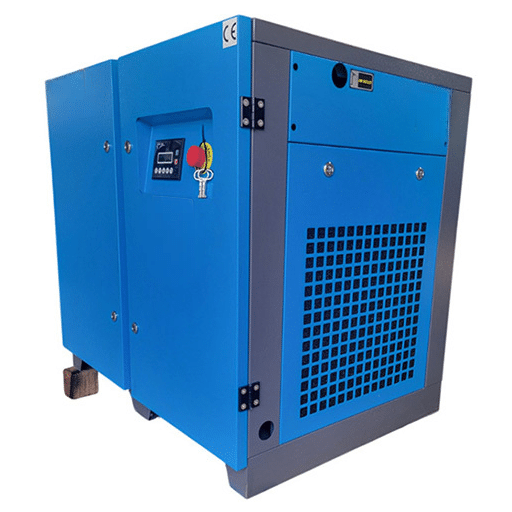
A fixed speed screw compressor is a rotary screw air compressor that runs at a constant motor speed. It produces compressed air by trapping air between two meshing rotors and reducing the volume as the air travels through the compression chamber. The result is a continuous, pulse-free flow of compressed air at a stable pressure.
The term “fixed speed” is important. It distinguishes this type from a variable speed drive (VSD) screw compressor, which adjusts motor speed to match real-time air demand. A fixed speed unit delivers a consistent volume of air and controls output through load/unload cycling. When tank pressure reaches the upper setpoint, the compressor unloads and vents internally while the motor keeps running. When pressure drops, it reloads and resumes compression.
Fixed speed screw compressors are the standard choice for operations with steady, predictable air demand. They are simpler than VSD units, have a lower initial cost, and are easier to maintain. For factories that need reliable compressed air across one or two shifts, a fixed speed screw compressor is often the most cost-effective starting point. For a deeper foundation, see our complete industrial guide to fixed speed air compressors.
How Piston and Fixed Speed Screw Compressors Differ
The mechanical difference between these two technologies explains almost every performance gap that matters in production. If you want to learn more about content on Fixed Speed Compressors, please check out our article on How Fixed Speed Compressors Work.
Compression Method: Rotary vs Reciprocating
The core distinction in any fixed speed rotary screw vs reciprocating compressor comparison is the compression mechanism. A piston compressor uses a reciprocating piston driven by a crankshaft. Air is drawn into a cylinder, compressed by the piston, and discharged in pulses. This on/off compression cycle creates pressure fluctuations and vibration.
A fixed speed screw compressor uses two interlocking helical rotors. Air enters at the suction port, is trapped in the rotor grooves, and is squeezed continuously toward the discharge port. There is no pulsation because compression happens steadily as the rotors turn.
Airflow: Continuous and Pulse-Free vs Pulsating
Piston compressors deliver air in surges. A receiver tank is required to smooth the pulses before air reaches downstream equipment. Screw compressors produce a near-steady stream of air, which is easier on filters, dryers, and pneumatic tools.
Duty Cycle: 100% Continuous vs 50-70% Intermittent
This is the most important distinction for industrial buyers comparing a screw vs. a piston compressor for continuous duty. Piston compressors are typically rated for a 50-70% duty cycle, meaning they need cool-down periods between cycles. Running a piston compressor continuously leads to overheating, accelerated wear, and premature failure. Fixed speed screw compressors are designed for 100% continuous duty, making them the default choice for multi-shift factories.
Operating Temperature and Air Quality
Screw compression generates less heat per unit of air delivered. Lower operating temperatures reduce moisture carryover and extend lubricant life. Piston compressors run hotter, which increases the load on aftercoolers and dryers and can increase oil vapor in the air stream.
Fixed Speed Screw vs Piston Compressor: Head-to-Head Comparison
The table below summarizes how the two technologies compare across the factors that drive buying decisions in continuous-duty environments. This direct fixed speed screw compressor vs piston comparison focuses on the specifications that matter most for factories running one, two, or three shifts.
| Factor | Fixed Speed Screw Compressor | Piston Compressor |
|---|---|---|
| Compression method | Rotary screws | Reciprocating piston |
| Duty cycle | 100% continuous | 50-70% intermittent |
| Airflow pattern | Continuous, pulse-free | Pulsating |
| Specific power | 15-18 kW per 100 CFM | 20-25 kW per 100 CFM |
| Energy efficiency at full load | 20-30% more efficient | Lower efficiency |
| Noise level | 55-65 dB(A) enclosed | 70-90 dB(A) |
| Maintenance intervals | 2,000-4,000 hours | 500-1,000 hours |
| Expected service life | 60,000-100,000 hours | 10,000-20,000 hours |
| Upfront cost (15 HP example) | $8,000-14,000 | $2,000-5,000 |
| Best use case | Continuous/multi-shift duty | Intermittent, small-scale use |
The numbers make the trade-off clear. A piston compressor costs less to buy but costs more per hour to run and maintain. A fixed speed screw compressor demands a higher initial investment but returns that investment through lower energy consumption, fewer repairs, and longer service life. These ranges are consistent with published comparisons from Atlas Copco and other industrial compressor manufacturers.
Want a tailored recommendation for your factory? Contact our team for a free compressed air system review based on your actual operating hours and demand profile.
Fixed Speed Screw vs Piston Compressor Energy Efficiency and Operating Costs

Energy represents 70-80% of a compressor’s total lifecycle cost, according to industry TCO analysis from the Compressed Air Challenge. That is why efficiency dominates the fixed speed screw vs piston compressor decision, and why the energy section of any piston vs fixed speed screw compressor energy efficiency analysis deserves close attention.
Specific Power: kW per 100 CFM
Specific power measures how much electrical input is needed to deliver a given airflow. A lower number means better efficiency. Fixed speed screw compressors typically consume 15-18 kW per 100 CFM, while piston compressors consume 20-25 kW per 100 CFM. Over thousands of operating hours, that gap becomes the largest single cost difference between the two technologies.
Annual Energy Cost Comparison
Assume a 15 HP compressor running at full load, 2,500 hours per year, with electricity at $0.12 per kWh:
- Piston compressor (22 kW input, 90 CFM): ~$6,600/year
- Fixed speed screw compressor (17 kW input, 90 CFM): ~$5,100/year
The fixed speed screw saves approximately $1,500 per year in energy alone at this usage level. At 4,000 hours per year, the annual savings grow to roughly $2,400.
The Part-Load Penalty on Fixed Speed Units
Fixed speed screw compressors are most efficient at full load. When air demand drops, the motor keeps running and the unit cycles between load and unload. During unload, a fixed speed screw can still consume 20-40% of full-load power. This is why receiver tank sizing and pressure band tuning matter. A larger tank reduces cycling frequency and helps the system stay in load longer.
When Variable Demand Changes the Math
If your demand swings significantly during the day, a VSD screw compressor may outperform a fixed speed screw. VSD units adjust motor speed to match demand, eliminating the unload penalty. The choice between fixed speed screw and VSD depends on your load profile, not just your total hours. For steady loads, fixed speed is usually the more economical choice.
Total Cost of Ownership: 5-Year Breakdown
The upfront price gap between piston and fixed speed screw compressors can feel large. The 5-year numbers usually tell a different story.
Consider a 15 HP system used in a small to mid-sized factory. The tables below compare ownership costs at three common operating levels.
5-Year TCO at 1,000 Hours/Year
| Cost Category | Piston Compressor | Fixed Speed Screw Compressor |
|---|---|---|
| Upfront equipment | $3,500 | $11,000 |
| Installation | $500 | $800 |
| Energy (5 years) | $13,200 | $10,200 |
| Maintenance (5 years) | $4,000 | $2,500 |
| Repairs / downtime risk | $2,000 | $800 |
| 5-year total | $23,200 | $25,300 |
At only 1,000 hours per year, the piston compressor is still cheaper over five years. The upgrade premium for a fixed speed screw has not yet been paid back.
5-Year TCO at 2,500 Hours/Year
| Cost Category | Piston Compressor | Fixed Speed Screw Compressor |
|---|---|---|
| Upfront equipment | $3,500 | $11,000 |
| Installation | $500 | $800 |
| Energy (5 years) | $33,000 | $25,500 |
| Maintenance (5 years) | $7,500 | $4,000 |
| Repairs / downtime risk | $5,000 | $1,500 |
| 5-year total | $49,500 | $42,800 |
At 2,500 hours per year, the fixed speed screw compressor becomes the lower-cost option over five years. The upgrade premium pays back well before year five.
5-Year TCO at 4,000 Hours/Year
| Cost Category | Piston Compressor | Fixed Speed Screw Compressor |
|---|---|---|
| Upfront equipment | $3,500 | $11,000 |
| Installation | $500 | $800 |
| Energy (5 years) | $52,800 | $40,800 |
| Maintenance (5 years) | $10,000 | $5,500 |
| Repairs / downtime risk | $8,000 | $2,000 |
| 5-year total | $74,800 | $60,100 |
At 4,000 hours per year, the fixed speed screw compressor saves roughly $14,700 over five years. In continuous-duty applications, the financial advantage becomes decisive.
Break-Even Analysis: When Does the Upgrade Pay Off?
Using the assumptions above, the break-even point for upgrading from a 15 HP piston compressor to a 15 HP fixed speed screw compressor falls between 1,500 and 2,000 operating hours per year. Factories running two shifts or more typically exceed this threshold and begin generating positive returns by year two or three.
Mini-story: The $18,000 upgrade that paid for itself in 16 months
A plastic packaging factory in Vietnam ran two 15 HP piston compressors on alternating shifts to keep up with demand. Valve failures occurred every six to eight months, costing $1,200 per repair plus half a day of lost output. The plant replaced both units with one 30 HP fixed speed screw compressor. Energy savings averaged $420 per month, maintenance dropped to $600 per year, and unplanned downtime fell by 90%. The $18,000 upgrade premium paid back in 16 months.
This example reflects a common pattern: once operating hours and maintenance costs are included, the apparent price gap closes quickly.
Maintenance: What Each Technology Actually Costs

Maintenance frequency is another area where the two technologies diverge sharply.
Piston Compressor Maintenance Schedule
Piston compressors have many wearing parts: piston rings, valves, gaskets, bearings, and crankshaft components. Typical service intervals are 500-1,000 hours. Valve failures are common in continuous-duty use. Maintenance tasks include:
- Checking and replacing valves and rings
- Tightening belts and fasteners
- Monitoring oil level and changing lubricant
- Inspecting air filters and coolers
- Addressing vibration-related loosening
Fixed Speed Screw Compressor Maintenance Schedule
Screw compressors have fewer wearing parts. The rotors do not touch, so there is no piston ring or valve wear. Typical service intervals are 2,000-4,000 hours. Routine maintenance includes:
- Changing oil, oil filter, and air/oil separator
- Inspecting and replacing air filters
- Checking belt tension or direct drive coupling
- Monitoring operating temperature and pressure
- Scheduled air-end inspection at major intervals
Common Failure Modes
Piston compressors commonly fail through valve fatigue, overheating, and bearing wear. These failures are more frequent under continuous use. Fixed speed screw compressors can suffer from oil contamination, air-end wear after very long service, and control system issues. However, their failure rate is generally lower in steady-duty applications.
Spare Parts and Service Availability
Both technologies are well supported globally. Piston parts are inexpensive but needed more often. Screw compressor parts cost more per item but are replaced less frequently. Over a 5-year period, total maintenance spend on a fixed speed screw compressor is typically 30-50% lower than on a piston compressor running the same hours.
When to Upgrade from Piston to Fixed Speed Screw
Certain operational signals make the upgrade decision straightforward.
Upgrade If You Run Continuous or Multi-Shift Operations
If your compressor runs more than 1,500-2,000 hours per year, or if you operate across two or three shifts, a fixed speed screw compressor is usually the better long-term investment. Its 100% duty cycle eliminates the cool-down requirement that limits piston compressors.
Mini-story: The hidden cost of the 50% duty cycle
A furniture manufacturer bought an oversized piston compressor assuming it could run continuously. During summer peak shifts, the unit overheated and shut down twice per month. Each stoppage idled a sanding line for 90 minutes. Lost labor and delayed shipments cost roughly $2,800 per incident. A fixed speed screw compressor’s continuous-duty rating eliminated the problem entirely.
Upgrade If Energy and Maintenance Costs Are Rising
If your piston compressor needs valve work every few months, or if your electricity bill keeps climbing, calculate your cost per operating hour. You may find that the money spent on repairs and excess energy could already cover a fixed speed screw payment.
Upgrade If Noise or Air Quality Is a Problem
Enclosed fixed speed screw compressors operate at 55-65 dB(A), while piston compressors often reach 70-90 dB(A). Lower noise improves working conditions and reduces hearing protection requirements. Cleaner, cooler air also extends the life of downstream tools and dryers.
Upgrade If You Need Stable Pressure for Production
Piston compressors produce pulsating airflow, which can cause pressure swings. If your equipment needs consistent pressure for quality control, a fixed speed screw compressor delivers more stable output.
Ready to test the difference? Request a fixed speed screw compressor assessment and we will estimate your payback period based on your current hours, energy rate, and maintenance history.
When a Piston Compressor Is Still the Better Choice
A fixed speed screw compressor is not the right answer for every buyer. Honest evaluation protects your budget.
Intermittent Use and Low Annual Hours
If your compressor runs less than 1,000 hours per year, the energy and maintenance savings may never offset the higher purchase price. Piston compressors remain economical for light, intermittent use.
Mini-story: The workshop that did not need to upgrade
A small metal fabrication shop used a 5 HP piston compressor for 30 minutes per day, three days per week. After five years, the unit required only one $80 valve kit. A fixed speed screw compressor would have cost four times as much upfront and never reached enough operating hours to justify the investment. The piston compressor was the right choice.
Very High Pressure Requirements
Piston compressors can achieve higher discharge pressures than standard rotary screw compressors. If your application needs pressures above 175-200 PSI, a piston or multi-stage piston unit may still be the practical option.
Tight Budget and Long Payback Period
If capital budget is constrained and your operating hours are moderate, a piston compressor may be the only viable choice. You can still plan a future upgrade when cash flow or usage increases.
Small Workshops and Backup Applications
For small workshops, garages, and backup compressor roles, a piston compressor is simple, portable, and cost-effective. It does not need the electrical infrastructure or footprint of a screw compressor.
Decision Framework: Fixed Speed Screw or Piston?
Use the framework below to match the technology to your application.
Quick Reference Table by Application
| Application Profile | Recommended Technology | Reason |
|---|---|---|
| Multi-shift factory, steady demand | Fixed speed screw | Continuous duty, lower energy cost |
| Single-shift factory, high hours | Fixed speed screw | Payback within 2-3 years |
| Intermittent use, <1,000 hrs/year | Piston | Lower upfront cost |
| High pressure above 200 PSI | Piston / multi-stage | Screw less common at this range |
| Variable demand across shifts | VSD screw | Best part-load efficiency |
| Small workshop, backup duty | Piston | Simple and portable |
Annual Operating Hours Rule of Thumb
- Under 1,000 hours/year: Piston is usually more economical.
- 1,000-2,000 hours/year: Evaluate payback carefully; depends on energy rate and maintenance costs.
- Over 2,000 hours/year: Fixed speed screw is typically the better long-term choice.
- Over 3,000 hours/year with variable demand: Consider VSD screw instead of fixed speed.
Final Checklist Before Upgrading
Before moving from piston to fixed speed screw, confirm the following:
- Your annual operating hours exceed 1,500-2,000.
- Your air demand is relatively stable.
- You have adequate floor space and electrical supply.
- You have budget for a larger receiver tank if needed.
- You have accounted for installation, piping, and dryer upgrades.
Need help sizing your system correctly? Our fixed speed compressor sizing methodology walks through demand calculations and safety margins.
Frequently Asked Questions
What is the difference between a fixed speed screw and a piston compressor?
A fixed speed screw compressor uses rotary screws to compress air continuously at a constant motor speed. A piston compressor uses a reciprocating piston to compress air in pulses. Screw compressors are designed for continuous duty and higher efficiency, while piston compressors are better suited for intermittent use.
Is a fixed speed screw compressor more efficient than a piston compressor?
Yes, at equivalent output, a fixed speed screw compressor is typically 20-30% more energy efficient than a piston compressor. It also has fewer wearing parts and longer service intervals.
Can a piston compressor run 24/7?
Most piston compressors are rated for a 50-70% duty cycle. Running one continuously causes overheating and accelerated wear. For true 24/7 operation, a fixed speed screw compressor is the appropriate technology.
How long does a fixed speed screw compressor last?
With proper maintenance, a fixed speed screw compressor can last 60,000-100,000 hours. Many units operate reliably for 10-15 years in industrial environments.
At what operating hours does a fixed speed screw pay for itself?
The payback period depends on energy rates, maintenance costs, and equipment pricing. In most cases, the break-even point falls between 1,500 and 2,000 operating hours per year.
What maintenance does a fixed speed screw compressor need?
Routine maintenance includes oil and filter changes every 2,000-4,000 hours, air filter replacement, separator element service, belt or coupling inspection, and periodic air-end checks.
Conclusion
The fixed speed screw vs piston compressor decision is not about finding the best compressor in absolute terms. It is about matching the technology to your duty cycle, demand profile, and budget.
For continuous and multi-shift factories, fixed speed screw compressors deliver lower energy costs, longer service intervals, quieter operation, and more stable pressure. The higher purchase price pays back through reduced operating costs, usually once annual use exceeds 1,500-2,000 hours. For intermittent use, small workshops, and high-pressure applications, piston compressors still offer a practical and economical solution.
Key takeaways:
- Fixed speed screw compressors are built for 100% continuous duty; piston compressors are typically limited to 50-70% duty cycle.
- Energy represents 70-80% of lifecycle cost, and fixed speed screw units are 20-30% more efficient than piston units.
- The break-even point for upgrading usually occurs at 1,500-2,000 operating hours per year.
- Maintenance costs for fixed speed screw compressors are typically 30-50% lower over five years.
- Piston compressors remain the better choice for intermittent use, tight budgets, and very high pressure needs.
If you are unsure which technology fits your operation, contact Shandong Loyal Machinery for a customized assessment. We will review your operating hours, demand pattern, and existing equipment to recommend a fixed speed screw compressor solution that balances performance, efficiency, and long-term value for your factory.