
Oil-Free Screw Compressor: The Complete Industrial Guide
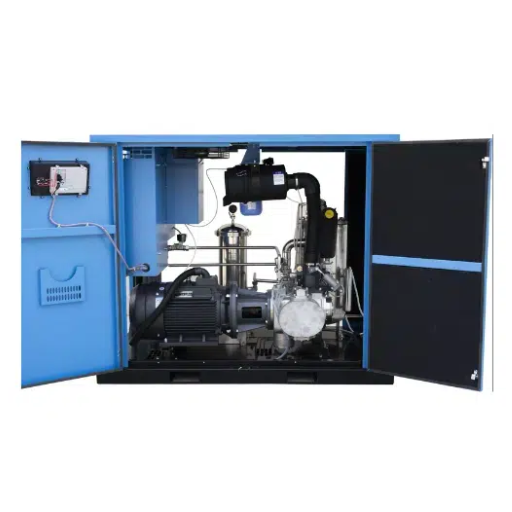
An oil-free screw compressor is a rotary screw compressor that compresses air with no oil in the compression chamber. The two rotors never touch. Timing gears keep them synchronized, and the air leaving the air-end carries no oil from the compression process.
That’s a real engineering advantage for food, pharmaceutical, medical, and electronics plants. It is also where most buyers stop reading and start assuming.
“Oil-free” describes the machine. “Class 0” describes the air. They’re not the same claim, and treating them as synonyms is the most expensive mistake in this category. A plant can install a perfectly good oil-free compressor and still fail an audit because nobody wrote down the purity limit, the test method, or the sampling point.
This guide treats the oil-free screw compressor as a purchase and an operating asset, not a technology demo. You will learn how a dry screw compressor works, what oil-free and oil-injected machines really cost over ten years, how to size and verify a system, what fails first, and when oil-free is the wrong choice.
If you are specifying a system now, our engineers can review your demand profile and air-quality target before you commit to a configuration. Talk to our team with your flow, pressure, and process requirements.
Key Takeaways
- Oil-free means no oil in the compression chamber. It does not mean zero oil in the delivered air unless you specify and verify a limit.
- ISO 8573-1 Class 0 is a negotiated specification tighter than Class 1 (0.01 mg/m³), not a fixed number or a badge.
- Oil-free machines eliminate oil changes but demand more attention to inlet filtration, cooler cleanliness, rotor coating condition, and bearing monitoring.
- Energy usually dominates lifecycle cost. A few percent of specific power outweighs the purchase-price gap over ten years.
- Oil-free is the wrong choice for general shop air, non-contact applications, and small intermittent loads where filtered Class 1 air is acceptable.
What Is an Oil-Free Screw Compressor
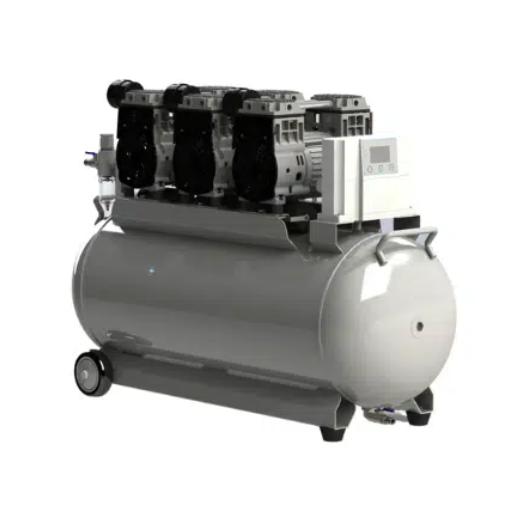
An oil-free screw compressor is a positive-displacement rotary compressor in which the compression chamber runs dry. Two intermeshing helical rotors trap and squeeze air, while external timing gears maintain the clearance between them. No oil enters the air path, so the delivered air contains no oil picked up during compression.
You will see the same machine under four names. Oil-free and oil-less mean the same thing. Dry screw describes the compression chamber. Non-lubricated refers to the rotors, not the whole machine. Suppliers also use “oil-free rotary screw air compressor,” which names the same machine by its rotor type.
That last distinction matters. On many oil-free units, the gearbox and some bearings are still oil-lubricated. The oil is sealed away from the air path, but it is present in the machine. When a supplier says “oil-free,” ask a precise question: which components are oil-free, and how is the oil kept out of the air stream? A written answer belongs in the quotation.
Where oil-free screw compressors fit
Oil-free is one of several ways to get clean air, and it is not the right answer for every flow and pressure.
| Technology | How it works | Typical flow | Typical pressure | Best fit | Watch-outs |
|---|---|---|---|---|---|
| Dry screw | Two non-contacting rotors, timing gears, no oil in chamber | 1 to 45 m³/min per unit | 7 to 10 bar, two-stage common | Continuous industrial air where Class 0 or near-Class 0 is required | Higher purchase price, higher discharge temperature, coating wear |
| Water-lubricated screw | Water injected into the chamber for sealing and cooling | 1 to 40 m³/min | 7 to 10 bar | Clean air with better cooling than dry screw | Water treatment, scaling, corrosion control |
| Scroll | Two spiral elements orbit without contact | Below 1 m³/min | 8 to 10 bar | Small clean-air loads, labs, dental, instrument air | Flow ceiling; not an industrial plant solution |
| Centrifugal | High-speed impellers, oil-free by design | Above 50 m³/min | 3 to 15 bar | Very large plants with steady demand | Poor turndown; surging at low flow; high capital cost |
For most factories in the 15 to 250 kW band, the practical choice is dry screw or water-lubricated screw. Scroll covers small clean-air loads, and centrifugal covers very large ones. A plant that needs 20 m³/min at 7 bar is not shopping in the same category as a dental clinic.
Our own oil-free screw compressor range covers 7.5 to 250 kW and 1.2 to 43.5 m³/min in the dry screw configuration, which is the band this guide focuses on.
How a Dry Screw Compressor Works Without Oil
The working principle is easy to state and hard to manufacture. Two helical rotors turn in opposite directions inside a precision housing. The male rotor has convex lobes, the female rotor has matching flutes, and the space between them closes as the rotors turn. Air is trapped at the inlet, carried along the rotor length, and squeezed into a smaller volume before it leaves at the discharge port.
The hard part is that the rotors cannot touch. Metal-to-metal contact without lubrication would destroy them in hours. So the machine uses three design features.
Timing gears. A gear pair at the discharge end fixes the relative rotation of the two rotors. The gears carry the drive torque and hold the rotor lobes a fixed distance apart. They run in an oil bath, sealed from the compression chamber.
Controlled clearance. The gap between the rotors and between the rotors and the housing is measured in hundredths of a millimeter. That gap is a deliberate leakage path. Some air slips back from the high-pressure side to the low-pressure side, which is why a dry screw air-end is less volumetrically efficient than an oil-flooded one.
Rotor coatings. Most dry screw rotors carry a coating that reduces friction if contact does occur and protects the base metal from corrosion. The coating is also a wear surface. Its condition is the single best indicator of air-end health, and it is why coating inspection belongs in every maintenance plan.
Why most industrial oil-free units are two-stage
A single-stage screw can only achieve a limited pressure ratio before discharge temperature becomes unmanageable. Without oil to absorb heat, the air leaves the compression chamber much hotter than it would in an oil-injected machine.
The standard solution is two stages with an intercooler. The first stage raises the air to an intermediate pressure, the intercooler removes heat, and the second stage takes it to final pressure. Two stages mean two air-ends, an intercooler, more piping, and a larger frame. That is a large part of why an oil-free machine costs more than an oil-injected unit of the same flow.
Two-stage compression also recovers some of the efficiency lost to dry running. Cooling between stages reduces the work needed in the second stage, so a well-matched two-stage oil-free machine can close much of the specific-power gap against a single-stage oil-injected unit. The size of that gap depends on the pressure ratio, the rotor design, and the operating point, which is why a single “oil-free uses X% more energy” figure is not reliable.
Why it runs hotter
Oil in an oil-injected compressor does three jobs at once: it lubricates, it seals, and it cools. The cooling effect pulls compression toward isothermal, which is efficient and gentle on components. A dry screw machine has none of that internal cooling. It relies on rotor speed, intercooling, and external coolers to keep temperatures in range.
Higher discharge temperature changes the system design downstream. It affects cooler sizing, condensate behavior, dryer selection, and the temperature rating of downstream filters and piping. A dryer chosen for an oil-injected system may not have the margin for an oil-free machine running at a higher inlet temperature.
Oil-Free vs Oil-Injected: The Honest Comparison
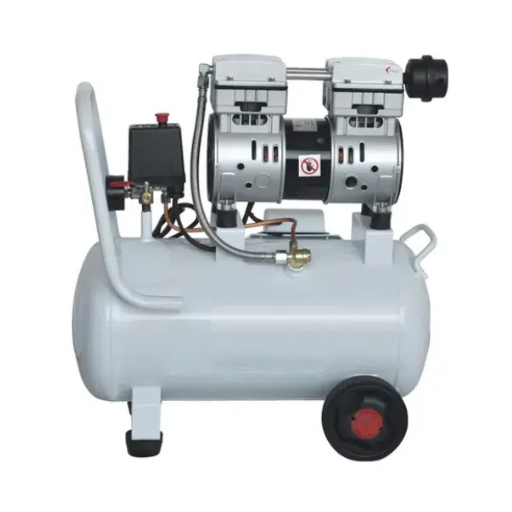
Most comparison pages pick a winner before the first paragraph. The useful answer is narrower: oil-injected wins on first cost and usually on specific power, oil-free wins on air quality and process risk, and the right choice depends on which of those costs your plant actually carries.
Efficiency: what the oil does for you
Injected oil seals the clearance between the rotors and the housing, which reduces internal leakage. It also cools the air during compression, which lowers the work required. Those two effects give a well-designed oil-injected machine an efficiency advantage at the same flow and pressure.
Oil-free designs answer with two-stage compression, tighter machining, and higher rotor speeds. The result is not a fixed penalty. It varies with pressure ratio, control type, and part-load behavior. At full load and moderate pressure, a good two-stage oil-free machine can be close to its oil-injected equivalent. At low load, the gap often widens, because dry screw machines do not turn down as gracefully without variable speed control.
The practical rule: don’t accept a generic percentage from either side. Ask both suppliers for specific power at your actual discharge pressure and at 100%, 75%, 50%, and 25% load. Compare those numbers, not brochure headlines.
Capital cost and maintenance profile
An oil-free machine carries a higher purchase price. Two air-ends, timing gears, coated rotors, tighter tolerances, and a more complex cooling circuit all cost money. The premium varies widely by size, pressure, control type, and certification, so treat any single percentage as a starting point for negotiation, not a budget figure.
Maintenance is where the comparison gets interesting. Oil-injected machines need oil changes, oil filters, separator elements, and oil analysis. Oil-free machines eliminate that list and replace it with a different one: inlet filtration, cooler cleaning, coating inspection, bearing monitoring, and timing gear backlash checks.
Neither machine is maintenance-free. The oil-free service profile is less frequent but more diagnostic. A missed oil change on an oil-injected unit is usually recoverable. A missed cooler cleaning or a worn coating on an oil-free unit can escalate into rotor contact and an air-end replacement.
For a deeper technology and cost comparison, see our oil-free vs oil-lubricated compressor guide. For the oil-injected side of the decision, the oil-injected rotary screw compressor guide covers the same ground from the opposite direction.
Air quality: what filtration can and cannot fix
A well-treated oil-injected system can deliver ISO 8573-1 Class 1 air. Coalescing filters, a good separator, and careful maintenance get oil content down to 0.01 mg/m³. That is clean enough for many industrial processes.
Class 0 is different. It is a specification tighter than Class 1, agreed between buyer and supplier. An oil-injected system can be built and tested to a Class 0 limit, but the result depends on filters working correctly at every moment, on separator performance, and on documented test data. The oil is still in the compression path. You are removing it downstream, not preventing it upstream.
An oil-free machine removes oil from the compression path entirely. That does not automatically deliver Class 0 air, because piping, receivers, dryers, and ambient ingress can all add contamination. It does mean the compressor is not the source, which is a much easier position to defend in an audit.
| Factor | Oil-injected | Oil-free dry screw |
|---|---|---|
| Oil in compression chamber | Yes | No |
| Typical achievable air class | Class 1 with good filtration | Class 0 when specified and verified |
| Purchase price | Lower | Higher |
| Specific power at full load | Usually lower | Usually higher, closes with two-stage design |
| Routine service | Oil, oil filter, separator, oil analysis | Inlet filter, cooler, coating inspection, bearings |
| Failure risk to watch | Oil carryover, separator failure | Coating wear, rotor contact, high discharge temperature |
| Best fit | General industrial air, non-contact uses | Food, pharma, medical, electronics, semiconductor |
Air Purity: What ISO 8573-1 Class 0 Actually Requires
This is the section most buyers skim, and most audits fail on. ISO 8573-1 defines air purity by three contaminant families: solid particles, water, and oil. Each is assigned a class number. “Class 0” is not a number in the table. It is a placeholder for a limit agreed between the equipment user and the supplier, and that limit must be tighter than Class 1.
Class 0 is a specification, not a number
ISO 8573-1:2010 defines Class 0 as “as specified by the equipment user or supplier and more stringent than Class 1.” For oil, Class 1 is 0.01 mg/m³ of total oil, meaning aerosol, vapor, and liquid combined.
That definition has a practical consequence. A supplier cannot simply claim “Class 0” and leave it there. The claim is meaningless without a stated limit, a stated test method, and a stated sampling point. A credible Class 0 offer states something like: total oil not exceeding 0.005 mg/m³ at the point of use, measured by ISO 8573-2, under defined flow and temperature conditions.
| Class | Total oil limit (mg/m³) | What it means in practice |
|---|---|---|
| 0 | As agreed, tighter than Class 1 | A negotiated specification, not a fixed value |
| 1 | 0.01 | Very low oil; typical target for critical processes |
| 2 | 0.1 | Low oil; suitable for many instrument and pneumatic uses |
| 3 | 1 | General industrial air |
| 4 | 5 | Basic industrial air, no sensitive process contact |
Remember that the class applies per contaminant. A system can be Class 1 for particles, Class 2 for water, and Class 0 for oil. A certificate that says only “Class 0” without naming the contaminant is incomplete.
How oil content is measured
Oil content is not measured with a handheld gauge in the compressor room. It is sampled and analyzed.
Aerosol and liquid oil are measured under ISO 8573-2. Oil vapor is measured under ISO 8573-5. The sample must be taken at a defined point, usually at the point of use or at the outlet of the final treatment stage, at a representative flow and temperature. Sampling upstream of a dryer or filter tells you about the compressor, not about the air your process receives.
Test frequency depends on the quality system. A common pattern is testing at commissioning, after any change to the treatment train, after major service, and then at an interval set by the plant’s quality risk assessment. Annual testing is common in pharmaceutical and food operations. More frequent testing follows a known problem, not a calendar.
What a Class 0 certificate should contain
Ask for a test report, not a marketing statement. A usable report includes:
- The ISO 8573-1 edition used.
- The class or limit for each contaminant: particles, water, and oil.
- The specific oil limit in mg/m³, not just “Class 0.”
- The test method for each measurement, including ISO 8573-2 and ISO 8573-5 where applicable.
- The sampling point and the operating conditions during the test.
- The test date and the laboratory that performed it.
- The result, expressed against the limit.
If any of those items are missing, you have a claim, not a verification.
Illustrative scenario: A food manufacturer specifies “oil-free compressor” in its project brief and buys a good machine. Nobody writes a Class 0 limit into the purchase order. At the first customer audit, the plant produces a test report showing Class 1 oil content. The auditor asks why the site’s own hygiene plan requires Class 0. The compressor is not at fault. The specification was never written. The plant pays for a second treatment stage and a re-test to close the finding.
For the standard explained in more depth, see our guide to ISO 8573-1 air purity classes.
Where food and pharmaceutical rules point
Food and pharmaceutical buyers often ask which regulation requires Class 0 air. The honest answer is that regulators rarely prescribe a milligram figure for compressed air. They require you to qualify the utility and validate it against a specification. ISO 8573-1 is the common language for that specification, and your quality team owns the limit.
The oil itself can also be a regulated material. In the United States, a lubricant that may contact food incidentally has to meet 21 CFR 178.3570. An oil-injected machine can use a compliant lubricant, but the oil still sits in the compression path and has to be managed. An oil-free air-end removes that pathway from the hazard analysis, which is simpler to document and simpler to defend.
What an Oil-Free Screw Compressor Costs and How to Model It
There is no honest single price for an oil-free screw compressor. Price moves with power, discharge pressure, number of stages, control type, cooling method, treatment train, certification, and installation scope. A number quoted without those variables is a sales device, not a budget.
What you can do is model the cost properly. That means separating the machine price from the system price and from the energy price, then comparing quotes on an identical basis.
What drives the purchase price
The largest drivers, in rough order of impact:
| Driver | How it moves the price |
|---|---|
| Power and flow | Scales with kW and m³/min, but not linearly. A 250 kW machine costs more than three 75 kW machines in absolute terms, though less per unit of flow. |
| Pressure and staging | Higher discharge pressure needs more compression work. Two-stage units cost more than single-stage units but recover efficiency at higher pressure ratios. |
| Cooling method | Air-cooled, water-cooled, and water-lubricated designs differ in installation and site-service requirements. |
| Control type | Fixed-speed, variable speed drive (VSD), and multi-unit sequencing change the price and the part-load energy profile together. |
| Air-quality package | Dryers, filters, receivers, and monitoring are often quoted separately. They are part of the system, not accessories. |
| Certification and testing | Class 0 verification, factory acceptance testing, and third-party witness testing add cost. They also add defensibility. |
| Installation | Foundations, ventilation, piping, electrical work, and commissioning vary enormously by site. |
The system cost buyers forget
The oil-free screw compressor is the visible purchase. The treatment train is where budgets quietly break.
A refrigerated dryer, a desiccant dryer, coalescing filters, a carbon filter, a receiver tank, and the piping between them can add a substantial share to the project. Desiccant dryers, which are often needed for low pressure dew points, consume purge air and add to the energy bill. Filters add pressure drop, and pressure drop costs energy every hour of operation.
This is why a system-level quote beats a machine-level quote. Ask for the full train: compressor, dryer, filtration, receiver, controls, and the pressure drop across each element at design flow. Then compare the total.
Our guide to choosing a compressed air dryer explains how dryer type changes both capital and operating cost.
A worked energy calculation
Energy is usually the largest lifecycle cost, so run the arithmetic before you argue about purchase price.
Take a 100 kW oil-free compressor running 4,000 hours a year at an industrial electricity rate of USD 0.10 per kWh. At full load, annual energy cost is:
100 kW × 4,000 hours × USD 0.10 = USD 40,000 per year
Over ten years, that is USD 400,000 before maintenance. Now compare two machines whose specific power differs by 5%. The higher-consumption machine uses 5% more energy for the same output:
USD 40,000 × 5% = USD 2,000 per year, or USD 20,000 over ten years
A 10% difference doubles that to USD 40,000. In other words, a modest efficiency gap can erase the entire purchase-price advantage of the cheaper machine. The exact numbers depend on your load profile and tariff, but the direction is consistent: measure specific power at your real operating point, not at the brochure’s best point.
The scale of the prize is why compressed air gets so much attention from energy auditors. The United States Department of Energy has long estimated that about 10% of the electricity used by American manufacturing goes to producing compressed air, and that some plants exceed 30% (DOE Compressed Air Tip Sheet #1, DOE/GO-102004-1966). The Compressed Air Challenge publishes the system-level guidance that grew out of that work.
When suppliers quote specific power, ask for ISO 1217 test data and check whether the data sheet follows CAGI conventions. A CAGI-style sheet states the test conditions, the tolerance, and the measurement method, which is what makes two suppliers’ numbers comparable.
Want a system-level number instead of a machine price? Send us your flow, pressure, duty cycle, and air-quality target, and we will help you scope the full train. Request a system quote.
How to Size an Oil-Free Screw Compressor
Sizing an oil-free screw compressor is not a nameplate exercise. The number on the datasheet is measured under reference conditions that rarely match your plant. Altitude, ambient temperature, pressure drop, and duty cycle all move the answer.
Start from measured demand
Don’t size from the sum of tool consumption. Measure the system. A week of data logging on the receiver and distribution header gives you average demand, peak demand, and the shape of the load curve.
Then add margin deliberately:
- Leakage. A realistic allowance is 10% to 20% in an older plant. Fixing leaks is cheaper than buying capacity to feed them.
- Growth. Add the expansion you can actually forecast, not a round 30% “just in case.”
- Peak behavior. If several processes start together, the peak matters more than the average. A receiver tank can absorb short peaks more cheaply than a larger compressor.
Correct for altitude, ambient, and treatment pressure drop
Three corrections separate a real sizing number from a datasheet number.
Altitude. Air density falls with elevation. A compressor rated at 20 m³/min at sea level delivers less mass flow at 1,500 m. The correction is roughly 3% per 300 m above sea level, though the exact figure comes from the manufacturer’s data.
Ambient temperature. Hot inlet air is less dense and harder to cool. A unit rated at 20°C ambient loses capacity at 40°C. In a hot climate or an unventilated compressor room, this correction can be larger than the altitude correction.
Treatment pressure drop. Dryers, filters, and piping consume pressure. If the process needs 6.5 bar at the point of use and the treatment train drops 0.5 bar, the compressor must discharge at 7.0 bar. Running at a higher discharge pressure costs energy every hour, so specify low-pressure-drop components and check the total.
A worked sizing example
A plant measures an average demand of 15 m³/min (about 530 CFM) at 6.5 bar at the point of use. It runs two shifts, about 4,000 hours a year, at an elevation of 1,000 m with a summer ambient of 38°C.
Add leakage and growth. 15 m³/min × 1.15 = 17.25 m³/min.
Add treatment pressure drop. 6.5 bar process + 0.5 bar treatment = 7.0 bar discharge.
Correct for site conditions. At 1,000 m and 38°C, assume a 12% capacity correction. Required reference-condition capacity = 17.25 ÷ 0.88 = 19.6 m³/min.
Select a model rated at 7 bar with at least 19.6 m³/min at reference conditions. Then confirm the corrected capacity at the actual site conditions with the manufacturer.
Check turndown. If demand falls to 6 m³/min at night, decide whether VSD, a smaller trim compressor, or storage is the better answer.
That is the difference between buying a “20 m³/min compressor” and buying a compressor that delivers 17.25 m³/min in your plant on your hottest day.
Illustrative scenario: A plant replaces an aging 75 kW oil-injected unit with an oil-free machine of the same nominal flow. It sizes on the datasheet, ignores 1,200 m of elevation and a new desiccant dryer, and runs short every August afternoon. Production adds a second shift, and the shortfall becomes a stoppage. The fix is a larger receiver and a pressure-drop audit, not a new compressor. The original error was comparing nameplate flow instead of site-corrected flow.
Maintenance, Failure Modes, and Air-End Life
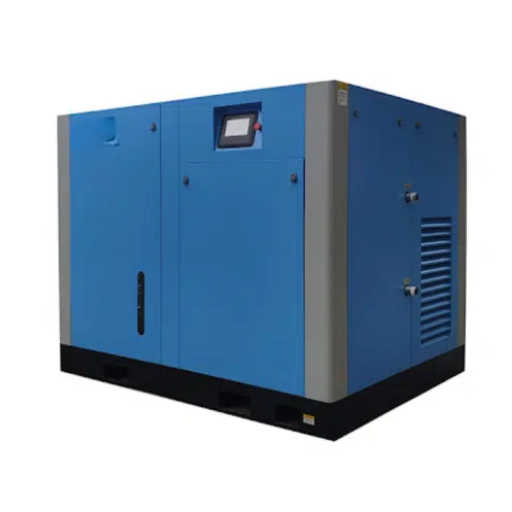
Maintenance on an oil-free screw compressor is often sold as “no oil changes.” That is true and misleading. The oil change disappears; the inspection load does not. What changes is the consequence of skipping work.
The service schedule that replaces oil changes
The intervals below are a planning template, not a substitute for the manufacturer’s manual. Your OEM schedule and site conditions govern.
| Interval | Tasks |
|---|---|
| Daily | Check discharge temperature and pressure, listen for unusual noise, inspect for leaks, confirm condensate drains work |
| Weekly | Check inlet filter restriction indicator, inspect cooler for dust and debris, review alarm log |
| 2,000 hours | Clean or replace inlet filter as indicated, clean coolers, inspect couplings and guards, check control calibration |
| 4,000 hours | Inspect rotor coating through the inspection port where fitted, check bearing vibration trend, verify safety valves |
| 8,000 hours | Bearing inspection or replacement per OEM guidance, timing gear backlash check, cooler performance test, full alignment check |
| 20,000 hours | Air-end inspection or overhaul assessment, coating condition assessment, decision point on rebuild versus replace |
The two items that matter most are inlet filtration and cooler cleanliness. A dry screw air-end has no oil film to cushion ingested dust. Particles that pass the filter become abrasive wear between the rotor and the housing. A fouled cooler raises discharge temperature, which accelerates coating degradation. Both problems are cheap to prevent and expensive to reverse.
What fails first on an oil-free machine
| Symptom | Likely cause | First action |
|---|---|---|
| Falling capacity, stable pressure | Rotor coating wear, increased clearance, inlet restriction | Check filter restriction, inspect coating, compare flow against baseline |
| High discharge temperature | Fouled cooler, high ambient, cooling water problem, sensor drift | Clean cooler, verify cooling flow and inlet temperature, check sensor |
| Metallic noise, vibration increase | Bearing wear, rotor contact, coupling wear | Stop the machine, inspect bearings and rotor condition |
| Oil in the air stream (unexpected) | Gearbox seal failure, contaminated downstream equipment | Isolate the source; do not assume the air-end |
| Water carryover | Dryer failure, drain failure, separator problem | Check dryer dew point and drain operation |
| Capacity loss after service | Incorrect filter, reversed rotation, control setting | Verify parts and rotation, check control parameters |
The pattern is different from oil-injected troubleshooting. On an oil-injected machine, oil carryover and separator performance dominate the fault list. On an oil-free machine, the thermal and wear path dominates: coating, clearance, coolers, and bearings.
Rebuild or replace
An air-end rebuild makes sense when the housing and rotors are serviceable, the failure is bearing-related, and the rest of the package is sound. Replacement makes sense when coating loss or rotor damage has changed the clearances beyond recovery, when parts lead times are long, or when the machine is near the end of its economic life.
Ask three questions before deciding:
- What is the measured capacity and specific power now, compared with commissioning data?
- What is the rebuild cost as a share of a new machine, including freight, downtime, and re-commissioning?
- What warranty does the rebuilder offer on the air-end, and for how many hours?
If the answers do not include measured performance and a written warranty, the rebuild is a gamble.
Illustrative scenario: A maintenance team moves from an oil-injected to an oil-free machine and drops the oil-change routine from its planner. Nobody adds cooler cleaning or inlet filter checks, because those tasks were never on the old schedule. Two summers later, discharge temperature alarms become routine and capacity has fallen by 8%. The air-end is still serviceable, but the coating is worn and the cooler is blocked. The cost of the missed work exceeds the value of the oil changes the team thought it had eliminated.
When Oil-Free Is the Wrong Choice
An honest guide has to say where the technology does not pay. An oil-free screw compressor is the wrong choice in four common situations.
General shop air with no product contact. If the air runs impact wrenches, cylinders, and blow-off guns in a metal shop, Class 1 air with good filtration is usually enough. Paying for oil-free adds capital and efficiency cost without reducing a real process risk.
Small, intermittent demand. A 5 to 15 kW load that runs a few hours a day rarely justifies an oil-free screw compressor. A scroll or piston unit, or a small oil-injected screw with filtration, usually wins on first cost and simplicity.
Budget-constrained projects with a clear Class 1 requirement. If the specification truly allows Class 1, an oil-injected machine with a properly maintained filtration train can meet it. The money may be better spent on dryers, filters, storage, and leak repair than on the compressor architecture.
Very large, steady loads where energy dominates. At high flow and stable demand, centrifugal compressors are often the better oil-free answer. A dry screw array may be the wrong tool at 100 m³/min and above.
The decision boundary is not “clean air versus dirty air.” It is “what does contamination cost us if it happens, and what does prevention cost every hour?” If the answer to the first question is a product recall, a rejected batch, or a failed audit, oil-free is cheap insurance. If the answer is a slightly shorter tool life, it probably is not.
How to Choose an Oil-Free Screw Compressor Supplier
The machine is only half the purchase. The other half is the documentation, the service capability, and the supplier’s willingness to put commitments in writing.
Ask every candidate for the following, and compare the answers side by side:
- A performance guarantee under your site conditions, not just a datasheet. Flow, pressure, specific power, and the correction method should be stated.
- ISO 1217 test data for the model, and a factory acceptance test (FAT) protocol you can witness or review.
- A written air-quality specification with the Class 0 limit in mg/m³, the test method, the sampling point, and the test report.
- Air-end warranty terms in hours and years, with the conditions that void them.
- A spare-parts list with lead times for filters, coolers, bearings, and the air-end.
- Service training and documentation for your maintenance team, in a language they can use.
- Reference installations at a similar flow, pressure, and industry, with contactable owners where possible.
A supplier that cannot produce these items is asking you to accept risk you cannot quantify. For an oil-free screw compressor, the air-quality specification and the air-end warranty are the two items worth arguing about hardest.
Shandong Loyal Machinery has built compressed air equipment for more than 20 years and supplies customers in more than 50 countries. Our oil-free range is documented with published performance data, and we quote at the system level so you can see the compressor, treatment train, and installation scope together.
Frequently Asked Questions
What is an oil-free air compressor?
An oil-free air compressor compresses air without oil in the compression chamber. In a screw design, timing gears keep the rotors synchronized so they never touch, and no oil enters the air path. The result is air with no oil picked up during compression, which matters for food, pharmaceutical, medical, and electronics processes.
How do oil-free screw compressors work?
Two helical rotors turn in opposite directions and trap air in spaces that shrink along the rotor length. Timing gears hold the rotors apart, and a controlled clearance allows a small amount of air to slip back. Two-stage designs with an intercooler are common because dry compression produces higher temperatures than oil-flooded compression.
Are oil-free compressors worth it?
They are worth it when contamination carries a real cost: a rejected batch, a failed audit, a product recall, or a patient-safety risk. An oil-free screw compressor is usually not worth it for general shop air, non-contact applications, or small intermittent loads where filtered Class 1 air meets the requirement. The decision is about process risk, not about which machine is “better.”
What are the downsides of oil-free air compressors?
Higher purchase price, usually higher specific power at the same flow, higher discharge temperatures, and a maintenance profile that depends on coating and cooler condition. Air-end life is sensitive to inlet filtration and cooling, and a failed coating can lead to rotor contact. None of these are reasons to avoid oil-free when the process needs it, but they are reasons to specify and maintain it properly.
Is oil-free air really oil-free?
Not automatically. “Oil-free” describes the compressor. The delivered air can still pick up contamination from piping, receivers, dryers, filters, and ambient ingress. If your process needs a defined limit, specify ISO 8573-1 Class 0 with a stated mg/m³ value, test method, and sampling point, then verify it with a test report.
How much does an oil-free screw compressor cost?
There is no reliable single figure. Price depends on power, pressure, staging, control type, cooling method, treatment train, certification, and installation. The useful approach is to compare full-system quotes at identical flow, pressure, and air-quality specifications, then model energy over the expected life. A machine that is cheaper to buy can be more expensive to own within a few years.
Conclusion
An oil-free screw compressor solves a specific problem: it keeps oil out of the compression chamber, which makes clean air easier to specify, verify, and defend. It does not solve the whole system. Purity depends on the treatment train and on testing. Cost depends on energy as much as on purchase price. Reliability depends on filtration, cooling, and coating condition.
If you take three actions from this guide before you buy an oil-free screw compressor, make them these. Write the air-quality specification before you request quotes, including the Class 0 limit, the test method, and the sampling point. Compare machines on site-corrected flow and measured specific power, not on nameplate numbers. Put the maintenance schedule for filters, coolers, and coating inspection into the planner on day one.
Get those three right, and the choice between oil-free and oil-injected becomes a business decision with numbers behind it, not a leap of faith.
Ready to specify your oil-free screw compressor system? Send us your flow, pressure, duty cycle, and air-quality target. Our engineers will help you size the compressor and the treatment train together. Contact our team.