
Air Compressor CFM Chart: How to Size a 5-10 HP Screw Compressor to Your Tools
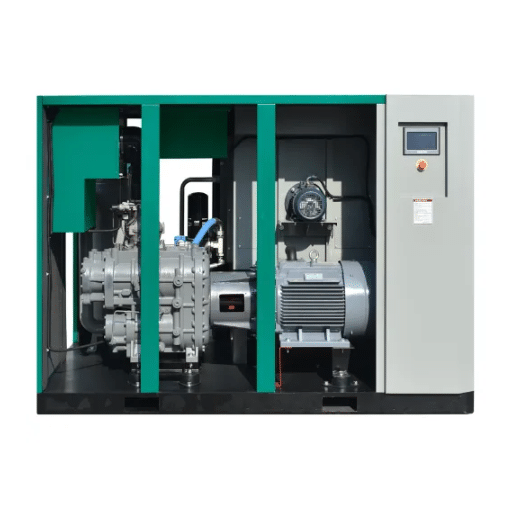
Miguel bought a 5 HP screw compressor for his two-bay auto shop in Miami. The spec sheet read 20 CFM. On paper, that was plenty. His total tool list added up to 35 CFM. He assumed the compressor would handle everything because 20 CFM sounded like a lot. He was wrong.
During busy afternoons, when two technicians ran impact wrenches while the lift operated, the pressure crashed to 60 PSI. The tools lost power. Work stopped. Miguel had sized for total tools, not simultaneous use. He needed an air compressor sizing guide that translated abstract CFM numbers into real tool counts.
This article is the guide. You will get a complete air compressor CFM chart for common shop tools, exact output numbers for 5 HP and 10 HP screw compressors, and a four-step simultaneous-use calculation that prevents Miguel’s mistake. Whether you run a one-man woodworking shop or a three-bay auto service center, here is how to match your compressor to your actual demand.
What CFM Actually Means (And Why It Matters More Than HP)

CFM vs HP: The Sizing Mistake Most Buyers Make
Horsepower tells you how big the motor is. CFM (cubic feet per minute) tells you how much air the compressor actually delivers. A 10 HP compressor with poor efficiency might deliver less usable air than a 7.5 HP unit with a better airend. When sizing a compressed air system, CFM is the number that matters.
Most buyers look at HP first because it is familiar. They see 5 HP and assume it powers a certain number of tools. But without knowing the CFM output and the CFM requirements of each tool, that assumption is a gamble. For a deeper look at selecting the right compressor type and size, see our 5-10 HP screw compressor complete buyer’s guide.
Displacement CFM vs FAD: Reading the Spec Sheet Correctly
Manufacturers list CFM in two ways. Displacement CFM measures the theoretical volume the airend displaces. Free Air Delivery (FAD) measures the actual air output at the discharge port under standard conditions. FAD is always lower than displacement CFM.
The industry standard for FAD measurement is ISO 1217, which requires testing at 68 degrees Fahrenheit, 14.5 PSI atmospheric pressure, and 0% humidity. If a spec sheet does not specify FAD or reference ISO 1217, the CFM number may be optimistic. Always compare FAD to FAD, not displacement to FAD.
Why 100% Duty Cycle Changes the Math for Screw Compressors
A piston compressor rated at 18 CFM might only deliver that output 60% of the time because it needs to stop and cool. A rotary screw compressor runs at 100% duty cycle. That means a 5 HP screw compressor delivering 20 CFM actually gives you 20 CFM continuously. A 5 HP piston compressor delivering 18 CFM in bursts effectively gives you closer to 11-13 CFM of usable continuous air.
This is why a 5 HP screw compressor can power more tools than a 7.5 HP piston compressor. The duty cycle advantage is not theoretical. It is the difference between a shop that keeps working and one that waits for the tank to refill. For more on this comparison, read our screw vs piston compressor comparison.
Complete Air Tool CFM Chart
The table below shows actual CFM consumption for common shop tools at 90 PSI and at 150 PSI. Use the 90 PSI column for most general shop tools. Use the 150 PSI column if you run high-pressure applications or plan to operate at elevated pressures.
| Tool | CFM @ 90 PSI | CFM @ 150 PSI |
|---|---|---|
| Brad Nailer | 0.3 | 0.5 |
| Stapler | 0.5 | 0.8 |
| Tire Inflator | 1-2 | 2-3 |
| Blow Gun | 2-3 | 4-5 |
| 3/8″ Impact Wrench | 3-4 | 5-6 |
| Die Grinder | 4-6 | 7-9 |
| 1/2″ Impact Wrench | 4-5 | 6-8 |
| Angle Grinder | 5-8 | 8-12 |
| Orbital Sander | 6-9 | 10-14 |
| Drill | 3-6 | 5-8 |
| HVLP Spray Gun | 9-12 | 14-18 |
| Conventional Spray Gun | 12-15 | 18-22 |
| 3/4″ Impact Wrench | 7-9 | 11-14 |
| Air Hammer | 3-5 | 5-7 |
| Needle Scaler | 8-12 | 12-16 |
| Sandblaster (small) | 10-15 | 15-20 |
| Plasma Cutter (air) | 4-8 | 6-10 |
| CNC Router Vacuum Hold | 6-10 | 10-14 |
| Frame Straightener | 8-12 | 12-16 |
| Paint Booth (small) | 12-18 | 18-25 |
Low-CFM tools like nailers and inflators draw under 5 CFM. You can run many of these on almost any compressor.
Medium-CFM tools like impact wrenches and grinders draw 5-15 CFM. These are where sizing decisions get important.
High-CFM tools like sandblasters, paint booths, and CNC vacuum systems draw 15+ CFM. These often dictate your minimum compressor size.
How Much CFM Does a 5-10 HP Screw Compressor Actually Produce?

Real-world CFM output varies by manufacturer, airend design, and operating pressure. The table below shows approximate FAD values at 125-150 PSI for common brands.
| Brand / Model | HP | CFM @ 125-150 PSI |
|---|---|---|
| Atlas Copco G5 | 5 | 19-21 |
| Quincy QGS 5 | 5 | 16-18 |
| US Air 5 HP | 5 | 18-19 |
| Champion 5 HP | 5 | 17-19 |
| Nexus 5 HP | 5 | 18-20 |
| Atlas Copco G11 | 10 | 38-42 |
| Quincy QGS 10 | 10 | 34-36 |
| US Air 10 HP | 10 | 40-43 |
| Champion 10 HP | 10 | 38-42 |
| Nexus 10 HP | 10 | 34-38 |
5 HP Screw Compressor: 18-22 CFM
A 5 HP rotary screw compressor typically delivers 18 to 22 CFM at standard operating pressure. That is roughly 3.5 to 4.5 CFM per horsepower. This output is sufficient for one technician running medium-demand tools continuously, or two technicians running low-to-medium demand tools with intermittent use.
For exact specifications by brand and voltage options, see our 5 HP screw compressor specifications.
10 HP Screw Compressor: 35-45 CFM
A 10 HP rotary screw compressor typically delivers 35 to 45 CFM. That doubles the 5 HP output while using twice the motor power. This range supports two to three technicians running medium-demand tools simultaneously, or one technician running a high-CFM tool like a sandblaster or small paint booth continuously.
For a full breakdown of 10 HP models and their electrical requirements, read our 10 HP screw compressor power output guide.
The Simultaneous Use Calculation: Sizing for Real Shops
Most sizing mistakes happen because buyers add up every tool in the shop. That is not how shops work. You need to size for the tools that run at the same time.
Step 1: List Your Tools
Write down every air tool you own or plan to own. Next to each, write the CFM at the pressure you will use. Use the 90 PSI column from the chart above unless you know you need higher pressure.
Step 2: Apply Duty Cycle Factors
Not every tool runs continuously. An impact wrench runs for 10 seconds, then stops for 30. A die grinder might run for 2 minutes straight. Apply these duty cycle factors:
- Intermittent tools (impact wrench, drill, nailer): 30-50% duty cycle
- Medium-duty tools (grinder, sander): 50-70% duty cycle
- Continuous tools (spray gun, sandblaster, CNC vacuum): 100% duty cycle
Multiply each tool’s CFM by its duty cycle factor. A 5 CFM impact wrench at 40% duty cycle contributes 2 CFM to your calculation.
Step 3: Identify Peak Simultaneous Demand
Determine the worst-case scenario. How many technicians work at once? Which tools do they typically run simultaneously? Add the duty-cycle-adjusted CFM for that peak combination.
Step 4: Add the 30% Buffer
Compressors lose output to leaks, hose length, fittings, and filter pressure drop. The US Department of Energy estimates the average shop loses 20-30% of compressed air to leaks alone. Add a 30% buffer to your peak simultaneous demand. If your peak is 25 CFM, size for 32.5 CFM.
Shop Scenarios: Three Real Calculations
One-Man Woodworking Shop
Sarah runs a woodworking shop in Portland. Her tools: a CNC router vacuum hold (8 CFM continuous), a brad nailer (0.3 CFM intermittent), and a die grinder (5 CFM medium duty). Her peak simultaneous use is CNC vacuum plus die grinder: 13 CFM. With a 30% buffer, she needs 16.9 CFM.
A 5 HP screw compressor delivering 20 CFM fits perfectly. She even has room to add an HVLP spray gun later without upgrading.
Need help matching compressor size to your electrical service? Our single-phase vs three-phase electrical requirements guide shows exactly what breaker and wire size you need.
Two-Bay Auto Shop
Miguel’s Miami shop has two technicians. Their typical simultaneous peak: two 1/2″ impact wrenches (5 CFM each, 40% duty cycle = 2 CFM each) plus a lift (negligible air use) plus occasional blow gun (3 CFM, 20% duty cycle = 0.6 CFM). Peak adjusted demand: 4.6 CFM.
That sounds low. But when one tech runs an orbital sander (8 CFM, 60% duty cycle = 4.8 CFM) while the other runs an impact, the peak jumps to 9.4 CFM. Add a 30% buffer: 12.2 CFM. A 5 HP unit at 20 CFM should handle this.
Miguel’s real mistake was not accounting for the busy-day scenario. When both techs run medium-CFM tools simultaneously, demand pushes to 18-20 CFM with buffer. He needed a 10 HP unit.
Metal Fabrication Shop
David runs a three-person metal fab shop in Austin. His peak simultaneous demand: plasma cutter (6 CFM continuous) plus angle grinder (6 CFM, 70% duty = 4.2 CFM) plus impact wrench (5 CFM, 40% duty = 2 CFM). Total: 12.2 CFM. With 30% buffer: 15.9 CFM.
A 5 HP unit would work. But six months later, David added a sandblaster (15 CFM continuous). New peak: 21.2 CFM plus 30% buffer = 27.6 CFM. The 5 HP unit could not keep up. He upgraded to 10 HP, which cost more than buying the right size initially. Planning for growth matters.
How Many Tools Can You Run? 5 HP vs 10 HP
The table below shows realistic tool combinations that fit within each compressor’s continuous output capacity. Remember to account for your specific simultaneous use, not just the total number of tools.
| Scenario | 5 HP (20 CFM) | 10 HP (40 CFM) |
|---|---|---|
| 1/2″ Impact Wrenches | 3-4 intermittent | 6-8 intermittent |
| Die Grinders | 3 continuous | 6 continuous |
| HVLP Spray Guns | 1-2 continuous | 3 continuous |
| Orbital Sanders | 2 continuous | 4 continuous |
| Sandblasters (small) | Not recommended | 1 continuous |
| Paint Booths (small) | Not recommended | 1 continuous |
| Mixed Auto Shop | 1-2 technicians, light duty | 2-3 technicians, medium duty |
| Woodworking | Full shop + spray gun | Full shop + multiple stations |
When You Need More Than 10 HP
If your peak simultaneous demand exceeds 40 CFM with buffer, or if you run continuous high-CFM tools like large paint booths, multi-station CNC systems, or industrial sandblasters, a 10 HP unit will not suffice. No manufacturer offers rotary screw compressors above 10 HP in single-phase. Moving to 15 HP or 20 HP requires three-phase power and a larger electrical service.
Tank Size vs CFM: What Actually Matters
Tank Size for 5 HP Screw Compressors
A load/unload rotary screw compressor typically pairs with a tank sized at 10 to 15 gallons per CFM of output. For a 5 HP unit delivering 20 CFM, that means a 200-300 gallon tank. The tank stores air during unload periods and smooths demand spikes.
However, the tank does not create CFM. It only delays the pressure drop.
Tank Size for 10 HP Screw Compressors
For a 10 HP load/unload unit delivering 40 CFM, a 400-600 gallon tank is common. If you choose a VSD (variable speed drive) screw compressor, the motor ramps up and down to match demand in real time. VSD units need less storage: 3 to 5 gallons per CFM, or 120-200 gallons for a 10 HP unit. For more on this decision, see our VSD vs fixed speed compressor comparison.
Why Tank Size Does Not Fix an Undersized Compressor
A 120-gallon tank on a 5 HP unit stores about 90 seconds of air at 20 CFM demand. If your tools continuously draw more CFM than the compressor produces, the tank empties. Pressure crashes. Work stops.
Tank size smooths intermittent demand. It cannot overcome a compressor that is too small for a continuous load.
Altitude and Temperature: The Hidden CFM Killers
Compressor CFM ratings assume sea-level conditions. As altitude increases, air density drops, and the compressor moves less mass of air per cubic foot. The rule of thumb: CFM output drops approximately 3-4% per 1,000 feet above sea level.
| Altitude | Approximate CFM Loss | Effective 5 HP Output | Effective 10 HP Output |
|---|---|---|---|
| Sea Level | 0% | 20 CFM | 40 CFM |
| 2,000 ft | 6-8% | 18-19 CFM | 37-38 CFM |
| 4,000 ft | 12-16% | 17-18 CFM | 34-35 CFM |
| 6,000 ft | 18-24% | 15-16 CFM | 30-33 CFM |
Temperature also matters. For every 10 degrees Fahrenheit above 68 degrees F, compressor output drops roughly 1-2%. A 5 HP unit in a 100-degree shop in Phoenix produces measurably less air than the same unit in a climate-controlled shop in Seattle. If you operate at high altitude or in extreme heat, upsize by one compressor class to compensate.
Leaks and Future Growth: The Forgotten Factors

The 20% Leak Tax Most Shops Ignore
The US Department of Energy Compressed Air Challenge estimates that the average industrial facility loses 20-30% of its compressed air to leaks. A single 1/8-inch leak at 100 PSI wastes approximately 8-10 CFM.
Most small shops have multiple smaller leaks at fittings, hoses, and quick-connects. If your calculated demand is 20 CFM, and you have typical leaks, your compressor effectively needs to supply 24-26 CFM. Fix leaks first. Then size your compressor.
Sizing for Expansion
Industry data suggests that 68% of small shops add equipment within three years of their compressor purchase. A spray booth, a third service bay, a new CNC station, or a sandblaster can push a properly sized 5 HP unit into overload.
If you plan to grow within two to three years, buying a 10 HP unit now often costs less than buying a 5 HP unit and upgrading later. The price difference between 5 HP and 10 HP is typically 2,000 to 4,000. Selling a used 5 HP unit and buying a new 10 HP unit costs far more than that gap.
Want a custom CFM assessment for your shop? Contact our team with your tool list and shop layout. We will calculate your exact simultaneous demand and recommend the right compressor size.
Frequently Asked Questions
How many CFM does a 5 HP air compressor produce?
A 5 HP rotary screw compressor typically produces 18 to 22 CFM at 125-150 PSI. Piston compressors of the same horsepower usually produce 14 to 18 CFM, but only in bursts because they cannot run continuously.
How many CFM does a 10 HP air compressor produce?
A 10 HP rotary screw compressor typically produces 35 to 45 CFM at 125-150 PSI. The exact output depends on the airend design, operating pressure, and ambient conditions.
Can I run two impact wrenches on a 5 HP compressor?
Yes, if they are used intermittently. Two 1/2″ impact wrenches drawing 5 CFM each at 40% duty cycle create an effective demand of 4 CFM. A 5 HP screw compressor at 20 CFM handles this easily. If both wrenches run continuously, the demand is 10 CFM, which still fits comfortably.
What size compressor do I need for a paint gun?
An HVLP spray gun draws 9-12 CFM continuously. A 5 HP screw compressor can run one HVLP gun with room to spare. A conventional spray gun draws 12-15 CFM and pushes the limits of a 5 HP unit if any other tools run simultaneously. For dedicated paint work, a 10 HP unit is safer.
Does tank size affect CFM?
No. Tank size affects how long the compressor can supply air above the cut-in pressure during demand spikes. It does not change the compressor’s CFM output. A larger tank delays pressure drop but cannot overcome an undersized compressor.
Conclusion: Size for Simultaneous Use, Not Total Tools
The most expensive compressor mistake is buying too small. The second most expensive mistake is buying too big and wasting capital. The key to getting it right is sizing for simultaneous use, not the total number of tools in your shop.
Here is the checklist. List your tools and their CFM requirements. Apply duty cycle factors to each. Identify your worst-case simultaneous demand.
Add a 30% buffer for leaks and pressure drop. Check altitude and temperature derating if applicable. Plan for growth if you expect to add equipment within three years. Then match the result to a 5 HP unit (18-22 CFM) or a 10 HP unit (35-45 CFM).
A 5 HP screw compressor handles most one-person shops and light two-person operations. A 10 HP unit supports two to three technicians running medium-demand tools simultaneously, or one technician running high-CFM equipment continuously. Buy the size that fits your actual peak demand, not the size that fits your tool count.
Shandong Loyal Machinery manufactures 5-10 HP rotary screw compressors with FAD ratings optimized for real-world shop conditions. We customize voltage, motor specifications, and tank configurations to match your tool list and operating environment. If you are unsure how to calculate your simultaneous demand, contact our engineering team for a free sizing assessment before you buy.