
Compressed Air System Design for Screw Compressors
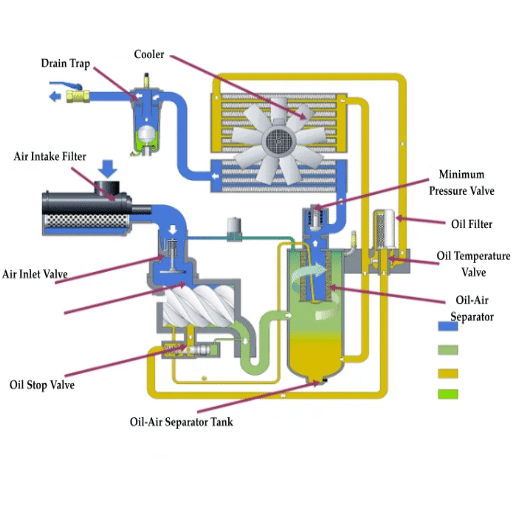
Minimization of energy wastage when using screw compressors calls for designing such compressed air systems correctly to be quite an important aspect of how to enhance industrial processes. Since the majority of plants trust screw compressors, given that they are efficient and effective for operations, there is also a potential productivity enabler or inhibitor when it comes to how an air piping system is designed and configured. In this regard, the article is an in-depth guide on the basic compressed air system design for screw compressors. From considering efficient system elements to proper location of equipment and reducing pressure losses, guidelines on important aspects for optimizing performance and environmental impact are discussed. This is because not only are new installations being considered, but useful suggestions on how to improve an already present compressed air system will be looked into.
Introduction to System Design for Screw Compressors

In the design of efficiency strategies for screw compressors, several aspects are taken into consideration. Starting with the issue of proper size for the compressor that matches the specific demand for air without neither or under or undersizing to avoid energy losses. The location of the compressor should allow for easy maintenance access as well as for ventilation for heat dissipation. Furthermore, optimizing energy transformation through appropriate piping and fittings is useful in decreasing pressure losses, therefore, improving the system design. Used together with a smart system, such a characteristic can optimize the use of the system appropriately and ensure that the efficiency of the system is maintained over a longer period. When these principles are properly addressed, a durable and economic screw compressor system can be developed.
📐
Correct Sizing
Match compressor capacity to actual air demand — avoid over or undersizing
📍
Strategic Location
Ensure easy maintenance access and adequate ventilation for heat dissipation
🔧
Piping Optimization
Use appropriate piping and fittings to reduce pressure losses
🤖
Smart Controls
Integrate intelligent systems to sustain long-term operational efficiency
Overview of Compressed Air Systems
Without a compressed air system, industries would practically collapse. Air used in running tools, handling materials, and system design is supplied to almost all industries. Compressed air systems are made up of major components consisting of compressors, air treatment systems, storage tanks, tracking distribution piping, and end-using equipment, and so on. Sufficient air is converted into energy by collecting, compressing, and treating it to some extent, which has to be clean and pressurized according to the specific operation to be performed by the compressed air systems.
To maximize the efficiency of compressed air systems, one should consider key pain areas, namely energy usage, leakages, and pressure losses. Industry data suggests that leakages can contribute 20%-30% of the total compressed air provided by a given system, and this is why leak detection and management systems are very important. In addition to this, deciding upon the proper compressor type to use – either rotary screw, reciprocating, or centrifugal compressors, and for what purposes – is crucial as regards optimal performance and minimizing costs.
⚠️ Industry Alert: Leakages can contribute 20%–30% of the total compressed air provided by a given system. Leak detection and management systems are therefore critical to maintaining energy efficiency.
The incorporation of thorough air treatment equipment, such as filters and dryers, is essential in today’s compressed air packages, as it ensures that the quality of air being used is preserved through the elimination of elements such as water and oil, among others. Moreover, the use of pressure control and storage makes it possible to sustain system design and reduce energy usage for no good reason. With state-of-the-art monitoring solutions and appropriate maintenance of equipment, companies are able to get better system performance, lower costs, and a more environmentally friendly business.
The Importance of System Design
System design is fundamental to enhancing the efficacy, effectiveness, and extensibility of technical structures. To avoid chi, such practices of structuring shall also be sufficient to ensure that the allocation of resources is efficient, the system’s operations are stable with different loads, and also assist in reducing any chi. These include, but are not limited to, the practice of developing systems which incorporate modularity, the property of the system that makes it convenient to develop and maintain the components separately, and also overdesign, as the opposite of underdesign, which enables the system to be available even in the event of failures of hardware or software. In addition, it is essential to consider the problem of scalability of systems design, in that systems should be able to handle growth in demand, both anticipated and unanticipated, without a drastic loss of performance.
The additional benefits of the existing system design include the application of advancements based on new technologies, such as automation tools and real-time monitoring systems in data-driven decision-making and predictive maintenance. Designing in alignment with organizational strategies is pivotal in ensuring that the structures that are constructed not only meet the purpose in the short term but also sustain the objective long term and within the constraints of budget and environmental protection. Consequently, the strong and solid design of the operations tools is a fundamental precondition for reliable, controlled, and efficient operations across all types of business activities.
Core Problems Addressed
⚙️ Current System Design Inefficiencies
Industries have been grappling with control system failures for a long time, and this results in performance issues arising from old structures, incompatible systems, and subsequent expansion. Transforming this kind of design weakness means incorporating flexible and separable designs that will acclimate to change in business needs as well as minimize wastage.
🔩 Services Repair and Equipment Downtime
One of the major causes of distress is predictability maintenance because breakdowns without warning enormously affect performance and also cause loss of income. Utilizing solutions such as monitoring in real-time together with analytics powered by AI enables the prediction of possible issues likely to arise, and therefore promotes smooth operations and minimizes repair expenses, among other things.
🔒 The Use of Technology to Compromise Data and Databases Through Security Lapses
The importance of network security and safety is heightened by the world’s fast reliance on control network structures. Therefore, it is necessary to have strict security measures such as encryption, multi-factor authentication, or routine system design checks that seek to prevent compromise and help meet the industry standard.
Fundamental Concepts in System Design
In a business context, whenever a system’s capacity to execute tasks is mentioned, scalability is introduced. A system is said to be scalable if the potential exists for optimization either by way of additional nodes or resources (dimensions) or vertically, which means upgrade of current elements. Ideally, if a system design makes room for efficient scalability, then the architecture shall be the one sustaining and maintaining the system level as the demand reaches higher levels, meaning this architecture can run for many years.
Key Components and Their Functions
| Component | Function |
|---|---|
| Load Balancers | Most network-based connective improves device systems by implementing load balancers between the connected servers, so that no one server gets stressed out by too much traffic flowing through it. Resource provisioning is enhanced, a system is made to work at its best, failure is managed, and lastly, the systems remain available and reliable enough to use. |
| Database System Architecture | The databases provide storage and retrieval of data used in the operation of various systems. For most scalable systems, distributed databases are put into use to manage very large amounts of data. Sharding, replication and caching improve performance and reliability. |
| Automated Caches | Automated caches provide storage of objects that are often requested by the database so as to reduce the time taken as well as the overhead work of the database. Common mechanisms include in-memory data storage systems such as Redis or Memcached, allowing very fast responses with the data coming straight from a cache. |
| Processing Queues | Message queues, systems like RabbitMQ or Apache Kafka, divide the system into services that interact with them asynchronously. They help manipulate a high density of tasks in an efficient manner as well as sustain the systems by bottleneck. |
| Content Delivery Networks (CDNs) | CDNs provide content delivery services from multiple geolocations, which improves user experience by offering low upload time content delivery from all endpoints. They also help scale up the system by reducing the burden on the server that handles the requests primarily, thus improving the service. |
These elements ensure the incorporation of growing work efficiently under system design parameters.
Understanding Efficiency and Performance
Efficiency and effectiveness happen to be the two important aspects when it comes to system functioning. While efficiency is more in regard to the ability of the system to do something with the least amount of resources. This is often measured in terms of throughput or even utilization of resources. On the other hand, when addressing the performance of a system, it is about how well it can accomplish tasks or sustain the required level of operation. This is measured in different aspects such as latency, response time, speed, and even the transaction rate.
For improved efficiency and performance of systems, there is a need for systems to be organized, such as no resource wastage, with minimum duplication, and processes being simplified as much as possible. The main tactics are the application of caching techniques so as to speed up the retrieval of the data, load balancing so as to balance the load across the servers, and database indexing, which reduces the time of execution of queries. Moreover, management tools exist for the purpose of assessing traffic performance to spot potential problems and make necessary modifications to ensure that the systems are reliable and can be scaled to the system design requested.
The two ideas are nearly synonymous. In a number of instances, efficiency enhances performance, while in other cases, performance can be achieved at the expense of efficiency, deeming a balanced approach to system design necessary for every application. Processes are so improved, and practices so modernized, that performance and efficiency issues of high demands on systems become naturally managed.
Scalability in System Design
Scalability, when it comes to system design, is the aptitude of a system to tackle increased workloads or to make room for more work as demand rises, without any loss of effectiveness. It consists of the ways in which an architecture can be expanded in order to perform a larger load in the same efficient and dependable way. Within the realm of scalability, we can speak of two main kinds:
↔️
Horizontal Scalability
This term means expanding the capabilities of a system by adding more machines or instances. The workload can be spread in many instances instead of one. In distributed systems, this approach is often deployed, especially when traffic or data is heavy.
⬆️
Vertical Scalability
This involves enhancing the performance of one machine through hardware improvement, such as adding more RAM or processors. This is easy and involves only a change of machine, but in doing so, the machine can only accommodate to the extent it can; therefore not reasonable for large expansion.
Factors like system design that promote easy scaling include, among others, designing a modular system; efficient load spreading among the components; and the use of complex databases that will partition or replicate data. It is important to take into account such measures as the use of memory buffer, post-processing, and clouds, amongst others, each of which helps deal with the scaling problem. This way, organizations tackle possible obstacles in executing their operations, remain low-cost at any scale, and retain operational experience for their clients whenever there is an increase in their demand.
System Design Fundamentals for Screw Compressors
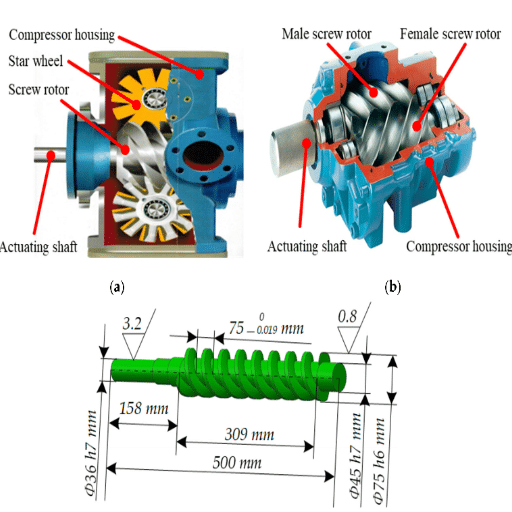
During screw compressor system design, there are a number of essentials that must be adhered to in order to achieve the reliability and high quality of performance. Many systems depend on the flow of gases and the thermodynamic characteristics of gases under compression, and this is what is critical since it shows the efficiency of the system. For one thing, the compressor needs to be correctly sized so that it is not underpowering or overworking in any of the applications.
In modern science, advanced control systems can be employed to establish a more stable operation as pressure and flow rates can be operated under changing constraints. For instance, wear and friction can be minimized through effective cooling and lubricant systems, which allow minimizing the heat that will be generated by the components, thus enhancing the compressor components’ service.
The choice of materials is equally important, being more resistant to wear when the operational conditions change. Finally, effective isolation of vibration and suppression of noise will enhance the operational safety as well as assist in meeting the requirements of regulatory authorities. With these factors taken into account, the screw compressor system design is more effective and long-lasting.
Designing for Reliability and Maintenance
During system design, performance and reliability are considered in such a way that they reduce the system’s downtime at any point in time and for each operation that it performs. Reliability focuses first on identifying components whose structural and functional properties can match the operational requirements. The equipment specification should correspond to the extreme load and operation cases expected, along with respective environmental conditions, which, in turn, decrease the possibilities of failure. Further, for mission-critical systems, redundancy in some of the main sub-systems or components is possible as this enhances system reliability, allowing the overall operation to continue without reducing efficiency, or even if some equipment fails.
It is crucial to take maintenance into account in the system design to accommodate it. It also requires the designers to make sure that no device unit is inaccessible for usual checks, maintenance, and software updates. The application of advanced methods of predictive maintenance, for example, the installation of condition monitoring devices, and the evaluation of test results, can enhance the reliability of the system. Further, in the pursuit of reliability while considering maintainability, the organizations contribute towards systems’ longevity and minimizing the cost of use.
Integration with Existing Systems
To ensure that new crates are taken into an existing setup successfully, it is very important to ascertain the compatibility of the two sizes in order to gauge any threats that might occur, for example, protocol, application version, or hardware version differences. The use of careful and meticulous communication standards, like API, middleware, and so on, guarantees that data is moved without hindrance from a system and also increases interoperability between systems. Just as such, they have focused on one change at a time, testing during integration, thereby ensuring all the systems are still operational at every phase of exploration. Proper integration workflows and configuration details should be contained in a document for the purpose of resolving problems and for continuous support and maintenance. Ideally, thanks to these new SQC models and Silicon packages, any technological investment within the firm is made in a seamless sense within the operational framework of the firm.
Load Calculations and Requirements
Precision in load calculation plays a crucial role in fine as well as efficient screw compressor system design and operation. The key load calculation parameters include the net air requirement, required system pressure, and the variation of the load expected on the system. The amount of air required is found by estimating the consumption of all the tools, equipment, and processes that use the compressed air and adding an allowance for future expansion, if any. The highest pressure is defined by the requirements of the heaviest users in operation, and anything beyond that is undesirable as it is both wasteful of energy and wears out the system.
While considering load variations—the peaks, the averages, and the troughs—it is helpful in choosing a compressor capable of providing for these variations. You may want to invest in variable speed drive- or VSD- compressors as their output can be quite controlled depending on the demand, and hence, energy is not wasted in such cases, where such dramatic changes are present. Moreover, this type of system design requires looking at issues like a decrease in pressure in the system pipes, leakage through the pipes, how much air freezers can hold, and a few more to ensure the refrigeration works consistently. If these approaches are employed from the outset, this ensures that a high load can still be supported without loss of efficiency or one’s ability to operate effectively.
| Parameter | How It Is Determined |
|---|---|
| Net Air Requirement | Estimate consumption of all tools, equipment, and processes plus allowance for future expansion |
| Required System Pressure | Defined by the highest-pressure user in operation; exceeding this is wasteful and causes wear |
| Load Variation (Peaks/Troughs) | Analyzed to select compressors — often VSD units — that match fluctuating demand |
| Pipe Pressure Drop | Calculated to ensure consistent delivery pressure throughout the distribution network |
| Air Storage Capacity | Tanks sized and positioned to buffer demand peaks and protect against pressure slippage |
Advanced Strategies in Compressed Air System Design
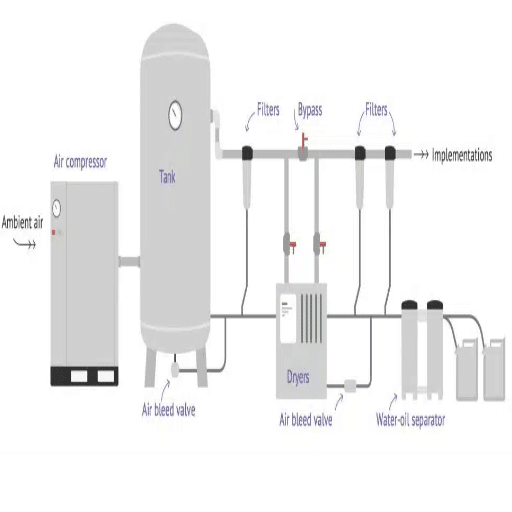
In constructing a modern air compression system, there are various considerations one must observe to improve efficiency and reliability:
-
1
Conduct a Rigorous Demand Study
Carry out a rigorous demand study to get an exact estimate of the consumption rates, peak periods, and component loadings. Through this method, it is possible to find the most efficient compressors without resulting in oversizing, which would be wasteful energy-wise.
-
2
Employ Staged Compression with Intercoolers
Appreciate the significance of staged compression if it is possible to employ it in the system design. Most of the time, intercoolers are used between stages to alleviate the heat caused by compression and eventually improve the performance as well as the lifetime of the equipment.
-
3
Optimize Air Storage System Design
Air storage system design is a key aspect of managing fluctuations – adequate volumes of compressed air tanks placed in strategic places minimize the risk of slipping below levels of pressure in a central system. This could be in the storage tanks themselves, as well as the piping system.
-
4
Minimize Leaks and Pressure Decrease
Regular gas-tightness inspection and guttering of the system should be a common practice because leaks will create excessive energy consumption. To minimize the pressure loss within the system, quality fittings can be used, a proper pipe diameter can be maintained, and after the flow optimization can be done.
-
5
Utilize Sophisticated Control Mechanisms
Sophisticated control devices provide an adjustable output level where the level of apportionment is in accordance with actual requirements to avoid energy loss due to unnecessary operation. These measures further include energy recuperation apparatus, such as heat used in heating devices derived from the compressors, thereby improving the cost-effectiveness and sustainability of the system design.
The set strategies focus on achieving optimum performance and low operating costs of a compressed air system.
Redundancy and Backup Systems
Ensuring constant operation along with durability requirements, especially in compressed air systems, necessitates redundancy and backup. Sound redundancy includes the principle of having two compressors in one compressor house directly connected, which serves the purpose of retaining the capacity even when a failure occurs in any one of the units. This is attained by use of N+1 redundancy, enabling operators to leave at least one additional compressor free and above its load base equivalent to the maximum levels the system design can carry, hence minimizing risk during the period that the system is not in operation.
More so, automatic control and monitoring aid in the switching between the main unit and its support backup units with ease, avoid unnecessary interruptions, and keep the pressure at the required level. Testing the backup units regularly is vital, besides maintaining these units in order to ensure that whenever these emergencies occur, these backup units work as expected for a long time, guaranteeing high long term availability of such systems in use.
🔄
N+1 Redundancy
At least one additional compressor is maintained above the load baseline to cover any single-unit failure
🤖
Automatic Switchover
Control systems detect failure and switch to backup units without interruption to pressure levels
🔍
Regular Backup Testing
Routine testing and maintenance confirm backup units are ready and operational when emergencies arise
Energy Management and Efficiency

Energy Management Techniques
Monitoring and improving energy consumption are crucial in energy conservation for saving expenses, increasing performance, and minimizing environmental damage. Among the most useful measures is the use of energy audits to evaluate loss, consumption patterns, and upgrade needs. More sophisticated Building Energy Management Systems (BEMS) can be used to record in real-time to enhance how the monitoring is done. Provision of energy sources that are renewable, such as solar energy and wind energy, assists in the reduction of greenhouse gases and the strains on the system design that exists. One can also minimize the need for peaks by placing demands during these fluctuations to both have energy and to save energy costs. It shall involve regular servicing of the equipment with training of the staff on the best ways of managing power in place for convergence efficiency.
Monitoring and Control Systems
Even though energy management is the responsibility of many stakeholders, they all, in reality, rely on monitoring and control systems, which therefore orient their activities properly and help managers make correct decisions. These systems can be equipped with comprehensive software applications and hardware sensors that are capable of screening and recording the energy usage, its overusages, or underusages, and automatic resolutions. In the case of BMS Building Management Systems, eco-friendly control is practical since it is synchronized with HVAC systems, light systems, and other fittings in the building, rendering it adjustable to the time of day, when there are people inside, or when the conditions outside change. To this end, the predictive analysis functions presented in such platforms may be used for learning and forecasting of future tendencies in energy usages allowing remedial steps towards savings and operational expenditures. Within the smart systems, it is also necessary to include the devices of the Internet of Things (IoT), as it helps to enhance the precision of the data collected from the field and to improve the system reaction time by adding anthropomorphic regulating systems.
Energy Efficiency in Compressed Air Systems
The systems for compressed air take a lot of electricity to run activities and are a major part of energy usage in various industries. This calls for identifying and correcting system design, such as leakages, pressure drops, and equipment that does not perform effectively, so as to optimize energy consumption. This is where regular maintenance comes in, as it is possible for leaks to go unnoticed but consume much of the energy in an excess of 20-30% energy leakage from the system. Using VSDs in a compressor system instead of using a motor with fixed speed, right compressor sizing, and proper management of cage system pressure are some of the means of cutting down on electricity costs. Heat recovery systems may also be installed to make use of the compression heat that would otherwise be lost. In this context, the performance of energy audits and the use of modern investigation tools support positive movements in the system design, which enhances the environmental sustainability of an enterprise.
Impact of Energy Losses and Methods to Mitigate Them
Industrial energy consumption is important and helps to improve operations, cost effectiveness, and concern for the beautiful natural environment. Key factors responsible for the energy waste include the poor operating regimes of equipment, overheads/leaks in the system, heat loss, and improper arrangement of processes. Energy loss in compressed air systems is due to improper system design or leakages, resulting in energy wastage, leading to an increase in the environmental cost of the system. Unlagged pipework in either short or long haul steam systems compounds this heat loss, reducing the efficiency of the system and increasing the energy use of the system.
To curb energy losses, an integrated strategy must serve the purpose. Indeed, the periodic upkeep by inspection and repair maintenance control programs limits the loss of energy resulting from layers or any other part that remains worn out undetected. The system design ensures the connection of pans and storage tank insulation as the energy thermal losses are reduced to a bare minimum. Utilization of energy-saving options, including but not limited to variable speed drives (VSDs) and motor high modern devices, enables loading to be achieved while reducing power use associated with it. In addition, the use of sensors for machinery operation assists operators in making adjustments faster because deviations would be highlighted promptly. Such techniques, aided by energy management system audits conducted from time to time, will enable industrial operations not only to achieve optimum productivity but also to be environmentally responsible.
| Energy Loss Source | Mitigation Strategy |
|---|---|
| Air Leakages | Periodic upkeep via inspection and repair maintenance programs; regular gas-tightness testing |
| Heat Loss from Pipework | Storage tank insulation and lagging of pipework to reduce thermal energy losses to a bare minimum |
| Fixed-Speed Motor Waste | Replace with variable speed drives (VSDs) and modern high-efficiency motors to match the actual load |
| Pressure Drop in Distribution | Use quality fittings, maintain proper pipe diameter, and perform regular flow optimization audits |
| Compression Heat Waste | Install heat recovery systems to redirect compression heat to space heating or process applications |
Variable-Speed Drives (VSDs) in Screw Compressors
For optimal energy efficiency and operational flexibility in screw compressors, the use of variable speed drives (VSDs) remains the best approach. There are variable speed drives which are controlled precisely to adjust the motor speed and therefore compressor output according to the demand, hence saving on unnecessary energy usage when not needed. In line with this, the greatest advantage is reduced cost during the lifecycle of such a machine due to the fact that lesser power consumption results in lower operating costs. Moreover, they enhance a longer equipment life as they make stop and start cycles less abrasive. This technology comes in handy in non-static operations where the level of activity may often change.
⚡
Precise Speed Control
Motor speed adjusted precisely to match actual air demand in real time
💰
Reduced Lifecycle Cost
Lower power consumption translates directly to reduced long-term operating costs
🔩
Longer Equipment Life
Fewer abrasive start/stop cycles reduce mechanical wear on compressor components
📊
Ideal for Variable Loads
Perfectly suited for non-static operations with frequently changing activity levels
Case Studies: Achieving Energy Efficiency in Real-World Applications
These examples illustrate the practical usefulness of implementing energy-saving system design employing variable speed drives, more specifically, in cases where turning or refraining from taxing due to request fluctuations and accuracy are of high importance.
⚙️
Design for Performance, Efficiency, and Longevity
From precise load calculations and strategic redundancy to VSD integration and real-time monitoring, every element of a well-designed compressed air system contributes to long-term cost savings, reliability, and environmental responsibility. Whether building from scratch or optimizing an existing installation, the strategies in this guide provide a comprehensive foundation for peak screw compressor system performance.
Reference Sources
Key Findings: This paper provides guidelines for system designers, emphasizing the importance of computing power, scalability, and future-proofing in physical system design.
Designs, Lessons, and Advice from Building Large Systems
Key Findings: Focuses on designing systems that can scale by 10X or 20X, with insights into handling feature changes and maintaining system integrity under varying loads.
Frequently Asked Questions (FAQs)
What are the main aspects I need to understand about system design?
Begin with such key and foundational system design aspects which are scalability, reliability, manageability, failover, and data consistency. Look at the proper or respective architecture (monolithic applications or microservices), load distribution techniques and patterns, application or data caches, sharding or partitioning, and also different types of storage like relational and NoSQL databases. Address requirements that are not functional in nature, including the aspect of response time, adverse effects of peak loads, where and how applicable – other concepts – consistent hashing – content delivery networks – channels – event-based architectures. A comprehensive plan, including architecture strings, interfaces, identification, regulatory requirements, and information systems oversight as guidelines for a technical interview, helps with the applicable situation.
What do I consider when conceptualizing designs for scattered and extensive networks?
It is a good idea to use horizontal scale, sharding or partitioning, replicating the data, and making services stateless. Scaled implementations make extensive use of load balancers; utilize CDNs for static contents; cache either in-memory or distributed to minimize the database load; and use asynchronous queues to handle. Systems that are by nature distributed necessitate reaching a consensus in-order to coordinate activities, by all means, providing partition tolerance. Although microservices help to separate mechanized blocks, independence will lead to managing the operation and the data complexity.
How much involvement with coding is needed in a system design interview, and how does it differ from solving architectural problems?
Most importantly, system design interviews assess the candidate’s ability to produce a well-crafted architecture and sound design decisions, rather than write working code, basic algorithms or codes are acceptable though, for the purpose of explaining things such as, API designs, relation/graphs of data or some other complicated algorithm codes for example, consistent hashing or the policy to evict cache. In such cases, when asked, be ready to draw class diagram patterns, write sample SQL statements, or any other form of REST or gRPC APIs for showing the various components’ interaction. Writing such code helps in showing an appreciation of the various query methods, indexing, turnaround query time, and the effect of designing a database on query processing, to name a few.
What impact do the type of database and the choice of query have on the design?
There is great emphasis on the selection of a proper database as part of any system. When one thinks of relationships or transactions in databases, there is no surpassing RDBMS or SQL, especially when it comes to their inability to handle complex joins. No SQL, on the other hand, does not need fixed schemas; writing comes quite fast as it is distributed and partitioned. Design choices include aspects such as the types of queries within the system, the design of indexes, how often reads occur compared to writes, and how much latency there shall be. There are hot reads, and those would require some form of caching; certain microservices would contain very complex queries that need to be answered very quickly, and this is where denormalization comes in handy. Eventually, consistency between services would be maintained through event-driven approaches. All information needs to be related to the form of storage and the replication or backup of data.
What trade-offs boil up whenever changing or introducing a new design to a system design?
You will be describing and evaluating the cost and complexity of microservices as opposed to monoliths, and also indicate when it is best to use SQL and when it is NoSQL, point out the overhead for maintaining strong consistency in an event-driven system, and the case of eventual consistency. Also, how do these options impact maintainability, ability to withstand failures, the overhead of operations (e.g., monitoring, tracing), using load balancers, CDNs, and caching to resolve particular restrictions? Otherwise, what would be the solution?
How do I plan for fault tolerance or low-latency computing system design?
For example, in order to make a system design fault-tolerant, it will need redundancy, health checks, automated failover in place, and also graceful degradation. Replication, multi-zone deployment circuit breakers, and retry back-off strategies are the aspects that can be used. As services are placed in proximity to the users through CDNs, API protocols have to be enhanced by optimization, queries made need to be efficient through the use of query plans, responses cached, and cross-synchronous service calls as little as possible. In order to avoid such a condition, rate limits, request batching, and queues should be used as they will improve total response time, especially in high traffic conditions.
And in this, where do APIs, authentication, and interfaces, in general, sit?
The APIs constitute the agreement between components of the system; specify unambiguous REST/gRPC/GraphQL endpoints, API versioning, and error reporting. Creating, consuming, and securing APIs as tokens, OAuth, and mTLS creates cross-cutting concerns, which should be addressed at the API gateways or service perimeters. Build the boundary layer such that it will incorporate throttling, appropriate input checks, and logging. In the creation of the organization’s core, keep in mind the consideration of API protocols in relation to performance and the developers.
What is the best way to go about making diagrams and answering the major questions in a system design interview?
Lay out needs (both functional and non-functional) first. Next, make a structure chart of a system, identifying several components (front end, back end, databases, caches, queues, and content delivery networks). Then, explain the purpose, functioning, and impacts of the design choices made in each component in turn. Provide instances such as sharding techniques, methods of caching, or market-driven workflows to back up the reasoning. All aspects of the system design should be built in such a way that they address scalability and maintenance issues. Finally, address how the system would be tested and operated in the post-deployment phase.