
Portable vs Stationary Air Compressor for Factory Use: How to Choose the Right System
It is estimated that every hour of anesthesia downtime in a hospital costs over $10,000. And though much of the time, plant managers are still considering the air compressor as a logistical piece of equipment more than as a strategic one. The compressibility of the materials based on economics, as well as the operational and maintenance costs of the wrong system, may make equipment disappear and, if present, blow up the costs just to do routine maintenance.
For example, in factories, it would be good in decision-making portable vs. a stationary air compressor: which one to choose. It would be wrong to overestimate the usefulness of compressed air in factories. It is the main element of pneumatic tools, automatics and automation systems, conveyor lines. Trying to fit a square peg in a round hole of your operational plans, but not with cost-effective benchmarks.
In this guide, we will clarify why portable and stationary compressors are beneficial for factories. You will get guidance on when and how it will be important and valid to use this or that. The costs for such a service spanning over ten years do exist, and various other factors concerning efficient operation are considered; for example, some factories manage to have both types of air compressors blowing air at the same time, thus achieving the optimum advantages of each system. As such, you should be in a position to select the air compressor system that fits in with your production requirements, in addition to controlling costs.
If you want to choose between screw compressors and piston compressors, you can check out our guide about Screw vs Piston Compressor.
What Is a Stationary Air Compressor?

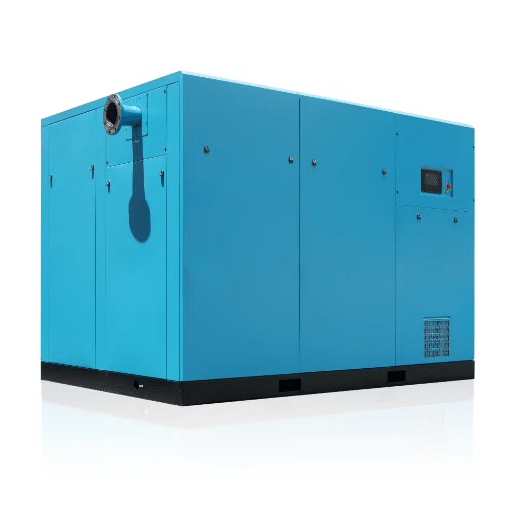
A stationary air compressor is a fixed installation piece of equipment that is designed for pumping continuous compressed air in large quantities to a permanent location. They are generally electric-powered, accommodated in a frame or on a base tank, and then connected to a wide distribution network made up of pipes, dryers, and receivers for the operation of the entire plant.
In factory settings, compressors that are fixed and do not move are typically rotary screw compressors. The efficient method functions by using two rotating helical screws, which do not pulsate and have no piston pads. Thus, the pressure does not fluctuate within the system, the air flows out at a consistent rate and can be operated for 24 hour without any rest time.
Stationary units come with a 5 HP attachment for use in workshop tools, and even more than 500 HP industrial applications. Plants with an array of 15 HP units to 100 HP capacity are sought after in 50 to 500 CFM at the operating pressure of 90-150 PSI. These are equipped with specialized air purification gear. Drying units remove the humidity. Another tool traps the particles– a line filter. The undisturbed condensate underwater oil separator bore emerges.
Large storage vessels collect the excess amounts of air needed due to the high demand periods and will supply it back to the systems with levels fully depleted. All the above-mentioned objects contribute to the fact that each pneumatic tool and actuator at every level corresponds to the eargets clean and dry air at a stable pressure.
Inter-linkage is the most advantageous aspect of energy-conserving buildings. A well-designed stationary system becomes invisible. It simply works, day in and out, sending products into the production line without requiring everyday monitoring by attendants. This level of dependability is one of the reasons why stationary compressors happen to be 58.4% of the global market and are poised to take in 87% of the industrial segment by 2026.
Mini-story: When Chen expanded his electronics assembly plant in Shenzhen, he installed a single 30 HP stationary screw compressor with a 500-liter receiver and integrated dryer. The system includes 12 pneumatic workstations, steers two automated pick-and-place machines, and conveys processed products by means of a belt. Using constant and unrelenting approach within three years, he managed to register only two unintended downtimes which was for four hours each due to air filter replacements. The average of his maintenance cost for all these years stands at $800.
What Is a Portable Air Compressor?
A mobile air compressor is a device that has been designed to create compressed air at the projected point, which does not depend upon any built-in systems. Such devices have other various appearances: small portable electric one-wheeled carts for simple tasks, trailers for construction sites and truck-mounted for mining and road construction works.
Power supplies are what separate portable compressors from fixed machines. The first are suited for a very small task or for a prolonged one; the electric compressors are plugged into the grid for operation. The second can be more powerful and does not require a connection to the power mains because they use diesel, turbine, and petrol engines. This is obviously the added benefit. Therefore, a type of diesel-driven air compressor, from any brand, is able to distribute compressed air out in the field, where there’s no power in the grid, and any other section of the plant where piping cannot run.
Portable compressors, as a rule, deliver less air flow compared to stationary systems. For instance, light-duty machines deliver between 2 and 10 CFM. It is possible, however, that heavy-duty industrial parables will exceed this figure to reach 30 to 100 CFM or more; even then, the costs of fuel and maintenance are high. Similarly, the tanks are very small, typically 20 to 60 liters and the cycles also have to be of intermittent and not constant use.
In a factory context, portable compressors are rarely the primary air source. They are tactical tools. A maintenance crew uses one to power pneumatic tools while servicing equipment far from the main air header. A plant keeps a diesel unit as an emergency backup in case the stationary system fails. A factory under renovation uses portables to power temporary workstations before permanent piping is installed.
Consequently, one might argue that the ability to move the equipment to another location comes at a cost. That is, the portable filters are always in the field and are not as clean as the stationary ones. The engine nets have to be maintained frequently. However, the most pressing concern becomes the price paid to fuel the portable. Over a consistent period of one whole year of ongoing usage, a diesel operated portably costs about twice to four times more than an equivalently powerful stationary electric compressor.
Key Differences for Factory Operations
The differences in their insulation are one of the reasons why factories construct their composite air systems with these considerations in mind. The chart shows some of the most relevant issues when it comes to petroleum in factories.
| Factor | Stationary Air Compressor | Portable Air Compressor |
|---|---|---|
| Mobility | Fixed installation, bolted in place | Wheeled, towable, or truck-mounted |
| Typical CFM Range | 50 to 500+ CFM | 2 to 100 CFM |
| Pressure (PSI) | 90 to 150 PSI standard | 90 to 150 PSI standard |
| Duty Cycle | 100% continuous operation | Typically 50% or less |
| Power Source | Three-phase electric (380V/400V) | Diesel, gasoline, or single-phase electric |
| Tank Capacity | 200 to 1,000+ liters | 20 to 200 liters |
| Noise Level | 65 to 75 dB with enclosure | 75 to 90+ dB |
| Air Treatment | Integrated dryers, filters, receivers | Basic or standalone treatment |
| Upfront Cost | Higher (3,000 to 50,000+) | Lower (500 to 15,000) |
| Operating Cost | Lower (electricity only) | Higher (fuel + frequent maintenance) |
| Lifespan | 15 to 20+ years with maintenance | 5 to 10 years under heavy use |
| Best Factory Role | Primary production air supply | Backup, maintenance, temporary use |
The duty cycle difference is critical. A portable compressor rated at 50% duty cycle must stop and cool down for half the time. Running it continuously causes overheating, accelerated wear, and premature failure.
Stationary screw air compressors are designed for continuous duty applications. They operate all day, every day, and require servicing after every 2,000 to 4,000 running hours.
The differences in operational costs simply make it worse. The cost of electricity for a stationary unit may climb in the range of 8-15 dollars per six hour shift. Comparatively, run diesel fuel costs for a stationary portable accumulator exerciser for the same period may rise to 30 to 50. Over 250 working days, the year is costly by 5,500 to 8,750 alone for these buys.
For factories evaluating a portable vs. a stationary air compressor for factory use, the decision usually becomes clear once total demand exceeds 15 to 20 CFM or continuous operation is required. Below that threshold, a portable unit might handle light, intermittent work. Above it, only a stationary system makes engineering and economic sense.
When to Choose a Stationary Air Compressor
A stationary compressor is the right choice for most permanent manufacturing facilities. Here are the specific scenarios where it delivers the best return.
Continuous Production Lines
For a factory that operates shifts at all hours, a fixed-speed vertical rotary screw air compressor is the one that makes the most sense. On assembly lines, automatic packaging equipment, and CNC machines, pneumatic actuators do play an essential role and they cannot depend on air throughout. Any delay in the availability of air stops every activity. When such an occurrence happens, delays follow stream flows and multiply.
Multi-Tool Simultaneous Operation
It is not common for a factory to only use one machine. For example, in an average car service station, there might be three impact wrenches, two air guns, and a sandblaster working simultaneously. A fixed plant capacity is simply designed to avoid pressure drops in such situations. With respect to the portable models, they are often found wanting in such situations when more than one high-CFM tool is in operation.
Plant-Wide Air Distribution
Compressors that are used in stationary applications are permanently installed in one place and connected to a piping network. Such a setup eliminates the problem of hoses spread all over the place, the trip hazards, and gives every tap the same pressure. If there is a need, adding another point would mean only adding a point to the distribution line.
Air Quality Requirements
The ISO 8573 provides clean air standards for certain manufacturing processes, such as the food industry, the pharmaceutical industry, and the electronics industry, where the quality of air must be controlled and maintained. These systems are always designed with refrigerated dryers, coalescing filters, and oil-water separators that, when put together, give air quality of class 1.2.1 or better. Most portable units typically do not achieve the same level of cleaning.
Long-Term Energy Efficiency
Electric stationary compressors, especially those with Variable Speed Drive (VSD) technology, match motor output to real-time demand. Instead of running at full speed and unloading excess air, a VSD compressor slows down when demand drops.
The fact that this mode of operation can save up to 35% to 50% in energy when compared to the fixed-speed operation should not go unmentioned. For a plant operating actively all year round with a limited number of hours of operation such as 4,000 hours, the savings run to thousands of dollars in operating costs.
Want more information? Our complete guide on how to choose an air compressor for your factory covers the full selection framework from demand audit to total cost of ownership.
When to Choose a Portable Air Compressor
Portable air compressors have their place due to certain specialized applications in the factories, despite the overwhelming preference of fixed systems convertible to semi-mobile facilities. Where and why portables are useful will be given here.
Mobile Maintenance and Repair
Maintenance crews often work far from fixed air drops. A wheeled portable compressor brings compressed air to equipment that needs pneumatic tools for repair. This eliminates the need for hundred-meter air hoses that create pressure drop and safety hazards.
Temporary or Construction Work
Factories undergoing expansion or renovation need air power before permanent infrastructure is installed. Portable compressors serve as temporary air sources for construction crews, allowing production to continue in unaffected areas. Once the expansion is complete, the portable unit moves to its next assignment or becomes backup equipment.
Emergency Backup During Outages
A portable diesel compressor as an independent system to the factory’s main electrical source, serves the purpose. This compressor plays an important role in a complaint because it provides power for the chute, bucket, cone crushers, and drill rigs which could otherwise fail to start when power is cut due to mechanical failures. Such a device offers the benefit of being returned quite easily because it has enabled workers to keep working through repairs, which, unlike time, money is of minimal value.
Remote Workstations
For large manufacturing plants housing large outdoor storage areas, docks, and outbuildings, air supply may be erratic or limited. A mobile air compressor at such locations will supply air as it is needed without the need to erect permanent tubing.
Field Service and Off-Site Operations
When mobile maintenance or technical services are offered, a portable air compressor is usually included as a part. Welders, grit blasters and others who use air powered tools need to be delivered air directly at client locations, which do not have any infrastructure erected.
Mini-story: Martinez is the owner of a metalworking plant in Mexico City. The core tasks in the manufacturing process which primarily involve welding and grinding are discharged through the use of the principal 25 HP fixed compressor. This is the year when it collapsed owing to a failure in the bearings within two days. However, as they had a 10 HP diesel engine armed with a portable compressor as reserve, the team was able to achieve and deliver a rush job amounting to $12,000 on time. It was that one in particular weekend only and the portable compressor stood up for its costs.
Factory Application Guide by Industry

Different branches of industry can have various criteria for air consumption. It is much easier to define whether the portable or stationary system suits your production by understanding the industrial air use of your company.
Automotive Manufacturing and Assembly
Car production factories, much like any other modern production facility, use compressed air for painting, tire inflation, pneumatic tools, and robotic actuation – among other applications. It is estimated that each assemblage unit would require an air flow of between 15 and 30 CFM. Therefore, when there are different stations being operational simultaneously, the total demand of air will quickly be more than 100 CFM. It is a common practice to have stationary screw compressors with integrated dryers. Portable units perform as a backup and are used only in maintenance and temporary painting facilities.
Food and Beverage Processing
Clean and compressed air is a crucial part of industrial food production. Due to stringent product safety requirements, the air used in food facilities must be completely free from oil or oil residues. For applications that use packaging lines and conveyor systems, and liquid and powder filling, an uninterrupted supply is needed. Fixed systems are those where only oil-free air of ISO8573 class 0 or 1 can be supplied. The use of portable compressors may be quite limited due to concerns for the quality of air available.
Electronics and Semiconductor Production
Clean, filtered air is vital for circuit boards’ production. For example, reflow soldering is needed. With this in mind, most pneumatic machinery, including pick-and-place machines and other tools that require compressed air such as pneumatic tools for electronic components manufacturing, would have a certain processing rate and expect a stable pressure with low moisture and oil content. In most cases, a stationary rotary screw with 20 to 50 horsepower, including refrigerant dryers and filtration, is used. Generally, portable compressors are not placed in a cleanroom.
Metal Fabrication and Welding
Assisted by injection, compressed air is also used in welding shops, laser cutting organizations, and metal polishing enterprises in order to effectively operate plasma cutting, pneumatic gripping, and soft grit blowing equipment. This ought to provide highly motivated and fluid requirements. One should expect a 30 to 75 HP permanently fixed compressor within compressor rooms. There might be portable systems mobilized to augment the central network, particularly should there be a call for exterior or in situ sandblasting activities.
Textile and Packaging Industries
Factories focusing on textile production utilize air for the operation of looms, handling yarn, and product finishing operations. All this air-driven equipment will require an extant, constant flow of air; thus, the air shall be moderate such that stationary systems from 15 to 40 HP can cover the same. As for the portable compressors, they are only required when the production line is being reconstructed or maintained during restoration.
| Industry | Typical CFM Demand | Recommended Type | Air Quality Priority |
|---|---|---|---|
| Automotive | 100 to 300+ CFM | Stationary | Moderate |
| Food & Beverage | 50 to 150 CFM | Stationary (oil-free) | Critical (ISO 8573) |
| Electronics | 30 to 100 CFM | Stationary (dry, filtered) | Critical |
| Metal Fabrication | 80 to 200 CFM | Stationary + portable backup | Moderate |
| Textile & Packaging | 40 to 120 CFM | Stationary | Moderate |
Sizing Your Factory Air Compressor
The decision so that one can find the right compressor entails knowing the peak air demand. Oversized consumes more power and space. Likewise, the option of making a mistake due to an insufficiently sized compressor, since the pressure drops, tools can not be used, and the compressor’s life is reduced, even reaching the compressor wearing out point.
How to Calculate Total Air Demand
List every pneumatic device in your facility. Record the CFM requirement and operating pressure for each. Identify which tools run simultaneously during peak production. Add the CFM of all simultaneously operating devices. Multiply by a utilization factor, typically 0.7 to 0.9, to account for tools that cycle on and off rather than running continuously.
Common Factory Equipment CFM Requirements
| Equipment | CFM at 90 PSI | Typical Pressure |
|---|---|---|
| Impact wrench (1/2 inch) | 4 to 5 CFM | 90 PSI |
| Impact wrench (1 inch) | 10 to 12 CFM | 90 PSI |
| Spray gun (HVLP) | 8 to 12 CFM | 40 to 60 PSI |
| Spray gun (conventional) | 15 to 20 CFM | 90 PSI |
| Angle grinder | 5 to 8 CFM | 90 PSI |
| Orbital sander | 8 to 12 CFM | 90 PSI |
| Sandblaster (small) | 15 to 25 CFM | 90 to 125 PSI |
| Pneumatic actuator (cylinder) | 1 to 5 CFM | 80 PSI |
| CNC machine tool changer | 3 to 6 CFM | 90 PSI |
| Packaging stapler | 2 to 4 CFM | 70 to 90 PSI |
Adding Safety Margin
After calculating the maximum flow rate expansion, and increasing it by 30%-50% to allow for more capacity. Service deterioration, fretting corrosion, sensor damage, wear and tear, and leakages should also be allowed with the pipe diameters. If your calculated peak demand is 80 CFM, size your compressor for 104 to 120 CFM.
In most applications, demand above 15 to 20 CFM requires the use of a rotary screw machine extensively. On the contrary, demand lower than 10 CFM with of and on duty cycles can be handled by a portable, though even the smaller outfits prefer stationary operation as these models do not allow for any extras.
The Hybrid Approach: Using Both Systems Together

The most resilient factories do not choose between portable and stationary. They use both in a complementary strategy.
Primary Stationary + Portable Backup
A 100% of the production capacity for the day is managed by the principal, that’s production handling. Capacities of portable and often accessible units of the primary system are often checked in one month for its efficiency, and such systems are constantly refueled or recharged, which will be expedited by all that checked equipment at disposal within the shortest period. Every plant does that, be it a car factory, a food processing factory or any other for which downtime costs are more than $1,000 in an hour.
Zone-Based Coverage
Large factories with multiple buildings or outdoor work areas install stationary systems in the main production hall. Portable compressors serve satellite zones, yards, and temporary project areas. This eliminates the need to build main airlines per-work areas frequently used as compressed air is not required permanently.
Seasonal Demand Surge
Whenever the stationary compressor is unable to cope, a mobile compressor which is cheaper than purchasing a new and more powerful air compressor, is only temporarily supplemented. This mixed system limits the use of resources without the usual financial commitments.
Cost-Benefit of Redundancy
Such backup generators can go anywhere from $5,000 to $15,000 for a diesel version. If, while in use, a mere 2-day production shutdown due to some fault results to a loss sale of $50,000, then that generator shows a return on investment. Most factories are not looking at ‘if’ they can get a backup generator; the question is whether they do without one.
Total Cost of Ownership
The sticker price tells only a fraction of the story. A complete cost analysis spans purchase, installation, energy, maintenance, and downtime over the equipment’s lifetime.
5-Year Cost Comparison
| Cost Factor | Stationary (30 HP Electric Screw) | Portable (Diesel, Equivalent CFM) |
|---|---|---|
| Initial Purchase | 8,000 to 15,000 | 6,000 to 12,000 |
| Installation & Piping | 2,000 to 5,000 | $0 |
| Annual Energy/Fuel | 2,500 to 4,000 | 7,500 to 12,500 |
| Annual Maintenance | 800 to 1,200 | 2,000 to 3,500 |
| 5-Year Total | 28,000 to 46,000 | 54,500 to 87,500 |
10-Year Cost Comparison
| Cost Factor | Stationary (30 HP Electric Screw) | Portable (Diesel, Equivalent CFM) |
|---|---|---|
| Initial + Installation | 10,000 to 20,000 | 6,000 to 12,000 |
| 10-Year Energy/Fuel | 25,000 to 40,000 | 75,000 to 125,000 |
| 10-Year Maintenance | 8,000 to 12,000 | 20,000 to 35,000 |
| Replacement (if needed) | $0 | 6,000 to 12,000 |
| 10-Year Total | 43,000 to 72,000 | 107,000 to 184,000 |
The numbers are clear. A stationary electric compressor costs more upfront but delivers dramatically lower lifetime costs. The energy savings alone typically recover the purchase premium within two to three years. Over a decade, the stationary system can save 50,000 to 100,000 compared to running a portable unit as a primary air supply.
VSD technology improves the economics further. A VSD stationary compressor running at partial load for much of the day uses 35% to 50% less energy than a fixed-speed unit. For factories with variable shifts or intermittent production, this efficiency gain accelerates payback.
Mini-story: The operations team at a plastic injection molding facility in Thailand faced a choice. Their old 20 HP piston compressor needed replacement. The purchasing manager favored a 6,000 diesel portable to avoid installation costs. The plant engineer pushed for a 12,000 stationary screw unit with VSD. They ran the ten-year numbers. The portable would cost approximately 95,000 in fuel and maintenance. The stationary unit would cost 48,000 including electricity and service. The engineer won the argument by $47,000. Three years later, the VSD compressor had already paid for its premium through energy savings.
Decision Checklist: Which Compressor Is Right for Your Factory?

Use this checklist to determine whether a portable or stationary air compressor fits your operation.
- Does your facility have a fixed production location? If yes, choose stationary.
- Do you need to power multiple tools or machines at the same time? If yes, choose stationary.
- Does your operation run for more than four hours continuously per day? If yes, choose stationary.
- Is your calculated air demand above 15 to 20 CFM? If yes, choose stationary.
- Do you have reliable three-phase electrical power available? If yes, choose stationary.
- Do you need air for food, pharmaceutical, or electronics production with strict quality standards? If yes, choose stationary with integrated treatment.
- Do you need to move compressed air between job sites or buildings? If yes, portable may be appropriate.
- Is your usage light and intermittent, under 10 CFM, for less than two hours per day? If yes, a portable unit might suffice.
- Do you need emergency backup air independent of plant power? If yes, add a diesel portable as secondary equipment.
- Are you willing to invest more up front for significantly lower long-term operating costs? If yes, stationary is the better financial choice.
If all questions from one to six were marked with a ‘yes’, then it is recommended that a stationary air compressor be the priority system to be used in the factory. If the answer to questions seven and eight is yes, one can opt for mobile equipment or complement its main system with it. If the answer to question nine is yes, suggest considering them as a complementary system as well.
Frequently Asked Questions
Can a portable air compressor handle continuous factory production?
No. Portable compressors are not rated for continuous use, which is typically around 50%. Continuous operations cause the heat of the compressor to rise, cause additional wear on the system, and reduce the compressor system’s life span. Stationary rotary screw air compressor is 100% duty cycle rated and is therefore preferred in any operation where continuous production takes place.
What size air compressor do I need for a small factory?
Calculate the cumulative CFM of all power tools and equipment that shall work at the same time, followed by incorporating a safety guarantee of 30% to 50%. Small worksites that have low service requirements may be able to utilise portable units less than 15 metric cfm. In the majority of small workshops, the optimal solution requires a 10-30 HP package recirculating screw compressor mechanically welded in one frame for the flow rate from 40 to 120 CFM.
Is a portable compressor a good backup for a stationary unit?
Yes, if it is diesel-powered and does not rely on the power supply of the factory. It can provide mobile source repair services in case of breakdown of the fixed compressor or when the factory power supply is not available. In the majority of cases, provisions that forestall such setups should also be incorporated. Usually, it is cheaper to do this than face the costs of a single shutdown of production.
How much does a factory air compressor cost?
The prices of non-flowing electric screw compressors are usually in the range of 3,000 for small and powerless 5 HP units, to 50,000+ for the large industrial systems. Their equivalents as the stationary type range from the cheapest 500 light electric models to their counterparts in heavy-duty use, costing 15,000+. For stationary systems related to portable compressors spacing, the total cost of installation costs, pipework, and air treatment is from as low as 2000 to as high as 10,000 US dollars.
Conclusion
Selecting between a portable and a fixed air compressor for retail purposes is not a matter of identifying which one is the cheapest; on the contrary, it must be based on how the facility functions. Fixed systems have the best results as far as industries are concerned since they ensure that there is constant airflow within the production line, stable pressure, and, most particularly, low operation cost. The portable compressors find their applications when an urgent call for maintenance arises, as well as in instances for providing air for a short while.
For example, the best factories are those that do not look at the production cost but the total cost of ownership. Such a cost is significantly different from a capital one. An electrically powered stationary compressor is likely to cost more at the point of procurement, but quite often, at the end of 10 years, it would have realized a savings of 50,000 to 100,000 as compared to having a portable compressor as the main air supply. This additional energy savings brought about by the Variable Speed Drive technology makes the operating costs of the already profitable maintenance even lower by 35 to 50%.
Observe your actual consumption capacity. Identify your peak concurrent tool utilization. Factor in an increase for future expansion. After considering the level above 15-to-20 CFM, or if you work 24/7, then consider rebasing a fixed rotary air compressor as long as the size will suffice. There may also be instances where it would be appropriate to incorporate a portable generator into your disaster recovery provisions in case of need.
Not sure which system fits your factory? Contact our team for a customized compressed air assessment. We look through your list of equipment, calculate utilization rates together with you, and take into consideration development perspectives to identify the optimal compressor dimension and type we are able to quote you for your particular purpose.