
Screw Compressor Cooling Systems: Oil Coolers, Aftercoolers, and Temperature Control
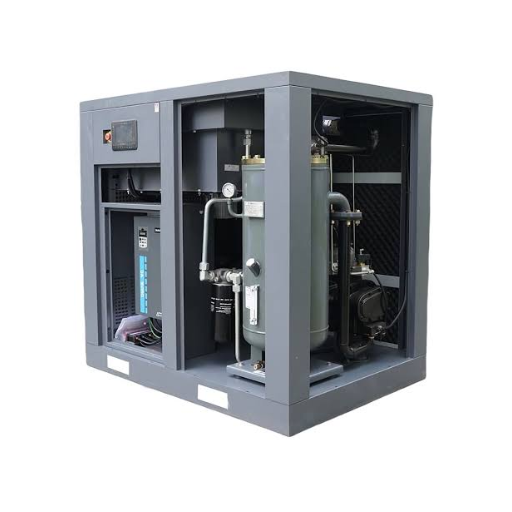
A screw compressor cooling system removes heat along two separate paths. The oil circuit carries heat from the airend to the oil cooler and returns cooled oil to the injection point. The air circuit carries heat from the airend to the aftercooler and out to the plant. A thermostatic valve holds oil temperature in range by blending cooled and uncooled oil before it re-enters the rotor chamber.
Daniel Okafor runs maintenance at a beverage plant outside Lagos. His 75 kW unit started tripping on high temperature every afternoon in March, when the room climbed past 38 °C (100 °F). Two service visits cleaned the same radiator. Neither helped.
The third technician put a torch behind the oil core of the combined cooler. It was packed solid with dust. The air core in front of it was spotless, so every visual check had passed. One fan, two cores, and only one had ever been cleaned.
This guide covers what each part must do, how the controls hold temperature, how to maintain it, and what to specify when buying. It does not diagnose a machine that is already hot. Our handles that.
Key Takeaways
- An oil-injected screw compressor has two cooling paths, not one. They share a fan but not a design limit.
- The thermostatic valve is a mixing valve, not a switch. It blends hot and cooled oil to hold injection temperature, typically between 71 and 85 °C (160 to 185 °F).
- Running oil too cold is a real fault. Oil below its operating band lets water vapour condense in the sump, producing emulsion and corrosion.
- Aftercooler performance sets the water load your dryer must remove.
- Package heat is recoverable: up to 96% through direct hot-air use, or around 76% through a heat exchanger.
What a Screw Compressor Cooling System Actually Does
A rotary screw compressor turns electrical input into pressure, and the temperature rise comes with it. Almost none of that energy leaves as useful work. Nearly all of it must be rejected as heat, and oil carries the largest share because oil is what the air end injects into the compression chamber.
That gives a working rule. Take the motor input in kW and treat roughly that figure as the heat the package must shed. A 75 kW unit is, for practical purposes, a 75 kW heater that also makes air.
The stakes reach beyond one machine. The estimates compressed air accounts for roughly 10% of industrial electricity use in the United States.
The two circuits
Keep these separate, because most cooling faults live in one circuit while the symptom shows in the other.
The oil circuit. Hot oil leaves the separator tank, passes the thermostatic valve, goes through the oil cooler, then the oil filter, and returns to the injection point. It lubricates, seals, and carries heat at once.
The air circuit. Compressed air leaves the air end as a hot mixture with oil, and the separator tank drops the oil out. The air then passes the minimum pressure valve and the aftercooler. Some designs put the aftercooler first. That changes service access, not the physics.
The air end is protected by an oil film on the rotors and bearings, and film strength falls as temperature rises. The controller usually displays air discharge temperature, but oil temperature is the variable the cooling system actually controls. If your machine is already tripping, work through our guide to .
To understand how it works, please read our article on oil-injected rotary screw compressor working principle.
Air-Cooled vs Water-Cooled Screw Compressor Cooling
Every screw compressor cooling system rejects heat to something. Air-cooled packages reject it to the room; water-cooled packages reject it to a water loop. That choice shapes how the machine behaves in summer.
Air-cooled packages
A fan pulls room air across finned cores and discharges it hot. Most small and mid-size packages are built this way: no water treatment, no pumps, no cooling tower, no freeze protection.
The trade-off is dependence on the air around the package. Dust loading, room temperature, and recirculation all matter. An air compressor cooling system built this way is only as good as the room it breathes, and the same unit that performs exactly as rated in a clean, ventilated room will not in a hot corner with its own exhaust bouncing off a wall.
Water-cooled packages
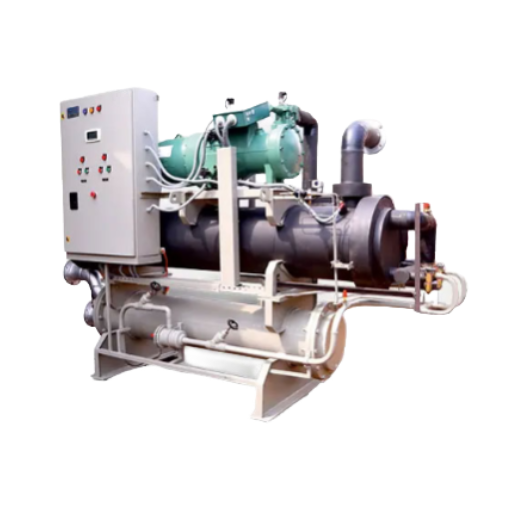
A water-cooled screw compressor uses shell-and-tube or brazed-plate exchangers on a cooling-water loop. It is immune to room temperature, quieter, and more compact. The constraint moves to the water: inlet temperature, flow, pressure, and fouling become maintenance variables.
Vendor notes commonly specify an inlet at or below 35 °C (95 °F), supply pressure of 0.3 to 0.5 MPa, and a 5 to 8 °C (9 to 14 °F) rise across the exchanger. Confirm these against your own manual.
Which one fits your site
| Factor | Air-cooled | Water-cooled |
|---|---|---|
| Room ambient above 40 °C (104 °F) | Poor fit | Strong fit |
| Reliable cooling water | Not needed | Required |
| Dust or lint in the room | Higher cleaning burden | Lower cleaning burden |
| Footprint and noise | Larger, louder | Compact, quieter |
| Freeze risk in winter | None | Real, if the loop is exposed |
For most small and mid-size factories, air-cooled is correct. Water-cooled earns its place where ambient is high, the room is tight, or the plant already runs a cooling tower.
The Oil Cooler and the Thermostatic Valve
What the oil cooler has to reject
Here is the calculation nobody publishes. The assumptions are illustrative, not a specification.
Take a 75 kW (100 hp) package at full load. Assume the oil circuit carries about 60% of the package heat load, roughly 45 kW. Assume an oil flow of 120 L/min at a density near 0.87 kg/L and a specific heat around 2.0 kJ/kg·K. That gives a mass flow of about 1.74 kg/s.
The temperature drop across the cooler is then:
ΔT = 45 ÷ (1.74 × 2.0) ≈ 13 °C (23 °F)
That is what the cooler exists to produce. If it delivers 8 °C on a hot day, it is not keeping up. If it delivers 3 °C, it is fouled or bypassing, and the thermostat is opening to compensate. Change an assumption and the number moves; the method travels.
What is inside the cooler
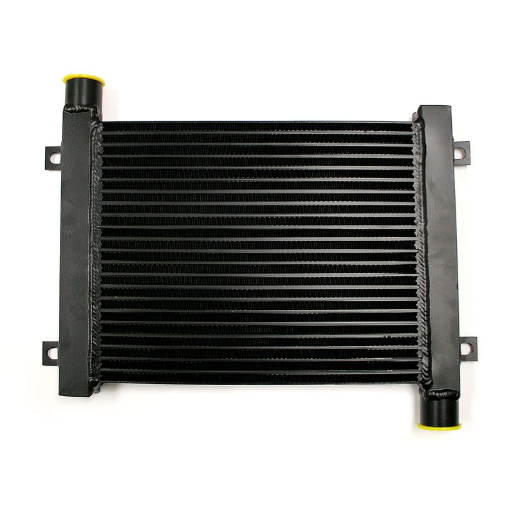
Air-cooled units use plate-fin or tube-and-fin cores. Their failure mode is external fouling: dust, lint, and oil mist bridging the fins. Water-cooled units use shell-and-tube or brazed-plate exchangers, and their failure mode is internal, where scale, biofilm, and silt cut flow and heat transfer together.
Combined, or combi, coolers put both cores in one housing behind one fan. That saves space and creates the situation in Daniel’s plant: two cores, one visual check, one of them cleaned.
The thermostatic valve: a mixing valve, not a switch
The valve sits between the separator tank and the cooler, and it has three ports. One takes hot oil from the tank. One takes cooled oil returning from the cooler. The third delivers the blend to the air end.
At cold start, it bypasses the cooler so the machine reaches operating temperature quickly. As oil warms, the element strokes and diverts progressively more flow through the cooler. Published figures put the opening range between roughly 71 and 85 °C (160 to 185 °F), though the exact range is set by the OEM and the specified oil grade.
That explains two opposite symptoms from one part. Stuck open, the machine runs cold and never reaches temperature. Stuck closed, it overheats with a perfectly clean cooler.
Why running too cold is also a fault
Operators chase high temperature and rarely think about low temperature. That is a mistake.
Compressed air leaves the air end saturated with water vapour. If the oil in the sump sits below the point where that vapour condenses, water drops into the oil. The result is emulsion: milky oil that lubricates poorly, corrodes steel, and shortens bearing life.
Light-load operation in winter produces exactly this. A machine running at 30% capacity in a cold room may never reach its intended oil temperature, so the thermostat stays partly closed and the sump stays cool all shift. The gauge looks healthy. The oil is not.
Marta found out the expensive way. Her plant in southern Poland ran a 45 kW unit two shifts in summer and one light shift from November to March. Every spring the oil analysis came back with elevated water, and every spring the service company replaced the oil separator, hunting a leak that did not exist. The oil was simply never getting hot enough to boil the condensate off. Running the unit at higher load through the winter and raising the room temperature ended a three-year pattern of unnecessary parts.
If oil analysis keeps showing elevated water with no leak to explain it, look at duty cycle before you look at the cooler.
The Aftercooler and Compressed Air Temperature
Approach temperature and what it costs downstream
Air leaves the air-end having absorbed compression heat and picked up heat from the oil it was mixed with, so discharge temperatures well above oil temperature are normal. The aftercooler brings that air down before it enters the plant, and everything downstream depends on it: separator, dryer, piping, tools.
An air compressor aftercooler cannot cool air below the temperature of the medium cooling it. The gap between the cooled air outlet and the cooling medium inlet is the approach temperature. A tight approach means good heat transfer. A wide approach means fouling, bypass, or an undersized core.
Approach also sets the water load. Warm air holds more moisture, and that moisture has to be removed somewhere. If the aftercooler leaves the air warm, the refrigerated dryer works harder, and any moisture that gets past it lands in the piping.
This is the first stage of water removal in the system. Our guide to covers what comes next, and if water is already showing at the drop points, walks through the diagnosis.
Aftercooler vs intercooler vs dryer
The three terms get used interchangeably online. They are not the same thing.
| Component | Where it sits | What it does |
|---|---|---|
| Intercooler | Between compression stages | Cools air partway through compression, on two-stage machines |
| Aftercooler | After the final stage | Cools discharge air before it leaves the package |
| Dryer | Downstream of the package | Removes remaining vapour to a target dew point |
A single-stage screw compressor has an aftercooler and no intercooler. Most “aftercooler vs intercooler” content online is about turbocharged engines, where the terms mean something else again.
Temperature Control in a Screw Compressor Cooling System
Published figures for oil-injected screw compressors cluster in a narrow band. Oil discharge typically runs around 80 to 95 °C (176 to 203 °F) at full load. Oil service life degrades noticeably above roughly 95 °C (203 °F), and high-temperature shutdown commonly sits between 100 and 110 °C (212 to 230 °F).
These are typical published ranges, not standards. They differ by OEM, oil grade, and load, and your manual governs. What matters is knowing your own machine’s normal band.
The high-temperature switch and the controller
The high-temperature switch is protection, not a fault. It opens when oil or discharge temperature crosses a setpoint and stops the machine before the oil film fails.
Treat a trip as information. It tells you the heat balance has moved, and the machine is telling you before the hardware does. Do not simply reset and restart. What to do after a trip, in order, is covered in our .
Ambient derating
Packages are rated to a stated ambient, commonly between 30 and 40 °C (86 and 104 °F), and the publishes performance against those stated conditions. Above the design point, heat rejection falls, oil runs hotter, and the machine derates or trips.
A package rated to 40 °C, installed where the room reaches 45 °C in summer, cannot deliver nameplate output in your worst month. The room is part of the screw compressor cooling system whether or not it appears on the drawing. Our guide covers heat output, ventilation CFM, and clearances.
Maintaining a Screw Compressor Cooling System
Cleaning is the highest-value maintenance task on any screw compressor, and it is the one most often done by looking rather than by measuring. Work on a locked-out, cooled machine.
- Inspect both cores, not just the visible one.
- Dry-brush or vacuum loose debris in the direction of the fins.
- Blow low-pressure air or rinse from the clean side outward, so debris leaves rather than embeds.
- Inspect for bent fins, oil mist, and corrosion.
- Check fan blades for cracks and the guard for security.
- Restart and verify the temperature drop against your baseline.
How often depends on the room, not the hour meter. A clean, ventilated plant may go a season between cleans. A foundry, textile mill, or woodworking shop may need it monthly. Inspect monthly and clean based on evidence.
Water-side: scaling and water quality
On water-cooled machines, the water loop is part of your cooling system. Scale, biofilm, and silt cut flow and heat transfer at once, so the failure is gradual and easy to miss.
The practical check is the temperature rise across the exchanger. If inlet-to-outlet ΔT collapses while flow and load are unchanged, the exchanger is fouled or bypassing. Published targets sit at 5 to 8 °C (9 to 14 °F), and a ΔT under about 5 °C points to poor heat exchange rather than a faulty sensor.
Water treatment is cheaper than tube bundles. Internal leaks announce themselves as oil in the water or water in the oil, and a failed brazed-plate exchanger usually cannot be repaired.
Specifying for Hot, Dusty, or Water-Constrained Sites
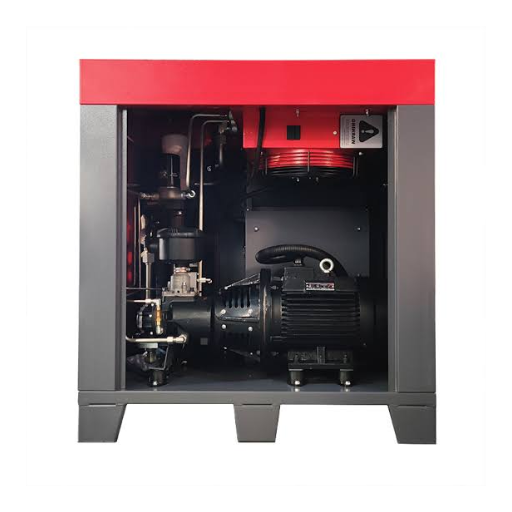
Most screw compressor cooling system problems are bought, not broken. They arrive as a mismatch between the package’s stated design conditions and the conditions on site.
What belongs on the datasheet
- Design ambient, and the maximum your site actually reaches, not the average
- Altitude, which reduces air density and cooling capacity together
- Cooling-water conditions for water-cooled units: inlet temperature, flow, pressure, and quality
- Dust, lint, or oil mist in the room, which sets the cleaning interval
- Indoor or outdoor installation, with or without an enclosure
- Heat-rejection margin above the calculated load
A supplier who asks for these is doing the job properly. One who quotes from a catalogue without them is selling you a nominal rating that may not survive your July.
Not sure what ambient to design for? and we will tell you which cooling configuration fits them before you commit to a purchase order.
Heat recovery: the cooling system as an asset
Heat leaving through the cooler is not waste in a plant that needs hot water or space heating.
publishes figures of up to 96% of input energy recovered as usable heat through direct hot-air use, and around 76% through a cooling-medium heat exchanger producing hot water. For a plant heating wash water, process water, or a workshop in winter, that changes the arithmetic of the purchase.
Most factories dump this heat into the room and then pay to cool a different room. If that sounds familiar, see our guide to .
Frequently Asked Questions
How does a screw compressor cooling system work?
It removes heat through two paths. Oil injected into the airend absorbs compression heat and carries it to the oil cooler, while compressed air carries heat to the aftercooler. A thermostatic valve blends cooled and uncooled oil to hold injection temperature in range.
What temperature should a screw compressor run at?
Oil discharge typically sits around 80 to 95 °C (176 to 203 °F) at full load, with high-temperature shutdown commonly between 100 and 110 °C (212 to 230 °F). Check your OEM manual, because the band depends on oil grade and package design.
Do I need a water-cooled or air-cooled screw compressor?
Choose water-cooled if your room regularly exceeds 40 °C (104 °F), space is tight, or you run a cooling tower. Choose air-cooled for almost everything else, provided the room is ventilated and you will clean the cores on schedule.
How often should I clean the screw compressor oil cooler?
Inspect monthly and clean on evidence. A clean, ventilated plant may need one clean a season. A foundry, textile mill, or woodworking shop may need it monthly. Measure the temperature drop before and after so the interval is based on data.
Can a screw compressor run with the oil too cold?
No, and it is a real failure mode. Oil below its operating band lets water vapour condense in the sump, producing emulsion, poor lubrication, and corrosion. Machines running light load in cold rooms are the usual victims.
Conclusion
A screw compressor cooling system is two circuits sharing one fan. The oil circuit protects the air end and carries most of the heat. The air circuit conditions the air before it leaves the package. The thermostatic valve holds both at a single target temperature.
Three things keep it out of trouble. Clean both cores, not just the visible one. Check the temperature drop across each cooler, because a clean-looking core can still be blocked. And specify the package against your real ambient and water conditions, not the catalogue’s.
If you are specifying a package for a hot, dusty, or water-constrained site, and we will match the cooling configuration to them. For the wider picture, see our .