
Oil-Injected Screw Compressor Energy Efficiency and Total Cost of Ownership
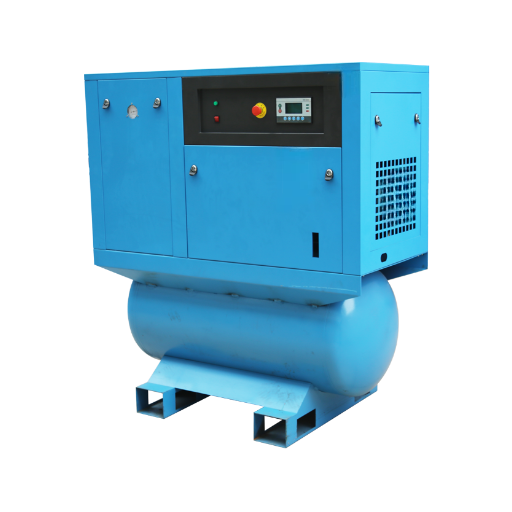
A plant manager at a metal-fabrication shop bought a 300 HP oil-injected screw compressor to “future-proof” the air system. The machine ran around the clock. When an energy audit finally metered it, the compressor was drawing 185 kW while producing almost no air—an oversized unit sitting unloaded, quietly burning electricity.
When the shop swapped in a correctly sized 75 HP unit with proper storage, the draw fell from 160 kW to 50 kW. The energy bill dropped by roughly $27,000 a year.
That story captures the central fact of oil-injected screw compressor energy efficiency: the purchase price is the smallest number on the bill. Across a 10-year service life, energy usually dwarfs what you paid for the machine. This guide shows you where the money goes, how to compare machines on the one metric that matters, and the crossover rules that decide when oil-injected is the right choice—and when it is not.
Want to know what your current air system really costs to run? Talk to our engineers about a system assessment before you buy.
Why Energy Efficiency Decides the Total Cost of Ownership
Total cost of ownership (TCO) for an air compressor is the sum of everything you spend over its life—not just the invoice you pay on day one. It includes the initial purchase and installation, the electricity to run it, planned maintenance and oil, repairs, and the cost of downtime.
Most buyers know this in theory. Very few model it in practice. When you do, the result is striking.
| Cost category | Share of 10-year lifetime cost |
|---|---|
| Electricity (energy) | ~75-80% |
| Maintenance and oil | ~12-15% |
| Purchase and installation | ~5-12% |
Different sources land on slightly different splits, but every credible one agrees on the direction. For large compressors (150 kW / 200 HP and above), electricity is roughly 75-80% of lifetime cost, maintenance 12-15%, and the purchase itself only 5-7%. The U.S. Department of Energy reaches a similar conclusion, with acquisition costs near 12% and energy plus maintenance making up the rest.
That ratio is why the Compressed Air Challenge and energy auditors focus on operating cost, not sticker price. A machine that is 5% more expensive to buy but 15% more efficient to run is the cheaper machine, usually within the first year.
You can express the whole thing as a single line:
10-year TCO = purchase and installation + electricity + planned maintenance + repairs + downtime-related cost
Everything in this article serves that equation. If you want the full technical and operational picture of these machines first, our complete guide to oil-injected rotary screw compressors covers the design and the oil circuit in depth.
How an Oil-Injected Screw Compressor Uses Energy
Oil-injected (also called oil-flooded or oil-lubricated) screw compressors dominate industrial compressed air for good reason: injected oil seals the rotor clearances, cools the air as it compresses, and lubricates the bearings. That sealing effect delivers a high volumetric efficiency and pushes the compression closer to isothermal, which is fundamentally energy-efficient.
But “efficient design” and “efficient operation” are not the same thing. Two numbers tell you whether an oil-injected screw compressor is efficient in your plant.
Specific Power: The Number That Matters
Specific power is the compressor’s energy efficiency expressed as power divided by air output. It is normally written as kW per 100 cfm (or kW per m³/min).
Specific power (kW/100 cfm) = package input power ÷ delivered flow
Lower is better. A machine that delivers the same airflow for fewer kilowatts costs less to run every hour of its life. For screw compressors in the 75-200 HP range, full-load specific power commonly falls between about 17 and 21 kW/100 acfm at 100-125 psig (roughly 6.0-7.4 kW per m³/min).
Specific power is measured under the ISO 1217 test standard and published on CAGI data sheets. Two cautions when you compare quotes:
- Every published figure carries a tolerance—typically ±5% on flow and up to ±8% on specific energy. Worst-case combinations can make a quoted number miss reality by about 10%.
- Manufacturers quote their best pressure point. Compare specific power at your required pressure, not the brochure’s.
The Load-Profile Problem
Here is where oil-injected efficiency lives or dies. A screw compressor is efficient at full load and wasteful when running unloaded or partially loaded.
An unloaded screw compressor—spinning, producing no air—still draws a serious fraction of its full-load power. Across 126 published CAGI data sheets, the total package input power at zero flow ranged from 22.5% to 40.6% of full-load power, with a median of 28.5%. In practice, oversized machines can sit unloaded for thousands of hours a year.
Field measurement makes the point bluntly. A real oil-injected rotary screw compressor tested in industrial service achieved only 27-48% efficiency against an expected 60-70%, because it ran at partial load with low demand. Oversizing alone typically wastes 10-15% of energy by forcing the machine into partial-load or unload operation.
The lesson: the same oil-injected air end can be a cost leader or a cost liability depending on how well it is sized and controlled to your real demand.
Oil-Injected vs Oil-Free Energy Efficiency: The Real Trade-Off
This is the most misunderstood question in compressed air. The honest answer is that neither technology wins everywhere—the outcome depends on pressure, purity, and duty.
Where Oil-Injected Wins
Oil injection does three efficiency jobs at once:
- It seals the gaps between the rotors, cutting back-leakage that would otherwise reduce output.
- It cools the air inside the compression chamber, moving the process toward isothermal compression, which needs less work.
- It lubricates the bearings and rotors directly, with no separate oil system to run.
Because of this sealing and cooling, oil-injected compressors generally carry a lower specific power than oil-free dry-screw units of comparable flow in standard industrial pressure bands. They also cost less upfront and have a lower life-cycle cost than small reciprocating units in continuous duty. For general manufacturing, pneumatic tools, packaging, and most factory air, oil-injected is the efficient default.
If you are weighing the general technology choice, our oil-free vs oil-lubricated compressor comparison walks through purity, maintenance, and application fit.
The “Filter Tax”: Pressure Drop You Pay For
Oil mixes with the air, so everything downstream has to remove it. An oil-injected system needs a coalescing train and often activated carbon filtration. That hardware costs more than it looks, because filters create pressure drop—and every psi of drop is energy you pay for.
On a 75 kW system, a documented comparison found total treatment pressure drop of about 4.8 psid for the oil-injected system versus 2.0 psid for oil-free. To push air through the extra filters and still reach the same header pressure, the oil-injected compressor had to run at a higher discharge pressure—94.8 psig versus 92.0 psig.
That gap compounds in two ways. First, higher discharge pressure means higher energy use: lowering set pressure by 1 bar saves roughly 7% of energy. Second, filters clog over time, so the pressure penalty grows between service intervals. This “filter tax” is a real, recurring line item in oil-injected lifecycle cost—one most TCO articles simply omit. It belongs in your model.
The Low-Pressure Exception
There is one clear region where oil-injected loses the efficiency argument: low pressure, below roughly 3-4 bar.
Oil-injected machines need a minimum pressure valve, usually set above 3 bar, to keep oil and air separation working. That valve forces over-compression at low delivery pressures, wasting energy. Oil-free dry-screw compressors do not need the valve, so their energy stays proportional to pressure.
A concrete low-pressure example makes it clear. At 17 m³/min, a low-pressure oil-free dry-screw unit needed about 3.2 kW/(m³/min), while the equivalent oil-injected machine measured closer to 4.5 kW/(m³/min). In low-pressure processes, oil-free can win on both specific power and total cost—despite the higher purchase price.
Looking for application guidance? Our article on oil-injected screw compressor applications covers more sectors in depth.
A 10-Year TCO Model You Can Reproduce
You do not need software to build a defensible TCO. You need three inputs and an honest accounting of each cost line. Here is the model, followed by a worked example.
Step 1—Energy Cost
Energy is the dominant line, so get it right.
Annual energy cost = input kW × operating hours × load factor × electricity tariff
Use the compressor’s package input power at your operating pressure, not the motor nameplate. Add an escalation rate of 2-4% per year for a multi-year model, because electricity rarely gets cheaper. If demand varies, base the load factor on a real measurement—not a guess.
Step 2—Maintenance, Oil, and Filters
Oil-injected maintenance centers on the oil circuit: oil and oil-filter changes, air filters, the air/oil separator element, cooler cleaning, and oil disposal. Industry guidance puts maintenance at up to roughly 15% of total cost of ownership. Budget by operating hours. Our oil-injected screw compressor maintenance schedule lists the 2,000-, 4,000-, and 8,000-hour service tasks and typical costs so you can build this line accurately.
Step 3—Repairs and Downtime
Downtime is the hidden cost most spreadsheets ignore. If a failed air end stops a production line, the lost output can exceed the repair itself. Estimate downtime cost as lost production per hour times hours stopped, and plan for at least one major service event in a 10-year horizon. A major overhaul can approach a significant fraction of the original purchase price.
Worked Example: 75 kW Oil-Injected, Two Shifts
Take a 75 kW oil-injected screw compressor at ~20 kW/100 cfm, running 6,000 hours a year at an average 75% load, on a tariff of $0.12/kWh.
| Cost line | Basis | 10-year total (approx.) |
|---|---|---|
| Purchase and installation | One-time | $28,000 |
| Electricity | 75 kW × 6,000 h × 0.75 × $0.12 | $405,000 |
| Maintenance, oil, filters | ~$4,500/yr | $45,000 |
| Repairs and overhaul (one event) | Mid-life | $18,000 |
| Downtime | 40 hours over life | $20,000 |
| Total 10-year TCO | ~$516,000 |
Notice the shape of the number. The purchase price is about 5% of lifetime cost. Electricity is roughly 78%. A compressor that is 10% more efficient on specific power saves about $40,000 in energy over the decade—far more than any likely discount on the purchase price. This is why you should calculate energy before you negotiate price.
To make the most appropriate choice, please read our article on how to choose an oil-injected screw compressor.
Want this model run on your own numbers? Request a system TCO assessment, and we will size the machine to your load profile.
Crossover Rules: When Oil-Free or Two-Stage Pays Off
Oil-injected is the default for standard industrial air. Two situations justify paying more for a different design.
Oil-Injected vs Oil-Free by Operating Hours and Purity
| Your situation | Recommended path |
|---|---|
| Standard plant air (ISO 8573-1 Class 3-4), moderate hours | Oil-injected: best TCO, lowest capex |
| Low pressure (below 3-4 bar) | Oil-free dry screw: avoids over-compression penalty |
| High-purity air (food, pharma, electronics), high hours | Oil-free: purity is a requirement, not a preference |
| Very low hours, intermittent use | Small oil-injected or piston: oil-free never pays back |
The crossover is driven by purity needs and operating hours. If your process genuinely requires oil-free air, the decision is made for you—the filtration chain needed to make oil-injected air “technically oil-free” usually costs more than the oil-free machine. If your process does not, oil-injected wins on TCO in the common pressure bands.
Single-Stage vs Two-Stage by Power Rating
Two-stage compression splits the work, intercools between stages, and lifts isentropic efficiency from a typical 65-75% (single-stage) to 80-88% (two-stage). That translates to roughly 15-20% more flow per horsepower, or equivalent energy savings.
The payback depends heavily on size and hours. A 2025 lifecycle cost study of oil-flooded multi-stage screw compressors found two-stage units reduced operating costs by roughly 20-75% over 10 years for 22-315 kW at 6-12 bar—with the advantage scaling steeply with power:
| Compressor size | 10-year lifecycle cost reduction (two-stage vs single-stage) |
|---|---|
| 22 kW | ~0.2% |
| 90 kW | up to ~11% |
| 315 kW | up to ~27% |
For small machines, two-stage barely moves the needle. For large, high-hour units, the savings can pay back the extra capex in roughly two to three years—sometimes under 24 months on energy alone. Sizing down also helps: a two-stage unit often delivers the same flow as the next size smaller, narrowing the price gap. For most industrial decisions, our guide on how to choose the right air compressor for your factory puts this into a step-by-step selection process.
How to Lower Your Oil-Injected Screw Compressor Energy Costs
Before buying efficiency, capture the cheap energy you are already losing. The most common waste is unloaded run time and leaks.
- Fix leaks first. Leaks commonly waste 20-35% of compressed air. A 3 mm hole at 7 bar can bleed a full m³/min.
- Lower the pressure band. Every 1 bar you remove from set pressure saves about 7% energy. Confirm every tool still gets adequate pressure before you cut.
- Right-size and add storage. Correct sizing plus a properly sized receiver keeps the compressor in its efficient loaded range and shrinks unloaded time.
- Control the schedule. Sequencing multiple units—a VSD as lead, fixed-speed as trim—beats a single oversized machine. For intermittent shops, simply shutting the air off at night (or wiring the compressor to the shop lights) removes hours of idle draw each month.
- Optimize oil injection. Tuning oil injection temperature and volume can cut specific power by around 3% on the right machine.
- Recover waste heat. More than 70% of a compressor’s input energy is available as usable heat. Routing it to process or space heating often pays back in under a year.
- Audit the system. An ISO 11011 compressed air energy assessment measures real load, pressure, and leaks instead of estimating.
For a deeper set of tactics, see our dedicated article on how to reduce air compressor energy costs.
Mini-story: A winery ran two 125 HP rotary screws hard in season, then part-loaded off-season. Adding a right-sized 75 HP VSD as lead, plus controls, storage, and leak repair, cut consumption by 218,000 kWh a year—about $27,000—with a payback near 1.2 years. Nothing about the original compressors was “broken.” They were simply the wrong machines for the load.
Frequently Asked Questions
How much does an oil-injected screw compressor cost to run per year?
It depends on size, hours, load, and tariff. A 75 kW unit running 6,000 hours at 75% load on $0.12/kWh costs about $40,500 a year in electricity alone. A 100 HP machine running 6,500 hours can exceed $50,000 annually. Energy, not purchase price, drives the number.
Is oil-injected or oil-free more energy efficient?
In the standard industrial pressure band, oil-injected usually has lower specific power because injected oil seals the rotors and cools the air. Below about 3-4 bar, oil-free dry-screw can be more efficient because it avoids the minimum-pressure-valve over-compression penalty.
How do you calculate the total cost of ownership of an air compressor?
Add purchase and installation, electricity (input kW × hours × load × tariff), planned maintenance and oil, repairs, and downtime cost over the expected life—typically 10 years. Electricity is normally the largest line, at roughly 75-80% of the total.
What percentage of a compressor’s lifetime cost is energy?
For large compressors, electricity represents about 75-80% of lifetime cost, maintenance 12-15%, and the purchase only 5-7%. That ratio is why efficiency affects total cost far more than the purchase price does.
Can I reduce screw compressor energy consumption without buying new equipment?
Often, yes. Leak repair, pressure-band reduction, added storage, better control and scheduling, and heat recovery typically cut energy use 20-35% at a fraction of the cost of a new compressor. Measure first with a compressed air audit.
Key Takeaways
The purchase price is the smallest cost of running an oil-injected screw compressor. Model the whole 10-year picture, and energy will dominate it.
- Compare on specific power (kW/100 cfm) at your real pressure, not the brochure’s best point.
- Energy is 75-80% of lifetime cost. Purchase is often under 10%.
- Load profile decides efficiency. Unloaded running draws ~28.5% of full-load power on average—right-size and control it away.
- Oil-injected wins in standard factory air; oil-free wins at low pressure and where purity is mandatory.
- Two-stage pays off at large sizes and high hours, where it can cut lifecycle cost by up to ~27% over 10 years.
The most reliable number you will ever get is one you calculate from your own kW, hours, and tariff. Start there. Then choose the machine—or the efficiency upgrade—that lowers the biggest line in the equation.
Ready to see your real total cost of ownership? Contact Shandong Loyal Machinery for a system assessment, sizing, and an efficiency plan built around your load profile. You will find out whether a new compressor, a control change, or a leak-repair program gives you the best return.